De-Ice De-Ice Baby: Cold Weather Opsicles
In the Northern Hemisphere the winter season is well and truly upon us, which means various extra things to think about – like different procedures, low visibility challenges, cold temperature corrections, where you left the other glove, and of course de-icing!

So, to help you out if you aren’t so familiar with all things Winter Ops we have put together a little series of Opsicles – Refreshing bits of ops info, just for members.

Winter Opsicle #1: De-Ice De-Ice Baby

Most operators we’ve met apply a “Keep it clean, keep it safe!” policy meaning don’t risk it; if there is anything on the airplane get it off before you take-off.

There are some caveats to this – less than 3mm of frost on the underside of the wing around the fuel tanks is generally acceptable. If you don’t have a tiny frost ruler to hand then a general rule of thumb is clear paint markings showing through means it’s ok. A light dusting of hoarfrost on the fuselage is also fine (if your manual says so).

The areas where anything is unacceptable are your critical surfaces – the upper surface of the wings, horizontal stabilisers, leading edge devices… Basically any lift and/or control surface on the aircraft. If you’ve ever done a Winter Ops Refresher you probably know this statistic off-by-heart but “a very small amount of roughness, in thickness as low as 0.40mm (1/64in) can disrupt the airflow and lead to severe lift loss…”
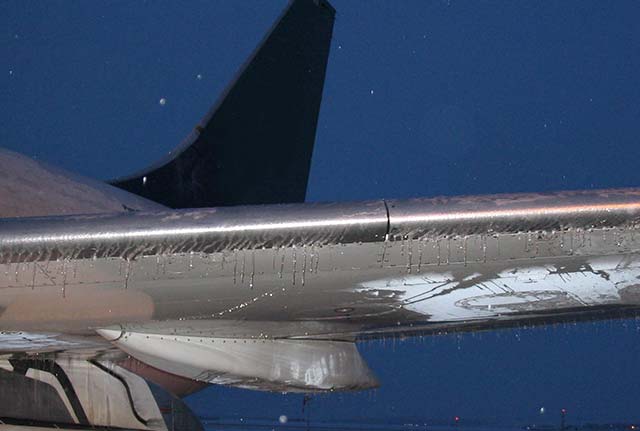
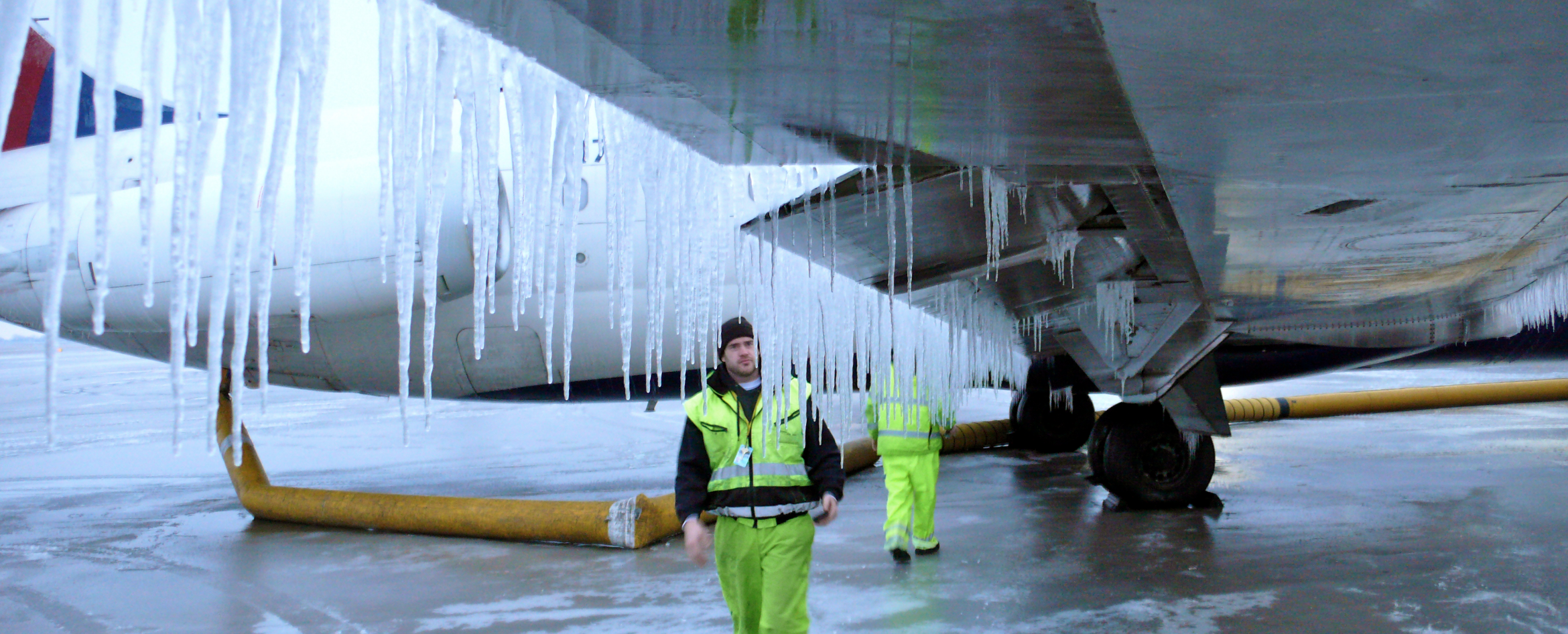
Icicles on leading edge: not good. Frost around fuel take: might be ok.

So keeping it clean seems like a good rule. Alas, a rule not all follow…

The trouble is, it can get confusing (no, that crew in the video weren’t confused, just negligent). But when you are out there, under pressure, managing a bigger and more complex workload, it can quickly get complicated especially when you throw in some variable weather conditions to the mix, and some different mixtures into your HOT calculations.

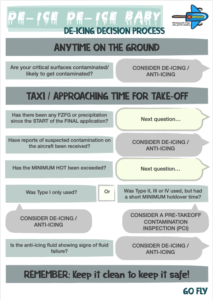
So our Winter Opsicle #1 is a handy guide to help with just that.

What’s in them?

De-Ice De-Ice Baby is looking at de-icing/anti-icing. It comes in three parts, and you can download all, none, just one depending on what you find helpful.

  • A De-Icing Decision Process checklist – to help you determine whether or not to consider de-icing/anti-icing.
  • Caution: Hot Stuff – a sort of FAQ on Holdover Times.
  • Too HOT to Handle – a generic guide on what HOT to expect.

None of these are designed to be used in place of official (and possibly much more accurate) documents and manuals, but we do hope they will provide some refresher info on things to think about during the winter season.

Over the winter season, we’ll try and post more so you can build up your own Winter and Cold Weather Ops Pack.
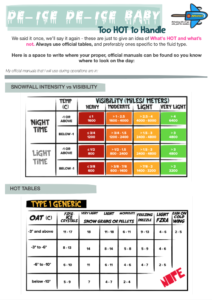
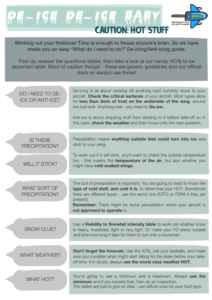
If you’re an OPSGROUP member you can click on each thumbnail to head to the Opsicle PDF download page.

Further reading

There is a huge amount of info out there (from more official sources) including:


Winter Is Coming

Well, we have a question for you.” The New York Center controller seemed amused.

“Go ahead,” I replied, my voice made uneven by the moderate turbulence we were bouncing around in. As I answered, I cast another look over my shoulder at the ice on the wings. The Dash-8 boots were doing their job, at least for now. The aircraft took on a bit of shudder as the props flung ice unevenly off of the blades.

The Center controller delivered the news with a mixture of ironic humor and pity. “Williamsport wants to know if you want them to plow the runway. They say they are closed currently. They have four inches of snow on the runway, but there is a hard crust of ice on top.”

I quickly retrieved the flight release and rifled through the six foot paper scroll to find the NOTAMs. Nothing about the airport being closed, thank Zeus. At least I didn’t miss something big like that. Dispatch should have known—but here we were, halfway between Philadelphia and Williamsport, in and out of freezing rain. I eyed the fuel gauges critically. Plenty left to get there and fly back, if need be. At least there was that.

“Well yeah,” I told the controller. “Plowing the runway would be helpful.”

That night ended with a circling approach to minimums through a narrow valley in light freezing rain mixed with snow. The First Officer flew the approach perfectly, and thanks to the superior stopping power of the Dash 8 we had plenty of slick runway left to play with. Just another Northeast U.S. winter night—par for the course from November until March.

Winter is coming. In some parts of the world, winter is already here and people are insistent on staying inside on top of their twin mattress. However, for pilots, they still have to brave the weather. Flying always brings challenges, but winter supplies extra problems that separates mere pilots from imaginative problem solvers. Problem solving must always be wrapped in a healthy rind of risk analysis. When things go bad in winter weather, they often go bad in a big way.

The accident record is filled with examples of the problems that ice and snow can cause. The American Eagle ATR in Indiana in 1994 was brought down by the crew’s lack of appreciation for the extreme effects of super-cooled large droplets (SLD). In 2005, Southwest Airlines slid off of the end of a slick runway at Chicago Midway. There have been icing induced loss of control events the world over and a few aircraft seem to slip off of the taxiway every winter. Sometimes, simply the additional worry and workload posed by extreme winter weather can add risk. A crew can find themselves rapidly being overcome by events, leaving little time to make decisions in a highly dynamic environment.

de-icing

Technology has come a long way in helping to mitigate the risks that winter can pose. There are now predictive charts for SLD that pilots can examine prior to flight. Deice and Anti-ice fluid technology has improved in past years; there are now three different types of fluid available for use, each tailored for a specific application. The holdover times (the amount of time that fluids remain effective) are revised on a yearly basis as formulations change and the science improves. Some airports are even experimenting with large heaters and infrared deicing technology. Predictive weather tools are much better as well, leading to proactive cancellations that allow aircraft to be positioned for relatively rapid system recovery once a major winter storm has passed.

But there are still problems … Even the best anti-icing fluids can rapidly lose effectiveness in the right conditions; temperatures near freezing with high humidity makes for large, wet flakes that can quickly saturate even the most robust Type 4 fluids and render them useless. Weather systems can capriciously change course with little warning, meaning the difference between a snow apocalypse and a mild dusting of white. Winter is expensive too, with deicing and anti-icing fluids costing more per gallon than jet fuel. Duty days get longer, crews get fatigued, schedules lag and dispatchers become swamped with work. There is nothing more expensive than operating a late airline, and late is often the rule rather than the exception when it comes to winter operations.

So, what is the key to safe winter operations? Planning is essential, but so is flexibility. Many airports have instituted gate hold programs for deicing operations, which helps prevent needless burning of jet fuel on the taxiway. Proactive assessment is key. Knowing the conditions at the destination prior to departure can mean the difference between a successful outcome and tens of thousands to dollars of expense for a divert to an alternate. Caution is the most important concept. Aircraft performance numbers are important, but takeoff and landing distance data should be taken with a grain of salt: it is not uncommon for conditions to vary significantly along the runway length, especially at smaller airports with limited snow removal capabilities.

Planning and caution can mean the difference between a successful, safe operation and having to have a crew have to get creative in the middle of the night. Winter is coming. Time to get ready.