Clarifying Cuba Overflight Permits and NAV Fees
Key Points
  • There are several overwater airways in the north-west corner of Cuban airspace where an overflight permit is not required.
  • If using these airways, you still need to pay NAV fees, otherwise you risk being denied entry to the airspace at some point.

For the longest time, we’ve been confused about the rules around Cuba overflight permits and NAV fees. Once upon a long ago, the requirements for these were contained in the MUFH/Havana FIR Notams, but alas, no more. We couldn’t find all the info we really wanted on them in the Cuban AIP either.

But thanks to CST Flight Services, we now have some answers in the report below. CST Flight Services provides a wide range of international trip support services in Mexico, Central and South America, The Bahamas and the Caribbean. You can contact them for more info at: customersvc@cstflightservices.com

Overflight Permits

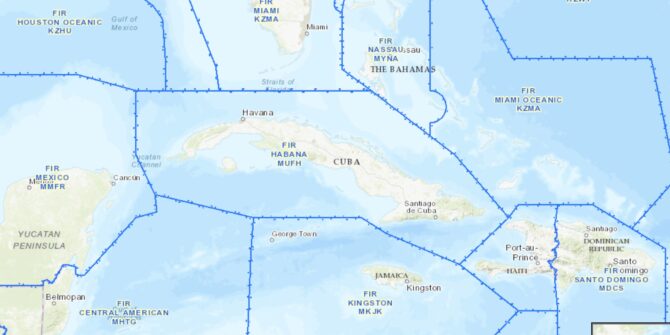
For airways that go through Cuba’s MUFH/Havana FIR and penetrate Cuba’s inner Air Defense Identification Zone (ADIZ) or overfly the island, a Cuba overflight permit is required and a permit fee, plus NAV fees, will need to be paid to Cuba.

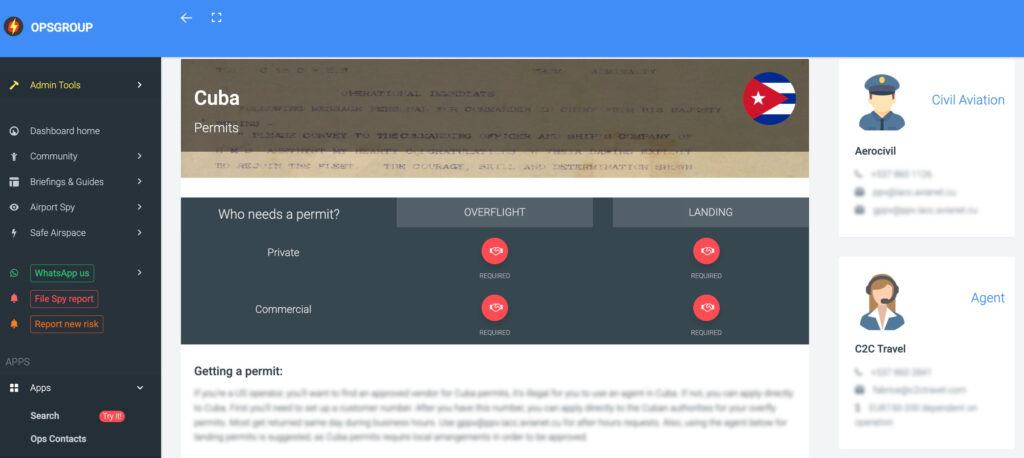
If you’re not a US operator, you can apply directly to Cuba for your overflight permit if you like. First you’ll need to set up a customer number. After you have this number, you can apply directly to the Cuban authorities for your permits. Most get returned pretty quickly – same day or next if you apply during business hours. OPSGROUP members can use the online Permit Helper tool in the members Dashboard to help with this, which includes email contacts.
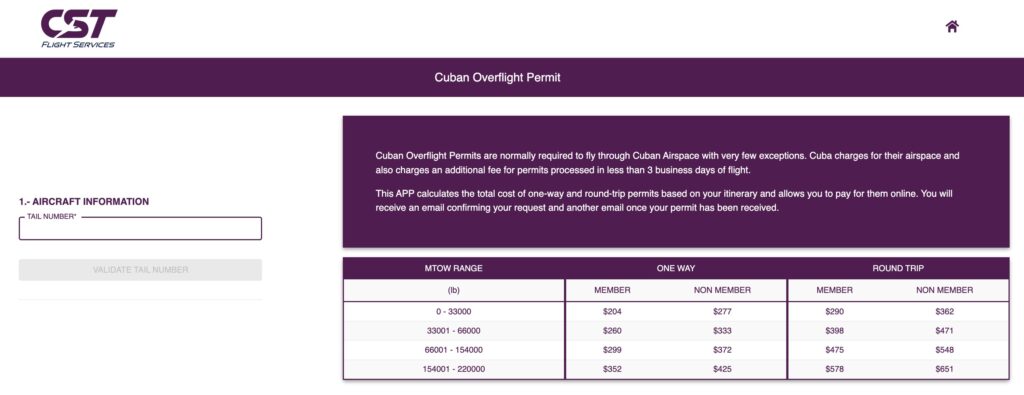
But if you’re a US operator, you’ll want to find an approved vendor for Cuba permits. CST have a service where you can apply for Cuba overflight permits online. The system determines whether you will need one, and calculates what the fee will be based on Cuba’s fee structure. You pay for it online, and CST get your permit for you.
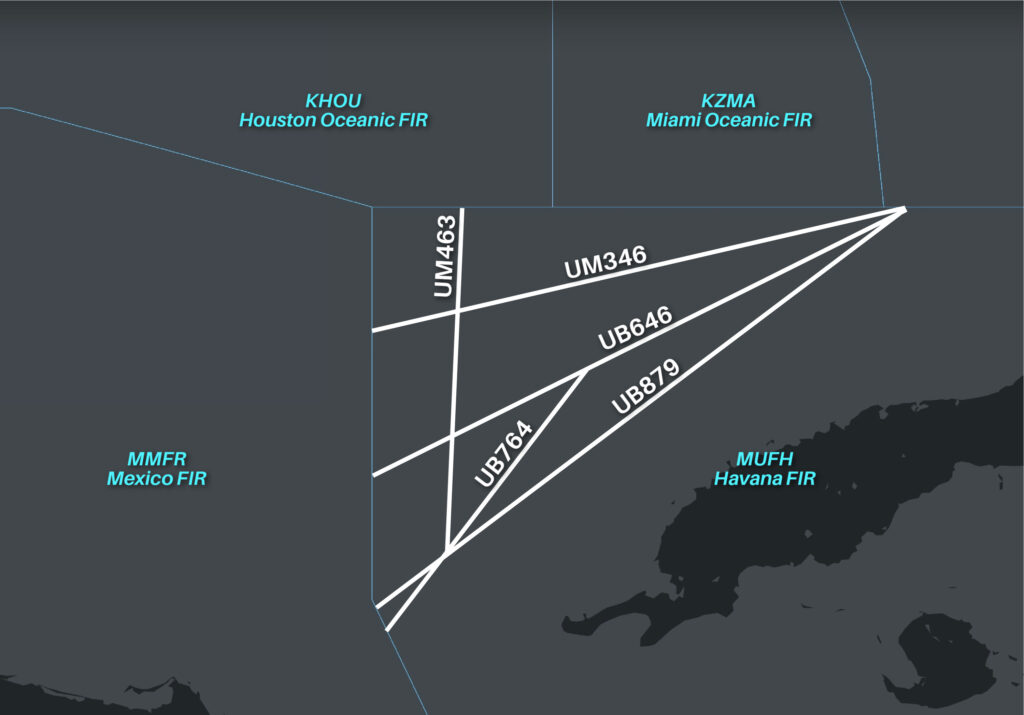
However, there are several overwater airways in the north-west corner of Cuban airspace where an overflight permit is not required. These are:

  • B646/UB646
  • B764/UB764
  • B879/UB879
  • M346/UM346
  • UM463

But if you’re flying these airways and not paying any NAV fees, watch out! …

NAV Fees

Cuba overflight permits are issued by Cuba’s Civil Aviation Department IACC, while airspace fees are assessed by Cuba’s ECNA – a different agency of the Cuban government.

When an aircraft flies on an oceanic airway, an airspace fee is still assessed but as no permit was issued ECNA doesn’t know who to bill and the unpaid fees accumulate against that tail number.

Over time, and with enough flights, that tail number will be blocked and that information given to the IACC and to Cuba’s ATC which can result in that aircraft being denied entry into Cuban airspace.

Therefore, if you have been using these oceanic airways, and have not been paying Cuba NAV fees for those flights, you may be denied entry on your next attempt to fly through the airspace.

NAV fees need to be paid to ECNA in Cuba in Euros – which becomes a bit of a challenge for many operators! Again, CST can help with this. Contact them at customersvc@cstflightservices.com for more info.

Flights TO Cuba

Now we’re getting into murky legal and political waters. If you want to actually fly TO Cuba, rather than overfly it, the short story is this:

US Part 91 (Private) flights: these have been completely banned since June 2019. Applies to all N-reg aircraft flying directly or indirectly to Cuba (i.e. from the US or another country). This was a policy introduced by the US Bureau of Industry and Security (BIS), which meant that U.S. operators could no longer operate an N-reg aircraft privately to Cuba for any reason – it doesn’t matter if your passengers meet OFAC’s “permitted categories of travel” or not, it’s a no-go.

US Part 135 (Charter) and Part 121 (Airline) flights: these are allowed to operate to Cuba. However, it’s a tricky business to do these flights and stay within the rules. Policies introduced by the Office of Foreign Asset Control (OFAC) in 2017 mean that there are only a handful of categories of permitted travel between the US and Cuba.

Non-US operators: If you’re heading to Cuba from anywhere other than US territory, it should be fairly straightforward. Get a landing permit, arrange your ground handling, file your flight plan, and off you go. Just double-check your insurance policy – if it’s provided or underwritten by a US company, you might not be covered for ops to Cuba. Check out our article for more info.
U.S. cracks down on scheduled flights to Cuba

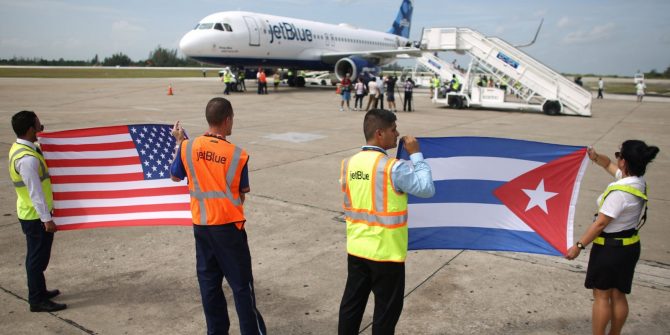
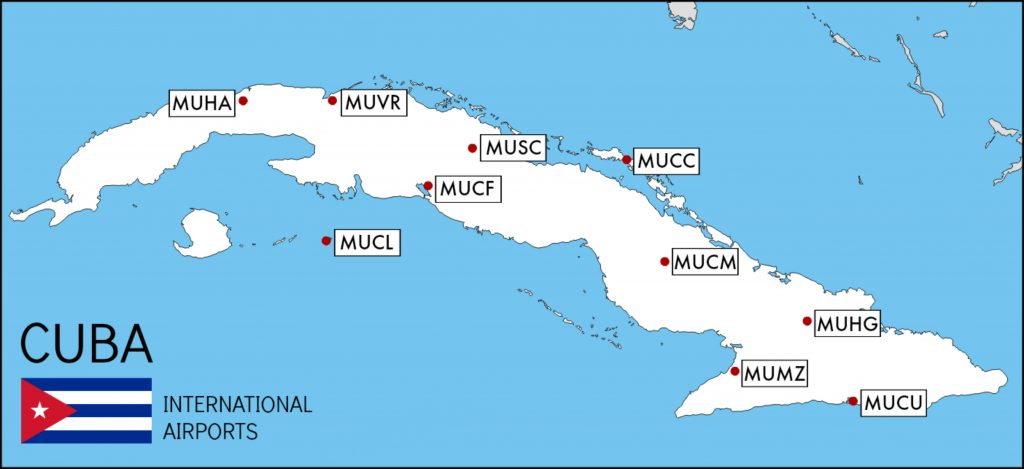
The U.S. has announced it will suspend scheduled flights to all airports in Cuba except for MUHA/Havana, in another attempt to limit cash flows going to the Cuban government. The affected airlines, including American, Delta and JetBlue, now have 45 days to wrap up their operations to those other destinations in Cuba, before the ban goes into effect on Dec 10.

This does not apply to Part 135 non-scheduled charter flights – these are still allowed to operate from the U.S. to any international airport in Cuba. However, it’s still a tricky business to operate these flights and stay within the rules. Policies introduced by the Office of Foreign Asset Control (OFAC) in 2017 mean that there are only a handful of categories of permitted travel between the US and Cuba.

As for Part 91 private flights from the U.S. to Cuba, these have been completely banned since June 2019. This was a policy introduced by the US Bureau of Industry and Security (BIS), which meant that U.S. operators could no longer operate an N-reg aircraft privately to Cuba for any reason – it doesn’t matter if your passengers meet OFAC’s “permitted categories of travel” or not, it’s a no-go.

For non-U.S. operators traveling to Cuba from anywhere other than U.S. territory, it should be a doddle. Get a landing permit, arrange your ground handling, file your flight plan, and off you go. Check out our article for more info.
If you’re headed to Cuba — even to MUHA/Havana — you should double-check with your insurance provider about your coverage. We received the following report, which suggests that with the new U.S. sanctions, many U.S. operators may no longer be covered:

“Being the insurance director of an Airline, I’m having the dilemma whether the insurance would cover any damages/losses/injuries may have occurred during Cuba flights. Because, when I raised the question, insurers simply replied with an aviation clause called AVN111/AVN111(R) which says insurers would verify each individual case with relevant sanction authority (in this case, OFAC) and do their best to grant permission to reimburse the losses. It can easily take years to get resolved which essentially means there is no actual protection against losses”…

In principle, U.S. operators with an insurance policy from a non-U.S. based insurer can get insurance cover for Cuban ops. However, in practice it may not be possible to even purchase this, as lots of these policies are underwritten by U.S. based insurers – especially for higher policy limits.


Midweek Briefing: Oceanic and Remote Procedures Update, Rome Airport Closed Friday

Oceanic and remote procedures updated: 12OCT The FAA this week issued a significantly updated version of their “Oceanic and Remote Airspace” procedures document. There’s a lot of good stuff here, even if you’re not operating an N-reg. Take a look at the PDF.

Rome Airport to close Friday 12OCT A reminder that LIRA/Rome Ciampino will close fully from Friday, for two weeks, as a result of urgently required runway maintenance. You can use LIRF/Fiumicino instead, but with significant restrictions.


LLBG/Tel Aviv starts winter runway maintenance work on 01Nov until 17Nov – Runway 21 will become primary landing runway, associated restrictions, not available as alternate during this time – check AIC 3/16.

LOWI/Innsbruck starting December 14th, the airport will introduce parking restrictions for private flights every week from 1800Z Weds until 1800Z Sunday.

TXKF/Bermuda Tropical Storm Nicole is approaching, expect some disruption and check before using as an alternate over the next few days.

HAZZ/Ethiopia The Ethiopian government has declared a six month State of Emergency from 9 October 2016. While details of emergency arrangements are not formalised, measures to restrict communication, movement and political expression are expected. Carry identification, avoid all large gatherings and protests, monitor the media for details on the application of the State of Emergency and follow all instructions issued by local authorities.

SPIM/Lima radar will be off the air on Friday from 19-21Z for repairs, procedural control, expect enroute delays.

EGGX/Shanwick. An exercise to test to the Volcano eruption response is underway, you may see multiple references to an eruption in Iceland – it hasn’t happened, it’s just a test. Stand down. Katla is also back to code Green.

UZZZ/Russia Karymsky volcano in the Kamchatka peninsula is active with colour code Orange, check before operating.

OKAX/Kabul FIR continues to have comms issues in the north east portion of Afghanistan airspace, VHF comms are not working on 118.3 or 128.5. There are some “Nordo” procedures, refer to AIP ENR 1.6-1.

MUFH/Havana has a couple of new entry points to the FIR – FUNDI and IKBIX – but they’re not for use yet, so don’t.

OPRN/Islamabad If operating to OPRN, be aware that on Saturdays and Mondays ATC will be practising non-radar procedural approach from 0500-0900Z until the end of the year.

SPJC/Lima has overnight parking restrictions from 14-21NOV, check with Airport company or handler prior to operating.

FZZZ/Democratic Republic of the Congo: the security picture is uncertain following recent political protests and there have been calls for further protests in Kinshasa, including on 19 October; you should follow travel advice and monitor local media for updates

SPZO/Cusco will not allow overnight parking from 10-20OCT.

FOZZ/Gabon Following the results of recent elections in Gabon, further strikes or demonstrations could occur in the capital Libreville and in Port Gentil. Avoid demonstrations, large crowds and rallies as they may turn violent.

UAZZ/Kyrgyz Republic Multiple embassies located in Bishkek have issued warnings to their citizens of an increased threat of a terrorist attack in the Kyrgyz Republic, possibly involving kidnapping and hostage taking, against Kyrgyz authorities and foreign diplomats during October 2016.

TQPF/Anguilla has introduced a ban on visitors from Guinea, Liberia and Sierra Leone, with a view to mitigating Ebola risk. Anyone who has been to those three countries in the last 21 days will not be allowed to enter.

VTSP/Phuket is suffering from ramp congestion, and will not allow non-scheduled flights to stay overnight until the end of the year.

WSSS/Singapore Changi has a couple of closures on 18 and 19 OCT due to a military exercise, check local Notams.

ZUUU/Chengdu has a new speed restriction inbound – fly 183 knots from IAF to IF, then 160 knots to 4nm. Notam U2748/16.

View full International Bulletin 12OCT2016


Monday Briefing: Cuba Travel opens up, Chile Airport strike ends

Cuba Travel opening up 21DEC Negotiations between the USA and Cuba on scheduled air services between the two countries are progressing at pace; meaning that we expect to see sanctions on private US Tourism Travel lifted as early as next March. See more below.

Chile Airport Strike ends 21DEC A four day strike was ended yesterday 20DEC in Chile by the Trade Union, as 3000 Airport workers across the country responded to the governments rejection of a pension plan. Several hundred flights were cancelled. Non-scheduled operations were largely unaffected, but the risk of further action remains.


HUEC/Entebbe ACC, Uganda. ATC in Uganda is reporting a significant increase in the number of flights entering their airspace without prior coordination from Sudan and Congo (Khartoum and Kinshasa FIRs). Regional ATC in Africa is known to be challenging, but this warning deserves attention. Crews should make all efforts to contact each FIR 10 mins in advance – HF 11300, or relay on 126.9 if unable.

KZMA/Miami FIR SpaceX announced Sunday it has pushed back its planned launch of a Falcon 9 rocket with 11 communications satellites to 2033 ET Monday. KZMA has issued NOTAM A1357/15 for launch. It will also affect the KZJX Jacksonville FIR and TJZS San Juan FIR. The FAA will also issue tactical advisories regarding the launch and will most likely restrict operation on AR6 and AR15.

EGGX/Shanwick have issued a reminder to flights operating on the “Tango Routes” (T9, T16, T213) that HF in all cases is required to operate here, and crews should be trained in the procedures. Request OCA Clearance 50 mins in advance. Primary/Secondary HF freqs: Southbound 6547/8879, Northbound 8879/6547.

LIPH/Treviso Fuel spillage on the runway has closed the airport until 1700Z today 21DEC.

Cuba and USA Reports in the international media last week indicated that an agreement between Cuba and the US is likely to be signed early next year, allowing up to 110 scheduled flights: 20 to Havana, 10 to each of the other 9 international airports in Cuba. At present, US visitors must still fall in to one of the 12 official categories for authorised travel; however, once scheduled services are in place, we anticipate this to be the leverage to remove the final hurdle for US citizens – visiting Cuba for tourism. The first flights will likely operate in early March.

It should be noted that there are no restrictions on the Cuban side. US Aircraft can land in Havana with a routine Landing Permit issued by IACC, and US Aircraft can overfly with a routine Overflight permit. We anticipate that the requirement for a permit will stay in place as this is routine in most Latin American countries, primarily to check Navigation Fee debts and Operator Profile.

Georgia and Ukraine On 18DEC2015, the EC announced that both Georgia and Ukraine meet requirements for being granted visa-free travel to the European Union’s Schengen zone. However, the European Parliament and the EU member states must vote in favor of granting Georgia and Ukraine visa-free travel before they are able to do so. Reports indicated that the decision could be put to a vote as early as 2016.

Haiti On 19DEC, election-related demonstrations across Haiti turned violent amid accusations of electoral fraud. Violent clashes led to the burning of several government buildings. Haitian police officers stated that they were trying to restore security to the country.

Space Weather/Polar Ops moderate an ongoing G1 geomagnetic storm expected for Mon, Dec 21. Please check the NOAA Space weather aviation dashboard for the latest actuals and predictions HERE.

PAZA/Anchorage ARTCC has a number of new procedures and systems in place effective 17DEC, including 30/30 RNP4 separation, an update to the Track Advisory program for westbound Russian Tracks, and standard routings. Check the current PAZA NOTAMs for complete information.

ZBAA/Beijing authorities have issued a red alert for high levels of air pollution and reduced visibility. The alert will be effective until 22DEC. According to China’s National Meteorological Center, air pollution levels are forecast to be slightly higher than those recorded from 06-09DEC.

EGLL/EGKK London Heathrow/Gatwick Airport train links will be disrupted over Christmas. The Gatwick Express trains will stop running for 10 days due to engineering works, with the last service of 2015 leaving Victoria station at 9.15pm on Christmas Eve and the first services of 2016 scheduled for 4 January. At Heathrow, the usual one-day closure on Christmas Day will be extended by three days. Neither Heathrow Express nor Heathrow Connect trains will run from London Paddington station during the period.

UBxx/Azerbaijan will become part of the IFPS (Integrated Flight Plan System) zone as of AIRAC 1601 on 07JAN2016. Azerbaijan will delegate responsibility for the provision of flight planning services for IFR/GAT flights within the Baku FIR to the Network Manager’s Integrated Initial Flight Plan Processing System. For more info see Azerbaijan AIC 01/2016 Series A, AIP ENR 1.10, AIP ENR 1.11 and NOTAM A0126/15.

UHPP/Petropavlovsk FIR Volcano Karmsky has recently been active with ash reported up to 15,000 ft and possibly affecting ops on R220. Please check for the latest Tokyo VAAC advisories.

The ICAO Council adopted a new tracking standard for certain international flights that requires crews to report their aircraft’s positions at least every 15 minutes. It will become effective in March 2016 and applicable 08NOV2018. The new requirement also will be formalized as Amendment 39 to Annex 6—Operation of Aircraft, Part I. Only aircraft with a maximum takeoff weight of more than 59,000 pounds and a passenger seating capacity of more than 19 are affected by the rule. Also, the requirement applies to over oceanic and other remote areas, and where air traffic service is obtaining position information greater than 15-minute intervals.

Christmas and New Years closures. Check opening times carefully during the next 2 weeks, as many major airports and FBO’s have closures, especially on 24, 25, 26DEC and 31DEC/01JAN.


Permit News: Cuba Permit requirements

– Minimum 3 working days advance notice of flight intending to cross Cuba

Data needed:

– Operator name and address
– Departure and Destination airports, and times
– Aircraft type, and registration
– Please note no requirement for airspace entry points/times, pilots licenses/medicals, C of A/R, or other documentation.

Your permit number will be sent to you by via email by return and should be inserted in Field 18 (RMK/) of your ATC flight plan, for example:

RMK/PERMIT CUBA 6821

The permit can be ordered online here.