South Atlantic Bulletin: CPDLC Warning

There’s been a lot of noise lately from the NAT, especially as we all come to grips with the removal of oceanic clearances.

But it’s important not to forget about the SAT – or South Atlantic. And it seems a CPDLC issue has been regularly occurring in the Abidjan Area Control Center – a large chunk of airspace found south of Africa’s Ivory Coast.

The issue arises from the fact that while the Abidjan ACC is geographically constrained by the much larger Dakar FIR, it is responsible for its own control.

It seems that pilots have been incorrectly logging onto GOOO/Dakar rather than DIII/Abidjan when transiting this airspace. ATC are concerned, and so a new SAT Ops Bulletin has been published. Here’s a closer look at what it contains, and how to mitigate this error on your next crossing.

The Airspace Picture

Part of the problem may be that pilots crossing the SAT are far less familiar with the airspace picture than they are of its big brother, the NAT. So, he’s a quick crash course.

Over the South Atlantic lies the ‘Atlantic Ocean Random Routing Area’, or AORRA.

This is essentially a volume of airspace between FL290 – FL410 within the Atlantico, Accra, Comodoro Rivadavia, Dakar, Dakar Oceanic, Ezeiza, Johannesburg Oceanic, Luanda and Montevideo FIRs.

This article is concerned with the Eastern Side of the AORRA – specifically the DIII/Abidjan ACC (Ivory Coast) which is contained within the much larger GOOO/Dakar FIR and where the confusion is occurring. Aircraft on routes that transit between South America and Sub-Saharan Africa will likely overfly this airspace.
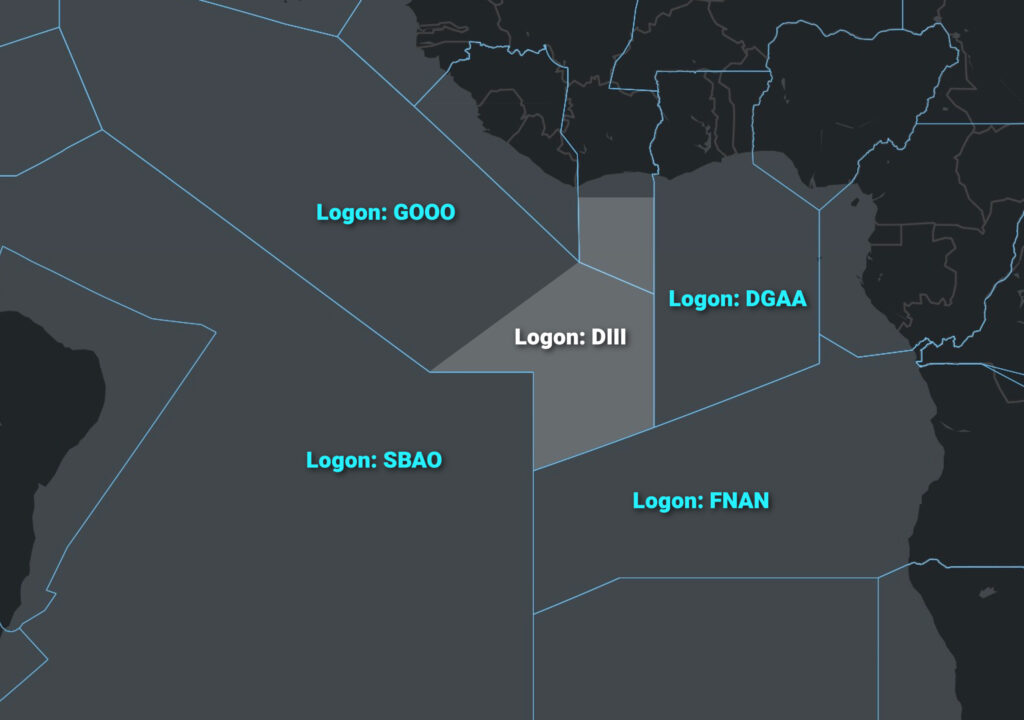
The folk at the South Atlantic Steering Group (SAT SG for short) have reported more and more instances of transiting aircraft incorrectly logging onto GOOO when they should be logging onto DIII while in Abidjan’s airspace.

This then creates communication issues for ATC.

Panic Slowly

While this is cause for concern, SAT SG are quick to explain that in most cases this can be managed safely but vastly increases workload for controllers who must manually resolve the mis-connection.

But occasionally the loss of comms has led to the activation of something called INCERFA – a top-secret ICAO catchphrase for where uncertainty exists as to the safety of an aircraft or its occupants. This alert phase carries its own protocols for ATC.

And so, the key message from the bulletin is this:

‘While Abdijan Airspace is geographically included within the Dakar FIR, it is essential that it is treated as a separate sector for CPDLC logon purposes…’

Simple!

What to do

None of us like unexpected paperwork. So, the SAT SG has also provided us with flight crew procedures to prevent communication problems when overflying Abidjan airspace. Check the SAT Ops Bulletin for these in full, but here’s the lowdown:

Before Entering: Check logged onto Abidjan ACC using correct code (DIII). Confirm logon active by checking uplink message response. Don’t log onto Dakar (GOOO) by mistake.

Failed Logon: Manually log on to DIII if auto fails. Notify Abidjan by voice ASAP if unable to establish CPDLC connection. If practical, trouble shoot before entering.

Transition between Dakar and Abidjan: Monitor handoff carefully. Ensure CPDLC switches before crossing the boundary. Verify correct CPDLC connection is active, especially entering Abidjan airspace.

Have more questions about the SAT?

You can reach the ICAO EUR/NAT office directly via icaoeurnat@icao.int.

For ops in the region, you might also be interested in this little guide on the South Atlantic Corridor we wrote before. OPSGROUP members cash download it from the Dashboard here.
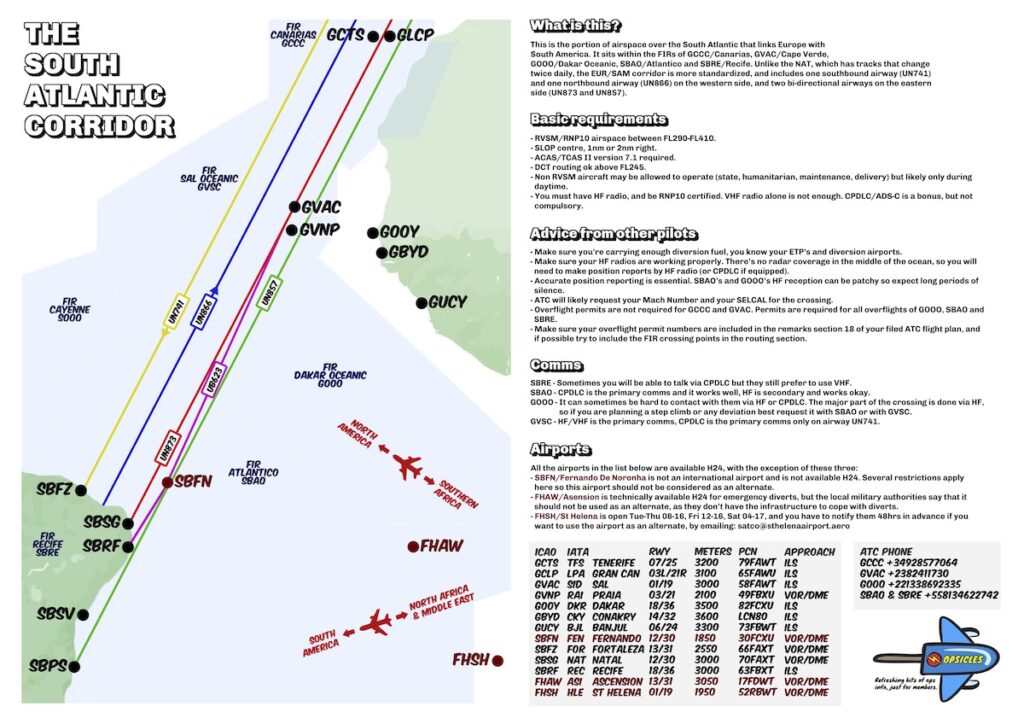
Click to download hi-res PDF.
Western Sahara Airspace Update

On May 4, the GCCC/Canarias FIR updated their airspace warning for Western Sahara, due to the ongoing conflict there.

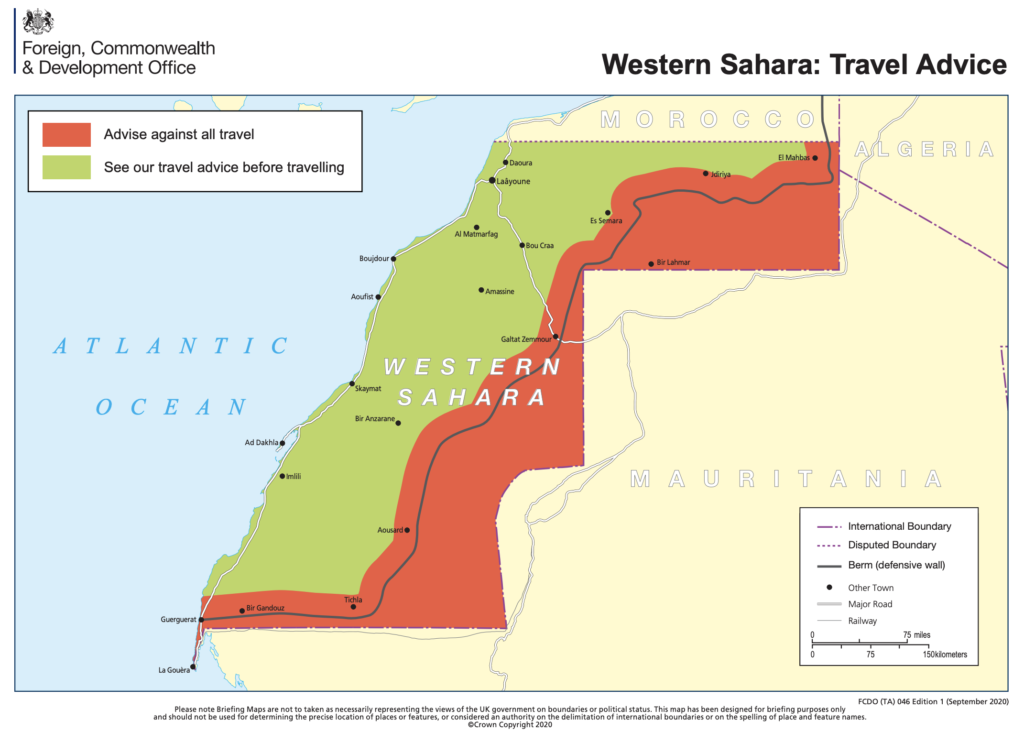
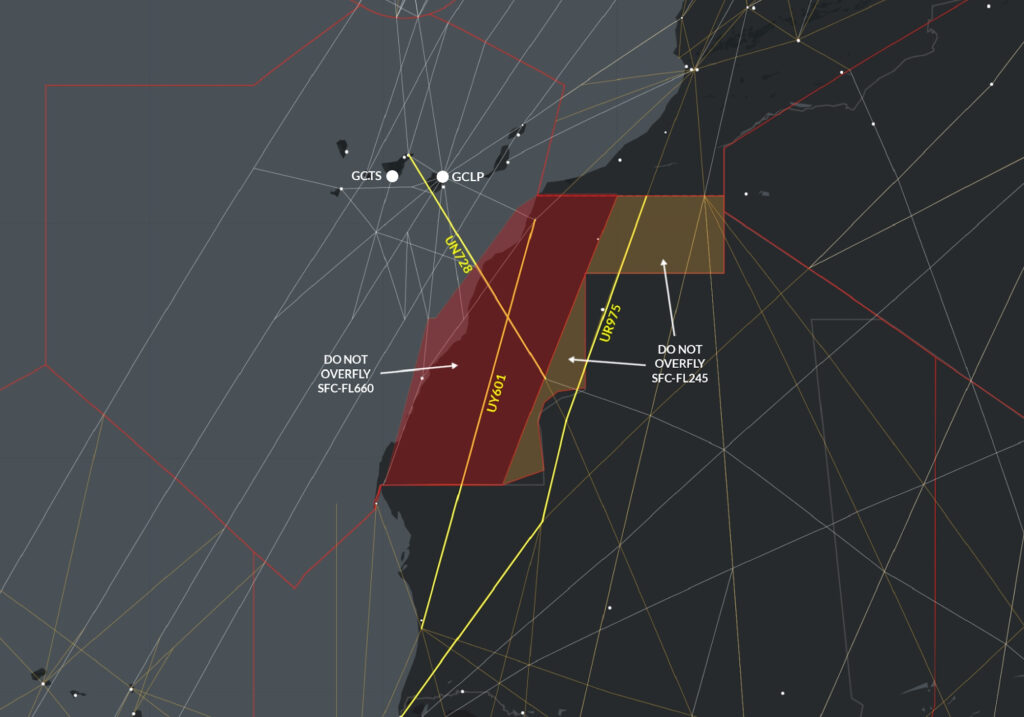
Previously, they said that aircraft overflights should be completely avoided in the eastern part of the country (i.e. airways UY601 and UN728), and should not be below FL245 in the western part. Here’s how that looked:

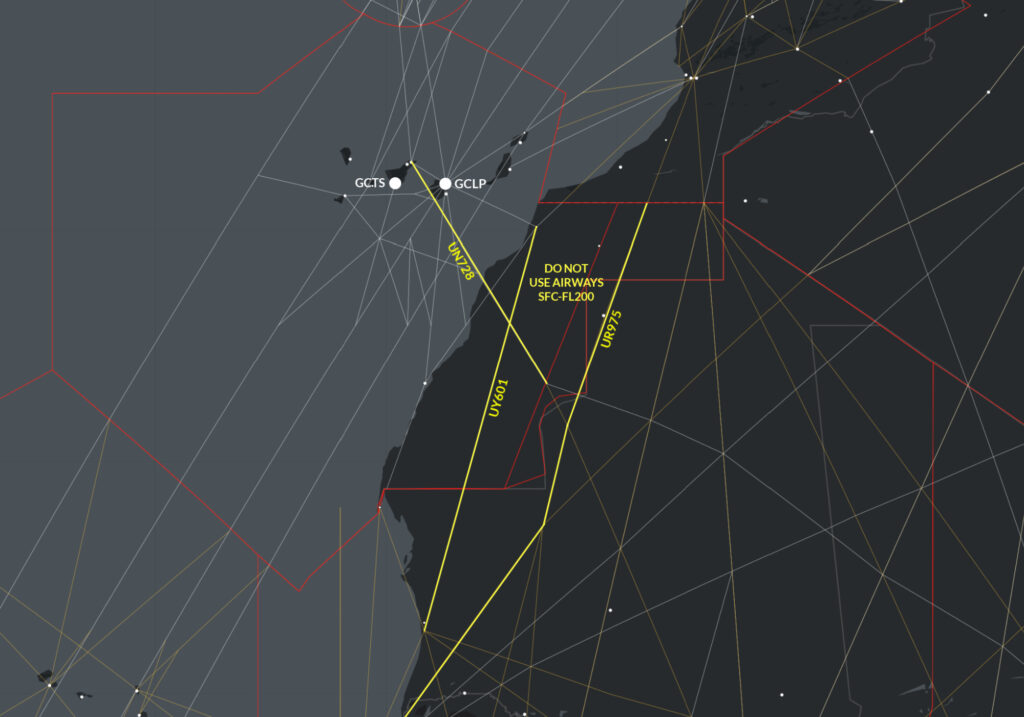
However, the updated warning issued on May 4 simply advises operators to avoid using the airways over Western Sahara below FL200:

Here’s the Notam:

GCCC B3323/21  - OPERATORS ARE REQUESTED TO EXERCISE PARTICULAR CAUTION 
DURING FLIGHT OPERATIONS IN WESTERN SAHARA AS PART OF FIR CANARIAS. 
IT IS RECOMMENDED TO AVOID OVERFLIGHT AT FLIGHT LEVELS BELOW FL200 
ON THE FOLLOWING ROUTES: UY601, UN728 AND UT975. 
04 MAY 08:53 2021 UNTIL 04 JUN 23:59 2021 ESTIMATED. 
CREATED: 04 MAY 08:54 2021

Still, not much of a warning. What’s really important is exactly what is missing: why.

The answer: Because the airways are over an active conflict zone, with a known threat of anti-aircraft fire.

Western Sahara is effectively divided straight down the middle, literally by a wall. Morocco controls one side, while the region’s independence movement (the Polisario) controls the other. In Nov 2020, the Polisario declared war on Morocco.

Why do they want to fight?

The two have never gotten along. The Polisario want independence and were at war with the Moroccan Government for a very long time, until a fragile ceasefire agreement in 1991. Since then there has always been tension.

In early Nov 2020, a Polisario protest blocked a whole bunch of Moroccan truck drivers at the border with Mauritania, shutting down an essential route that connects Morocco to the rest of Sub-Saharan Africa. Morocco weren’t happy, and breached the ceasefire agreement by sending forces into the demilitarized zone to remove them.

The Polisario immediately declared war on Morocco, and clashes began straight away.

Why does it matter?

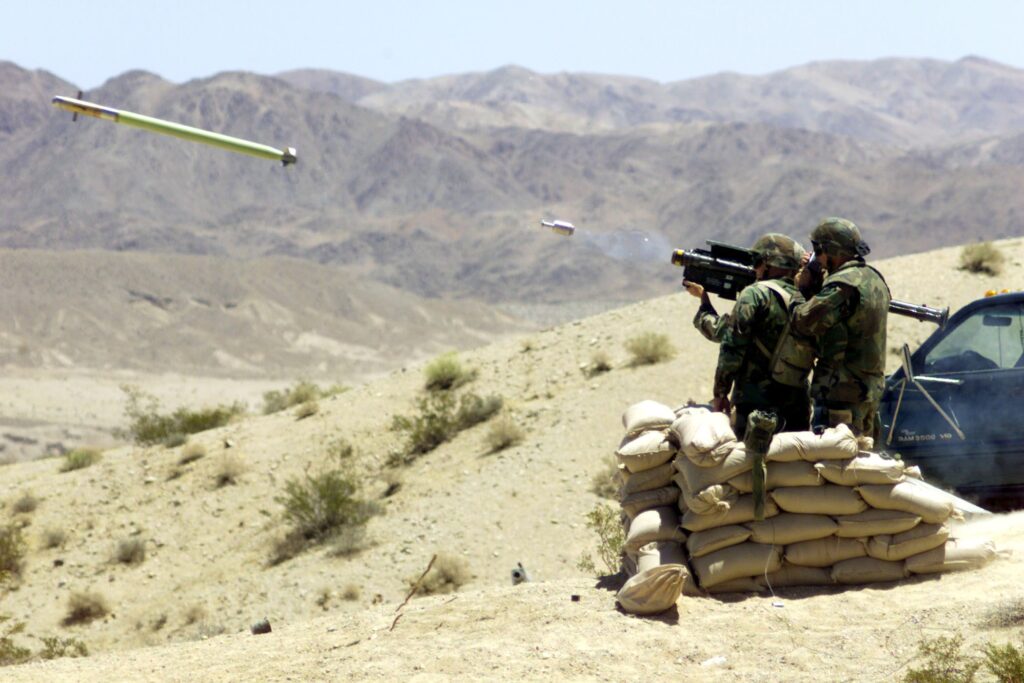
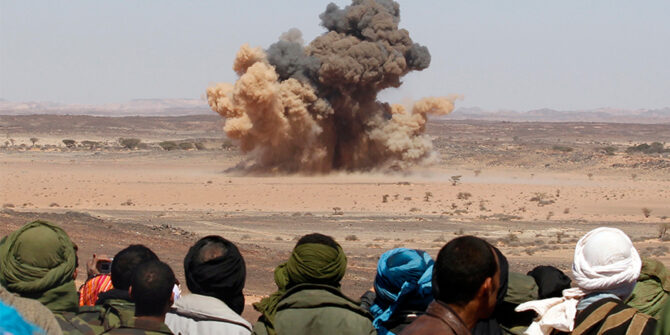
The FAA were onto it when they immediately carried out a risk assessment and published a notice. The big deal is that the Polisario are likely to have access to anti-aircraft weaponry left over from the previous war. This includes man-portable air defence systems (MANPADS) and surface-to-air missiles. The FAA think these weapons pose a risk to aircraft as high as 12,000 feet.

To make matters worse, they are suspicious that Morocco are flying drones over their territory – something that has been denied by Morocco. It wouldn’t be the first time an aircraft has been shot down there either – the Polisario downed two DC-7 airliners with missiles back in 1988.

What about airspace?

The sky over Western Sahara airspace is split between two FIRs –GCCC/Canarias and GOOO/Dakar. If the conflict escalates further, this is likely to complicate things.

So far there has been only one warning from the Canarias side – the NOTAM above. Nothing from Dakar yet.

There are currently three major airways affected. Two of them (UY601 and UT975) run the length of the region in a south westerly direction – likely to be used by aircraft transiting some routes between Europe and South America. The other airway, UN728 is a direct track from the coast to GCTS/Tenerife which may be used by smaller aircraft or those doing tech stops in the Canary Islands.

So if you’re  planning flights to the Canaries, or overflying central Africa, pay close attention to the risks involved. Continue to monitor Safeairspace.net as the situation develops.


Bamako Airport reopens following military coup

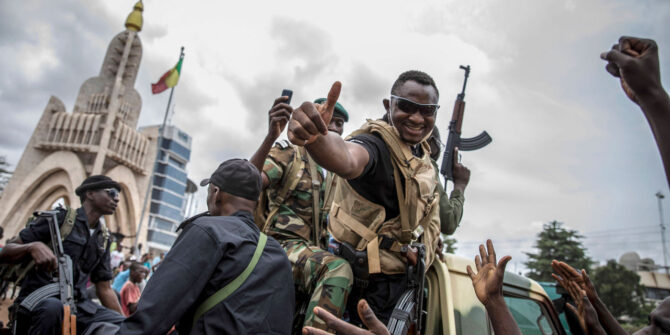
Bamako Airport has reopened following last week’s military coup which overthrew the government, though monitor GOOO/Dakar FIR and GABS/Bamako Airport Notams for further – it may change.

The Bamako TMA (which sits under the GOOO/Dakar FIR) remains operational with overflights unaffected.

ICAO is actively monitoring and ensuring that there is a timely flow of information on continued airspace/ATC service availability. MedAire have given us a local situation update: with the continuing uncertainty they recommend against overnights until things settle. There is likely to be a high demand for emergency/evac flights in the coming days, and they recommend those to be quick in and outs for now.

Meanwhile, the Northern Mali conflict continues, and there have been no improvements in stability. The US, Germany, France and the UK all have airspace warnings in place, advising to operate FL250/260 or higher, and avoiding GATB, GAGO, and GAKL airports. We would suggest, as usual, that a higher level closer to FL300 is more sensible.

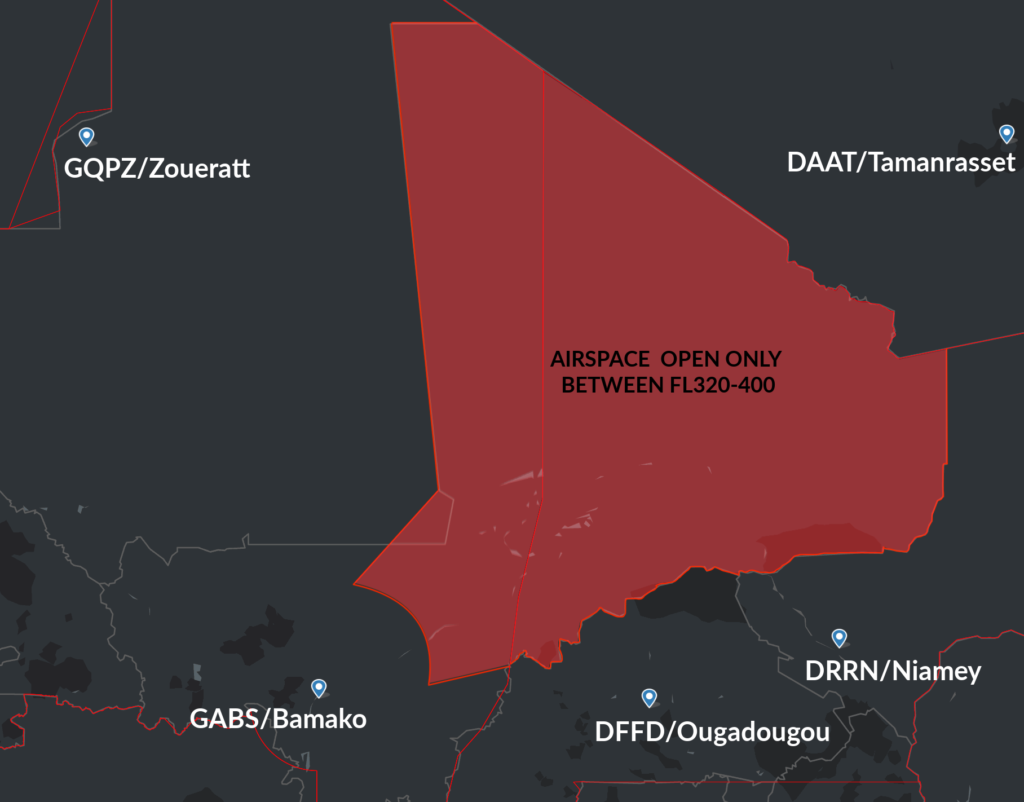
Senegal and Niger control the airspace over Mali, and they have long-standing Notams (published under the GOOO/Dakar and DRRR/Niamey FIRs) warning that you can only fly between FL320-400 through the entire airspace in Mali north of the GABS/Bamako TMA due to military ops across the region. Here’s what that looks like:

The UK recommend against all travel to northern Mali, and against all but essential travel to the south of the country, including Bamako. The US advice is more straight-forward: do not travel to Mali due to COVID-19, crime, terrorism, and kidnapping.

For more info on operating in this region, check out SafeAirspace.net


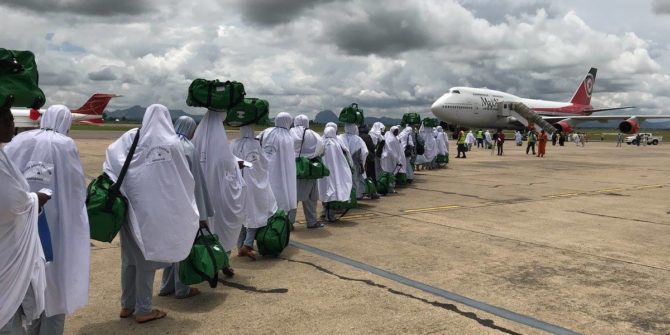
Africa: Hajj 2019 routes in operation

The Hajj routes for 2019 will take effect from 18 Jul through to 9 Oct.

What are Hajj routes?
Every year, millions of pilgrims travel to Mecca and other sites in Saudi Arabia – and this changes the predominant traffic flow over the African continent. ATC in the FIRs most affected put in place standard routings to help flow that traffic.

Normally, traffic is very much north-south predominant, with Europe-Africa flights being the main flow. When Hajj operations start up, a good amount of traffic starts operating east-west (ie. Africa-Saudi Arabia and vice versa), and this is something to be aware of when cruising along at FL330 with spotty HF comms.

So, in addition to the normal IFBP belt and braces on 126.9, keep an eye out for a much higher amount of crossing traffic during the coming months.

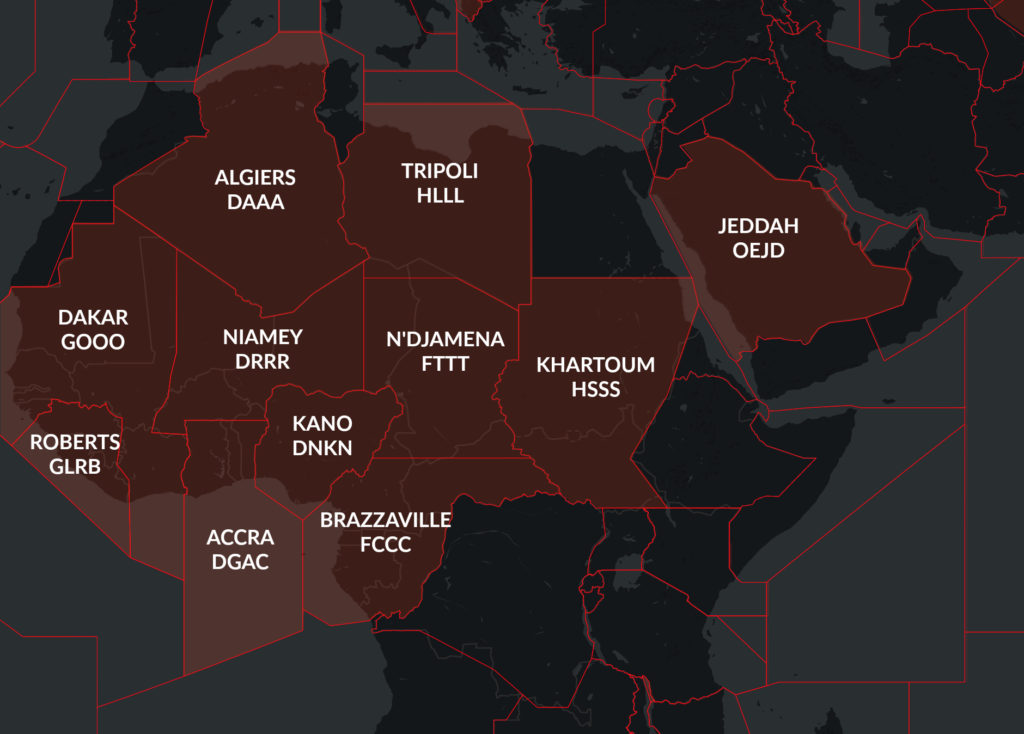
The FIR’s affected are: Algiers, Accra, Brazzaville, Dakar, Jeddah, Kano, Khartoum, N’Djamena, Niamey, Roberts, and Tripoli.

Of these, watch out for Tripoli – risk remains high across Libyan airspace at all flight levels, and multiple countries have “do not fly” warnings in place. There are daily airstrikes taking place, severe limitations in ATC services, and massive areas of the FIR are without surveillance and communications capabilities. Malta FIR is currently managing all east-west routes in this airspace, and operators can contact them for additional information on email: airspace.cell@maltats.com

The Hajj routings are contained in this ASECNA AIP Supplement.

Further reading:

  • Read IFALPA’s information on recommended procedures when operating in the African region here.