Go-Arounds Aren’t Normal

Go-arounds are often described as routine. And the guiding principle is that we should be ready to execute them safely, accurately, and immediately on every approach, and without hesitation.

It sounds good on paper, but this expectation is among a myriad of niceties we tell ourselves that all competent pilots have covered. And I’m not sure I agree.

Rose tinted: “Go-arounds are normal, and we’re always ready and prepared for them!”

For starters go-arounds aren’t routine. They’re just not.

We know this to be true. On average, a long-haul pilot will do one every five to ten years.

Secondly there are the reasons behind them. Weather related go-arounds tend not to be the ones we’re struggling with. Why? Here’s one suggestion –  because when conditions are marginal, we are ready for it – we’ve briefed it, we believe it may happen. Our brains are primed for action.

But what about when we’re not expecting it – when we’re not primed? When the weather is good, the airplane is on rails and sign-off is within arm’s reach. Are we as prepared then?  

Incident histories are littered with go-arounds gone awry, and they often have a major trend in common – the crew weren’t ready for them. Because the reason for the go-around was unexpected, it wasn’t routine.

And when we encounter a non-routine event, we become fallible to limitations that all pilots possess in times of surprise or emergencies. Enter our ‘inner ape.’ It’s hard to tame, so when we have an emergency we fall back on one particular mantra. Ape repellent, if you will – ‘aviate, navigate, communicate.’ The idea is to break down an overwhelming situation into manageable chunks.
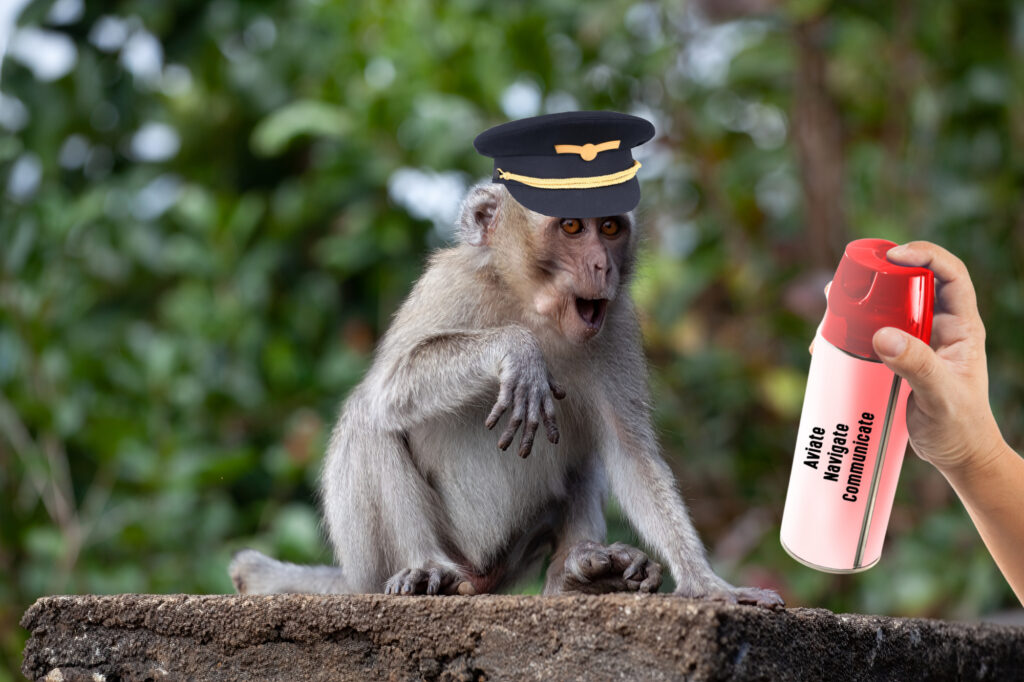
Poor little thing.

So why then are we failing to apply the same idea to unexpected go arounds?

A healthy dose of ‘deer in headlights’ might be the answer. It’s no secret that when we are surprised, our brains stop for moment. It is hard wired into us from the days when we were running away from woolly mammoths.

Fight or flight is instinctive in all of us.

Our instinct is to act now, and think later. And those big ol’ TOGA switches are a huge trigger. Once we push them, it’s on. We are bombarded with rapid fire mode changes, oodles of thrust, noise, configuration changes, high nose attitudes, and typically we’re going up faster than a fart in a bath.

Our brains can switch into overload mode – there is too much information coming at us and too fast to stay ahead of the airplane, or even with it.

Here’s a couple of scenarios to mull over – how would you manage your airplane?

  • You’re instructed to go-around above the published missed approach altitude.
  • ATC instructs you ‘caution traffic 1 o’clock 2 miles. Cancel published missed, maintain 1500′, turn left heading 180 degrees, expect visual circuit.’
  • The pilot flying is about to bust through your missed approach altitude, but isn’t responding to you or ATC.

Had we not briefed the missed approach as routine, along with the runway lighting, expected taxiway turn-off and our parking bay, we might be more prepared. But the evidence is suggesting that we’re not.
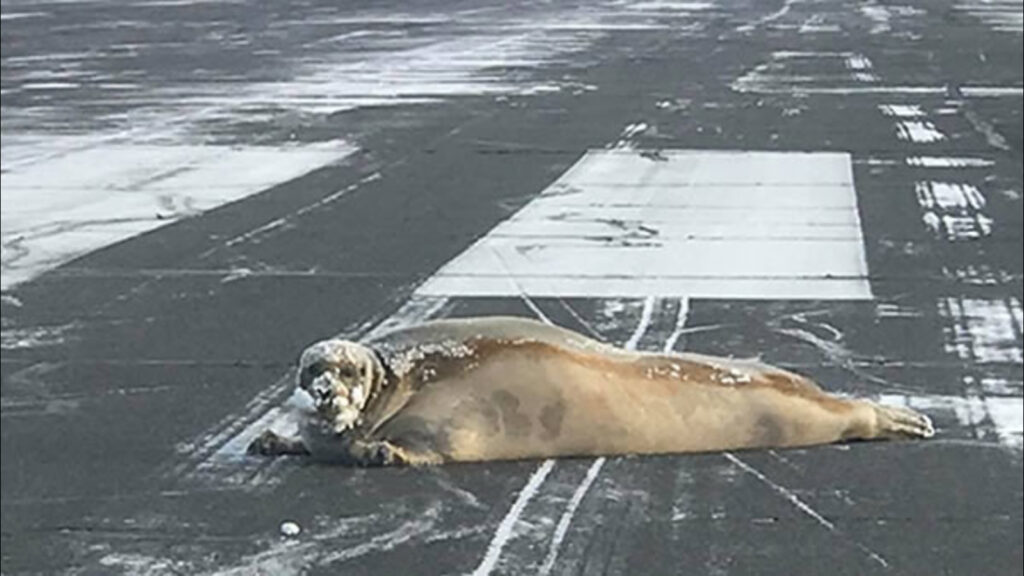
There was nothing routine about this 400 pound seal that decided to take a nap on a runway in Barrow, Alaska.

Our approach to go-around training, along with other abnormals, needs to focus on the unexpected, the non-routine. The industry has already discovered that we learn less when we know what is coming in the sim, and that the real world is rarely as forgiving.

Danger Club returns!
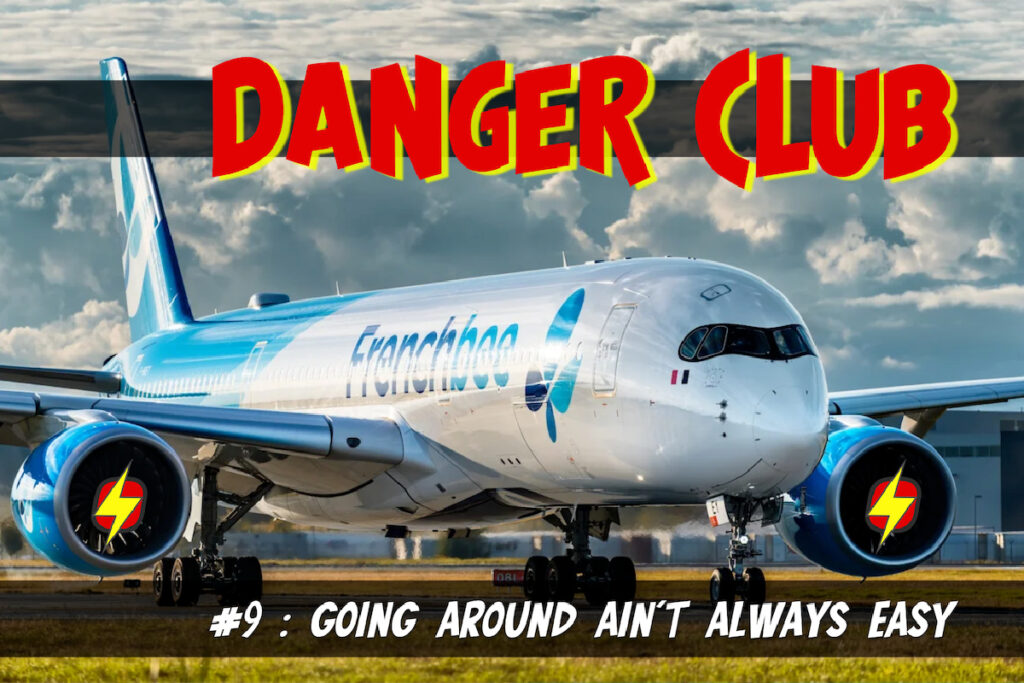
We’re starting the conversation at sunset. Almost dark. A French Bee A350 is landing in Paris Orly, after an 11 hour flight from SFO. Almost home. But 3 miles out, the machine says “WINDSHEAR“, and the flight goes from routine to 🤡 go-around circus 🤡 in about 10 seconds.

The F/O checks out. Startled and frozen. The captain is now single pilot, but doesn’t know it. The airplane doesn’t know it either, so keeps flying- busting the altitude, heading for departing traffic. But nobody’s flying it.

Here’s your challenge: park any judgement on the crew at the door. Step inside DANGER CLUB, and ask, with your curious-raccoon-mind: “How could this happen to me?”

This is where we might start, but we don’t know where we’re going with this one …

> Go-Arounds ain’t always easy (even if they tell us they should be)
> How bad can startle be?
> How do we get ourselves back in the game?
> Was this all the Captains doing? (Even if the report focuses on the FO)
> Do we HAVE to go-around right away?

That’s where we start … this Thursday, July 14, at 1730Z.
Will you join us, curious raccoon?

> The (very readable) accident report is here.
> Also, there is an excellent – as always – video from Mentour Pilot  about the whole incident. Highly recommend!

Unstable Approaches: Why Aren’t We Going Around?

Late last year, IATA put out a bulletin noting that the number of unstable approaches in 2020 was a lot higher than in previous years.

Look a little further back and you’ll see this has been a trend for some time now.

Fly the line and it’s not hard to see why we are getting unstable – there are a bunch of reasons including weather, other traffic, challenging clearances, complex airspace, fatigue and even currency given the state of the industry, to name only a few.

So what’s the big deal?

IATA also know that in most cases, we’re not going around.

The numbers don’t lie, and they’re scary. Get this – a recent study estimated that 97% of unstable approaches flown in IMC didn’t fly a missed approach. That’s huge.

The leading cause of aviation accidents worldwide are runway excursions. The Flight Safety Foundation looked into all of them over a fourteen-year period and found that 83% of them could have been prevented by a go-around. That’s over half of all accidents recorded. It’s a big deal.

What do we actually mean by ‘unstable’?

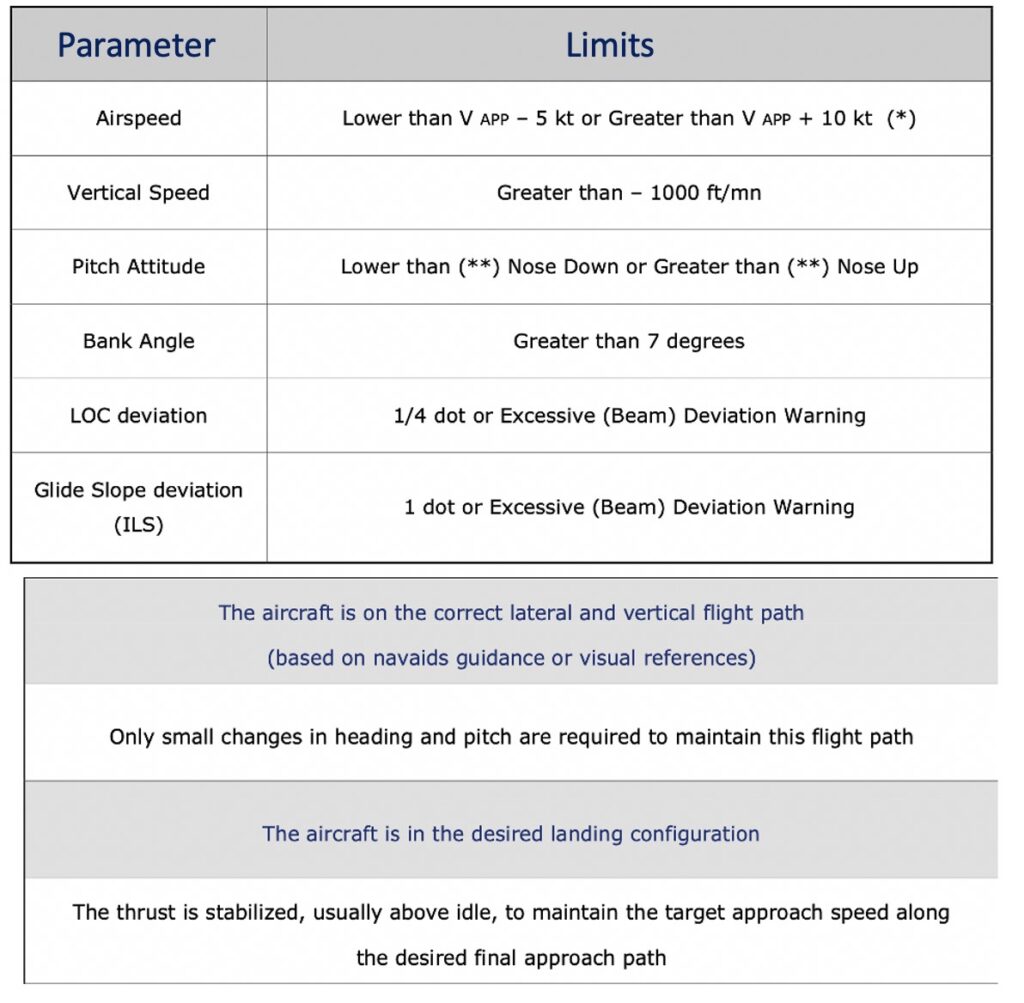
In a nutshell it is any approach that doesn’t meet the stable approach criteria in your SOPs by a certain height – usually 1,000 feet off the deck. And it’s not just the ones that have gone badly wrong either – the criteria are usually pretty tight…

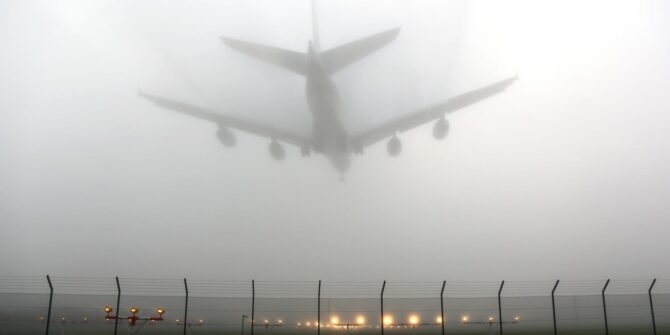
Like the picture, the decision appears to be black and white: If you don’t meet the criteria, you have to go-around.

So why aren’t we doing it?

Good question. There are a bunch of factors but the most important is pilot psychology. Either consciously or sub-consciously we are making a decision to not go-around. Here are some suggestions about what may be happening inside our heads.

1. We’re pilots

Which means we’re mission-orientated. We want to get in and we don’t like conceding defeat. Nor do we enjoy being reminded that we have reached the limit of our ability to fix whatever has gone wrong.

Experience also tells us that if we persist a little longer we can re-stabilise. After all a little speed brake, a little more sink rate you’ll have the thing back on rails long before the runway out the window is too close for comfort.

The problem is we’re fixating on completing the mission.

Studies have shown this behaviour is insidious. It creeps up on you and you begin to normalize the risk. Just like a speeding driver arriving home unscathed, the danger becomes typical. But it gives you far less capacity and room to deal with anything unexpected.

2. Training

A go-around is a normal procedure, but boy do things happen quickly. It’s okay when you know it’s coming. But it’s when you’re off the script that they get especially challenging. Especially after something stressful has already happened.

Studies show that pilots are more reluctant to go-around in scenarios they haven’t practiced. This includes when the aircraft is only partially configured or is very low to ground (such as a bounced landing or botched flare). Complicated airspace and procedures can also be major deterrents to hitting those TOGA switches.

3. What the other guy/gal thinks

Everyone’s personality is different, and we don’t always get along. You might like a good book, while your offsider might prefer a good base jump. When it begins to matter is when it affects safety.

We react differently depending on the dynamic with the other pilot. This can include embarrassment at going around, a lack of support for the decision or disagreement with whether the approach can be safely salvaged. But if you begin to see a go-around as a reflection of your abilities, you are already on a slippery slope. Add an offsider who might judge you for going around and you’re in for a dangerous ride together.

Cockpit gradient is another contentious issue. Too steep and it can turn a multi-crew aircraft into a single pilot one. Age, experience, rank or culture can all contribute. Take this animation of a visual approach on a calm sunny day in San Francisco a few years back. Watch the animation and decide when you would have said something. There were two Captains and a First Officer on the flight deck.

Credit: Airboyd

4. Organisational Pressure

The elephant in the room. No one is pointing fingers but now more than ever operations need to run on the ‘scent of an oily rag.’ Fuel is a big part of that. Crew may be encouraged to carry less of it in the first place which can lead to  fuel anxiety and reluctance to go-around. Or it may be the simple economic cost of using it compared to trying to re-stabilise an approach. It’s no secret that go-arounds use a lot of fuel.

Other factors may come into play too – scheduling, delays, an unwanted diversion or even duty time limits. There are a bunch of external factors which can creep their way into the flight deck and affect our decision making.

So what can we do to improve our Go-Around decision making?

IATA have made some solid suggestions:

1. Make the decision as early as you can. Historically, accidents that follow a decision to go-around usually reflect a late decision. Don’t wander down that garden path. Lion Air Flight 904  serves as another example.

2. Brief the heck out of them. Every time.  Make sure you include what you will be looking for to continue the approach, what may make a go-around more difficult on that particular day and how you will get around those challenges.

3. Encourage acceptance on the flight deck that a go-around is a possibility at any stage. Always prioritise the safest outcome.

4. Follow those SOPs. Operators should always have a mandatory requirement to go-around when stable approach criteria aren’t met. On the flipside, there should never be any punitive reaction to a crew’s decision to go-around. They show good decision making.

5. Fuel policy. Have one which always allows for go-arounds and accept they are a necessary cost of operating an airplane out there.

Up for more reading?

It’s a big issue so there are plenty more places to look. Here are a couple of really good links to get you started.

  • IATA periodically publish a whole bunch of useful stuff about unstable approaches, go-arounds and risk mitigation.
  • Flight Safety’s work on unstable approaches.