Saudi Arabia Overflights – Free Route Gotcha
Key Points
  • The Southeastern section of the OEJD/Jeddah FIR is now Free Route Airspace.
  • It’s not straightforward. New procedures have been published in the Saudi AIP.
  • If your flight plan does not comply, you are likely to be instructed to descend below FL300.

Background

We’ve received a new report from an OPSGROUP member after a recent run-in with ATC in the OEJD/Jeddah FIR.

The problem stemmed from a small (and confusing) change that became effective on April 18.

Essentially, ATC were upset that their filed route did not comply with newly published Free Route Airspace (FRA) procedures buried deep within the bowels of the Saudi AIP.

The fallout of non-compliance is the ATC equivalent to the ‘naughty corner’ with aircraft directed to descend below FL300 for the duration of their crossing of the affected airspace.

In this case, the member was able to negotiate to remain at their preferred level but not before a fair amount of head scratching as to why they got in trouble in the first place.

As large amounts of traffic are now transiting Saudi Arabia to avoid Iran further north, it is especially relevant right now.

New Free Route Airspace

On April 18, a large chunk of Southeastern Saudi Arabia (known as the SE Sector) became Free Route Airspace (FRA).
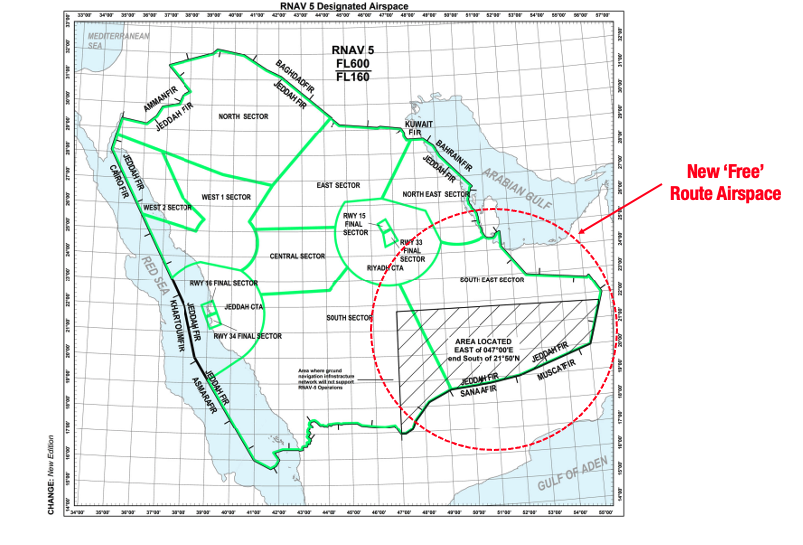
Typically, FRA means that pilots can freely plan any route they like between defined entry and exit points without reference to the ATS route network. This saves both money and time – simple.

However, this is where things get hazy.

The change was notified in this easily overlooked FIR Notam:
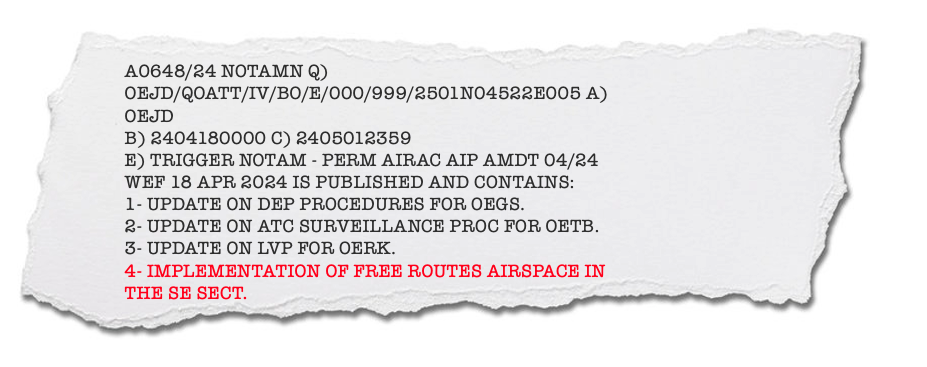
This directs you to the Saudi AIP. This is great if you have a spare half an hour to prove who you are, download a special app and access it. To save you the trouble, the relevant bit is ENR 2.2.4 which you can find here.
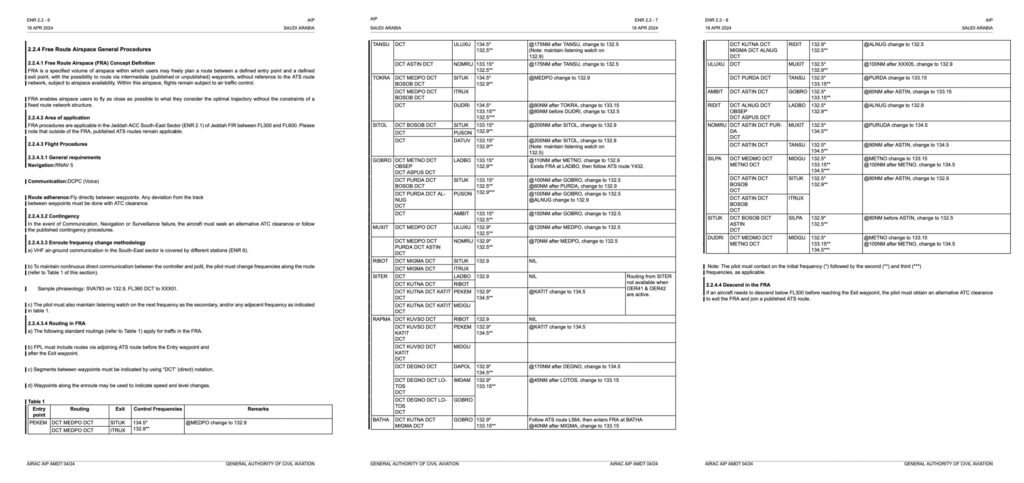
Click for PDF.

Here’s the kicker – it’s Free Route Airspace, but not really. You still need to plan and file via the standard routes found via the link above.

In other words – ‘fly whatever route you like, as long as it is one of these ones.’

Turns out if you don’t, they will want you out of the ‘FRA’ which means a descent below FL300 (or a climb above FL600 if you’re piloting the Space Shuttle).

Keep listening out.

There are also some really specific comms requirements you need to follow along each route as the sector is controlled by several VHF frequencies. It seems you cannot rely on ATC to tell you when to switch.

“Normal” routes.

Don’t forget the Free Route Airspace only applies to the SE Sector of the Jeddah FIR. Everywhere else in Saudi airspace, you’ll need to follow “normal” ATS routes as per usual.

But even these “normal” routes are a pain. Saudi Arabia (like many other countries in the region) has preferred routes depending on where you’re flying from/to – so you’ll need to make sure you file on one of these. For some reason Jeppesen recently stopped publishing them, so now you have to get them from (yes, you guessed it) the Saudi AIP! SUP 8/24 talks about it. You basically download this Route Availability Doc and work out a route from there.

Other Free Route Airspace in the region.

Qatar and the UAE are the only other countries in the Middle East that have implemented FRA, and unlike Saudi Arabia, both seem fairly straightforward.

Qatar – has implemented a corridor of FRA straight through the middle of the OTDF/Doha FIR, available from FL275-460. The Qatar AIP does not currently list any restrictions on its use.

Click for PDF.

The UAE – has implemented FRA in parts of the OMAE/Emirates FIR from FL355-600 – basically the parts around all the airports, and the airspace connecting with the OOMM/Muscat and OIIX/Tehran FIRs. Like Qatar, the UAE AIP does not currently list any restrictions on its use.
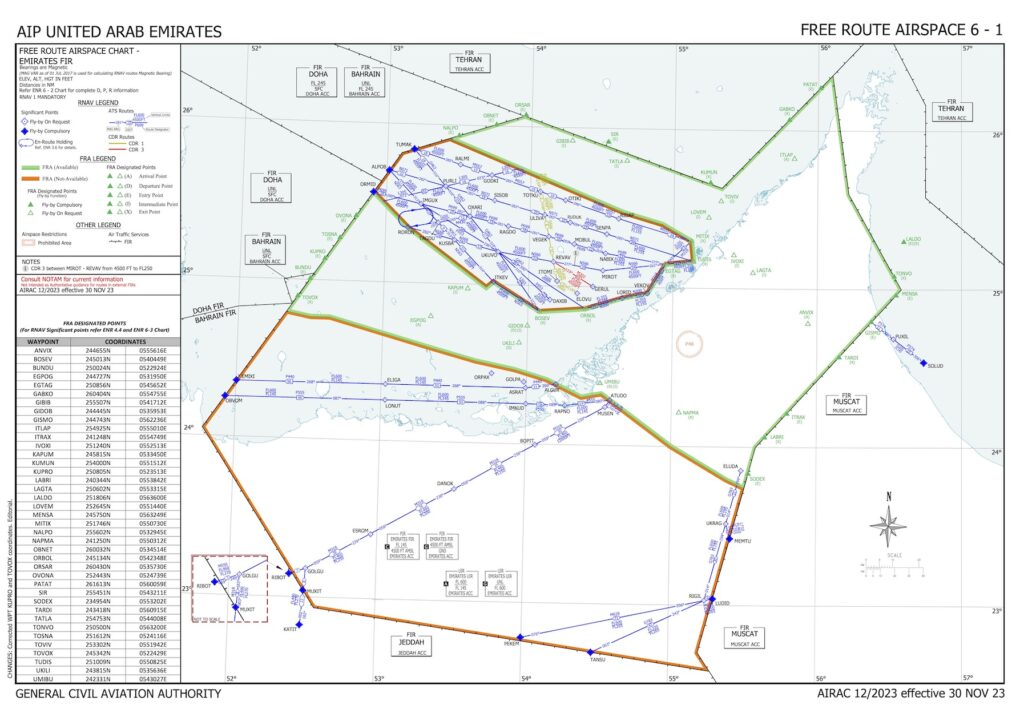
Click for PDF.

Please report back.

Thank you to the member who got in touch.

These changes can be hard to spot. Especially when you pay an operational penalty for procedures like this one that are poorly written, hard to find, or obscure.

We need your help to spread the word whenever you come across something different – in Saudi Arabia or elsewhere. Thousands of other like-minded pilots will thank you later.

If you have something you’d like to share, you can reach us on team@ops.group. We’d love to hear from you.

Free Route Airspace Around The World

The amount of Free Route Airspace (FRA) you have available to you on your worldwide flights is growing. Here is a look at some of the new regions opening up, some that have been there for a while and some of the ones which probably never will be…

A quick overview if what it is.

Free Route Airspace is where you are allowed to fly direct rather than point to point.

“Free route airspace (FRA) is a specified airspace within which users may freely plan a route between a defined entry point and a defined exit point, with the possibility to route via intermediate (published or unpublished) significant points, without reference to the ATS route network, subject to airspace availability.”

Now, there are usually some limits to this:

  • Your direct segment can only be 200nm long otherwise you’re going to have to file an intermediate point
  • You’ll also need an intermediate point anytime there is a level change or change in flight rules
  • You can take DCTs that cross FIR boundaries, but will need to coordinate in advance for this.

Then there are the aircraft requirements (otherwise you’ll be sticking to the published routes). These are general and not all FRA airspace will have the same requirements:

  • Mode S transponder
  • ADS-C
  • CPDLC (not everywhere, but most)

The New One: Africa.

(Well, parts of it).

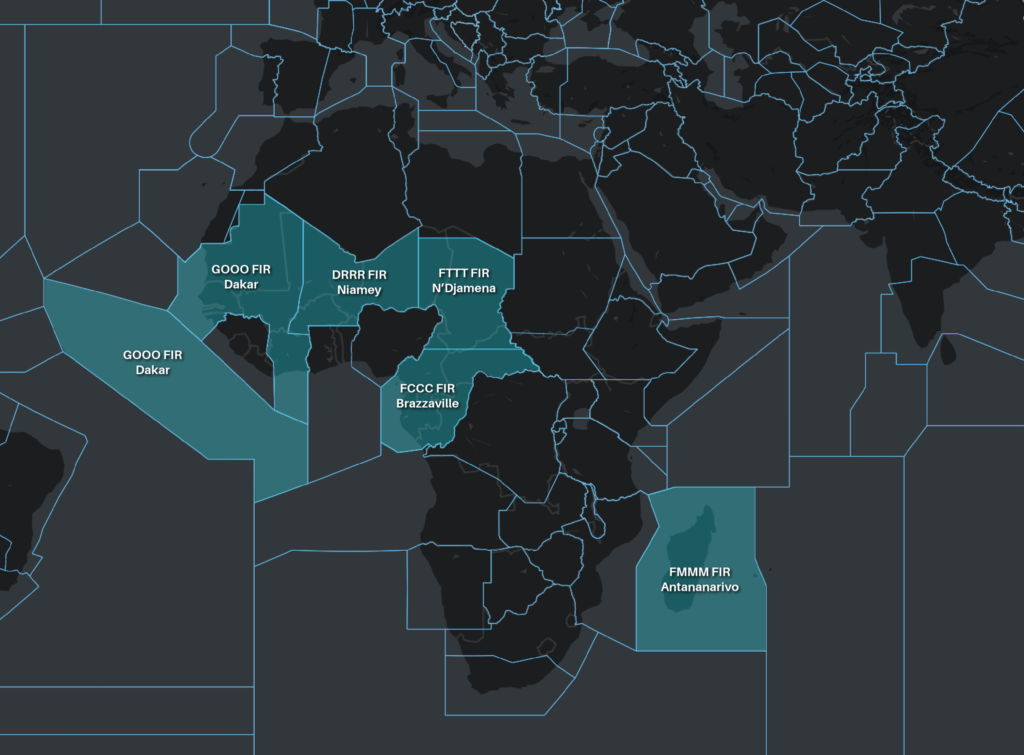
This actually came in during Covid because ASECNA (the air traffic folk for the region) wanted to help with fuel savings and efficiency for all the struggling airlines. Nice of them. Even nicer is they have now extended it until at least October 2022.

If you are flying through the FMMM/Antanarivo, FCCC/Brazzaville, DRRR/Niamey, FTTT/N’Djamena, GOOO/Dakar oceanic or terrestrial FIRs above FL290 then you can basically take directs.

Of course, there are some limits – free routing through restricted airspace will generally not be possible when that airspace is active, and bits of the normal airspace might occasionally not be available either. So you will have to keep an eye out for notams on these.

All the info on Africa’s FRA is published in AIC 27-22 which you can find right here.

The United Kingdom

We wrote a big old post on this back in December 2021 because it was the “biggest airspace change ever implemented in the United Kingdom” (their words not ours).

The major-ness of this is that it covers areas in the North Atlantic, Scotland, England and Northern Ireland. There is even a portion in the London UIR which is now FRA.

This FRA is H24 and from FL255-FL660

Europe

We should have started with Europe because they’ve been trailblazing FRA since 2008, when they became the first in the world to implement it. They have a whole implementation plan which you can read up on here.

Once the whole airspace is implemented they reckon it will amount to 1 billion nautical miles saved.

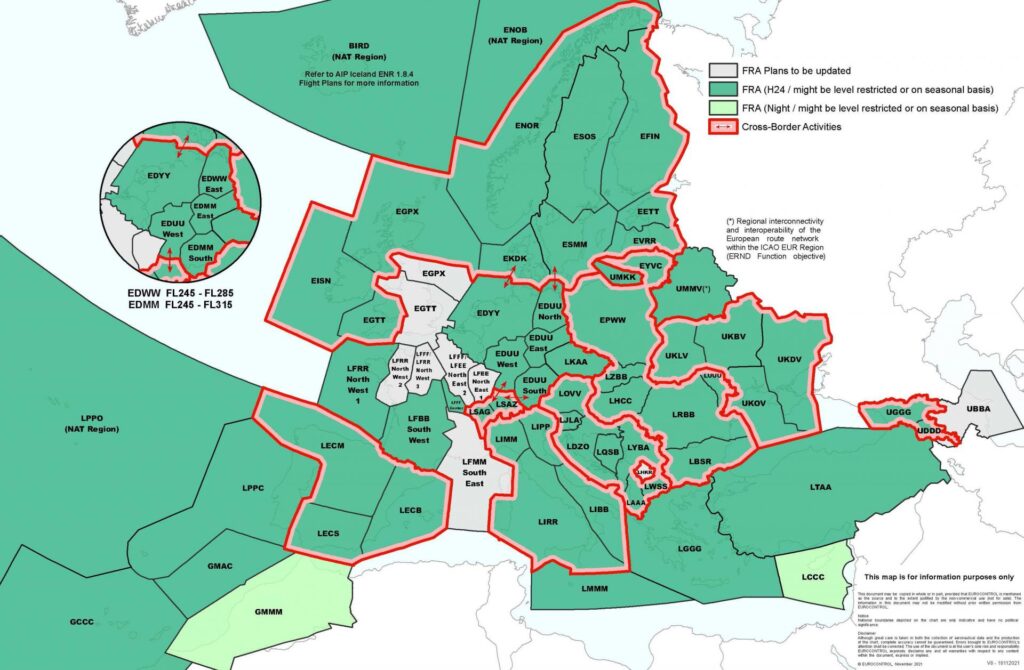
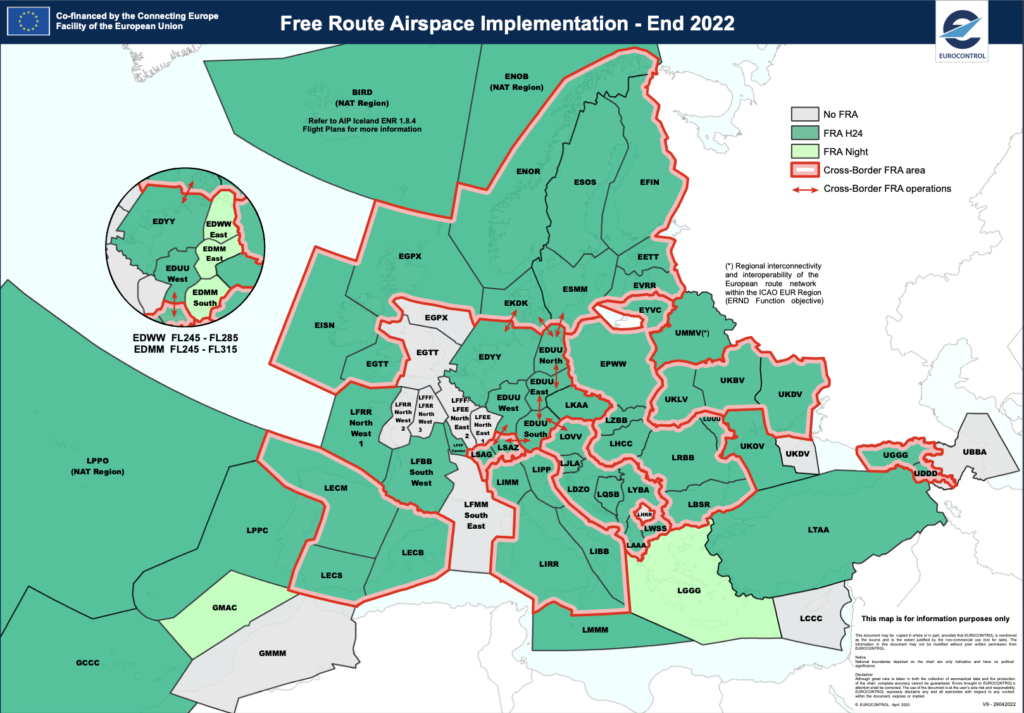
As of the end of 2022, this is what will be available:

The Cross-Border FRA is the key stuff because it means you can file those 200nm segments across border. Currently, Belgium, Luxembourg, the Netherlands, Germany, Denmark and Sweden all have cross-border FRA operations. These are increasing through to 2030 (when the whole region should be FRA and cross-border).

2022 is the year it’s (nearly) all happening.

The European Commission has a deadline of 2022 for implementing FRA Europe-wide above FL305.

The legal stuff for the implementation is all in here if you want a read.

They also have a jumbo document with all the planning requirements if you need it.

Maastricht. (Yes, we know this is part of Europe).

Maastricht of course have free route airspace. The Maastricht Upper Control Area (MUAC) has had it from FL245-FL660 since a long time. Here’s their page on it.

Some fairly standard stuff applies:

  • You can’t file within 2.5nm of the lateral boundary
  • Directs do need to connect to SIDs, STARs (if required) 
  • There are published enter and exit point for the MUAC region

They have something new too though.

Now, this isn’t FRA stuff, but is “making routing through airspace more efficient” stuff so we figured a good thing to add in here too.

The big change is the “dualisation” of the N125 route. What is this? Well, its a busy route that used to be bi-directional and have aircraft climbing and descending which was a mess. So now it is two parallel routes.

Here is a picture of it:

Might not look like much, but it impacts a bunch of German airports, some in the Netherlands and also some overflights so if you fly through this area often, it’s worth knowing about.

One last thing in Maastricht…

Maastricht also publishes their own AIRAC brief which basically coincides with the new AIRAC cycle. This doesn’t supersede the AIP, but provides some handy “complementary” information to help with flight planning.

NOPAC FRA

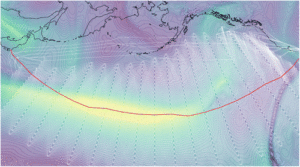
A study was published on this earlier in 2022 and the results showed, unsurprisingly, that there is much better efficiency for flights able to utilise free routing – especially because winds can be utilised better. This isn’t quite the same as Free Route Airspace, its more “free to plan your route for minimum time or fuel burn”.

They saw around 243kg saved on eastbound flights and 469kg on westbounders.

However, they also saw a potential increase in loss of separation events, so a balance in separation and efficiency comes up. To be honest, we aren’t sure what the situation is with this. It seemed to be a trial to see if viable, but no news on whether it will go any further.

The North Atlantic

The next step for the NAT is more likely to be Nil Tracks than full free route airspace. And there is no sign of nil tracks becoming a permanent thing anytime soon.

Mongolia

They are implementing FRA but it is dependant on China (where entry points are dictated by city to city pairs) and Russia (which is currently not talking to many of their neighbours on aviation related topics).

Russia

Russia has some FRA, but is looking to add more entry and exit points. See above for progress on this though.

The US

The FAA are implementing some High Altitude Redesign plans which you can read all about this Circular.

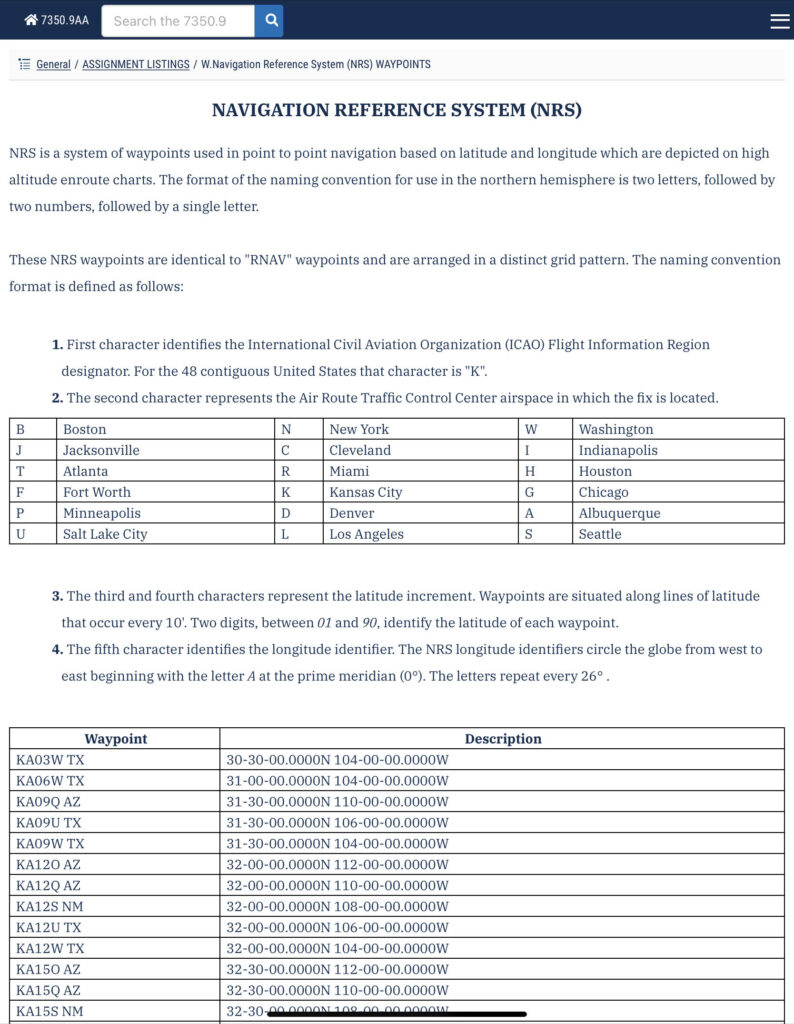
They don’t call it Free Route Airspace, but if you’ve flown in the US you might have noticed you do tend to get a lot of directs. If you want to plan for these a little more ‘officially’ then you need to look out for the (little-known by some) waypoints all around the US known as ‘NRS (National Route System)’ waypoints.

Coming to an airspace near you…

Free Route Airspace is predominantly a ‘Europe Thing’, and a very good one, but a work in progress. If you work in the planning side of things, keep an eye out for changes to European airspace as more FRAs and cross-border routes become available.


UK Free Route Airspace

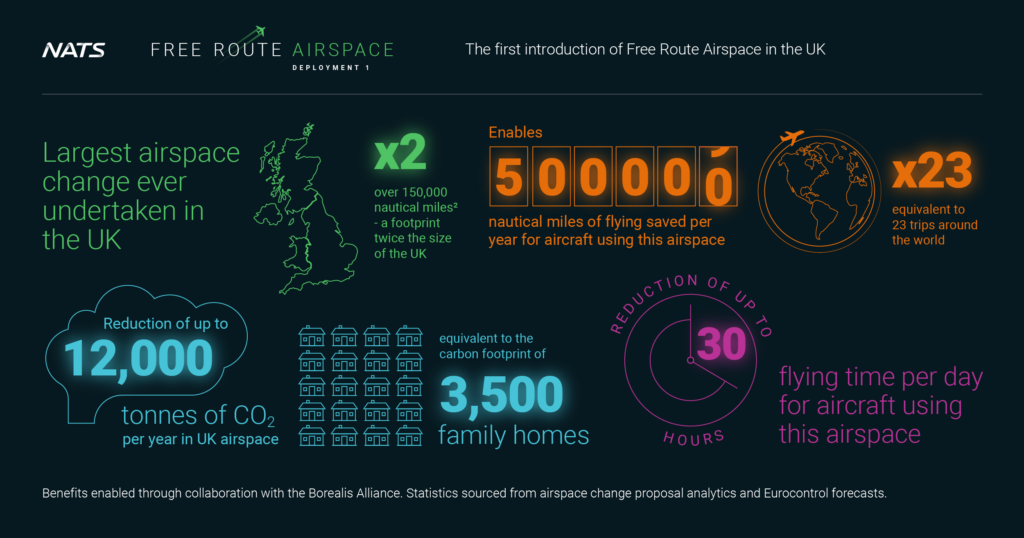
December 2 has been a big day in the UK – it marks the biggest airspace change ever implemented in the United Kingdom.

A big portion of UK airspace is now free route airspace, and here’s what you need to know about it.

What is ‘free route’ airspace?

In ‘not free route airspace’ you are confined to what is effectively a motorway (freeway if you’re American) in the air – a big corridor, defined by points along it, and you follow these until you reach your junction ad turn off. It is rarely the most direct route.

Free route airspace allows you to route from a defined entry to a defined exit point direct. Straight through the fields if you like. It also allows more freedom for operators to fly the most time or fuel efficient route, taking into account weather.

The benefit is big.

That it is. 

The new airspace structure in the UK is expected to save around 500,000 nm a year of flying and that means a big reduction in CO2 – they are estimating around 12,000 tonnes a year.

Here is NATS own article on it.

Where is this airspace?

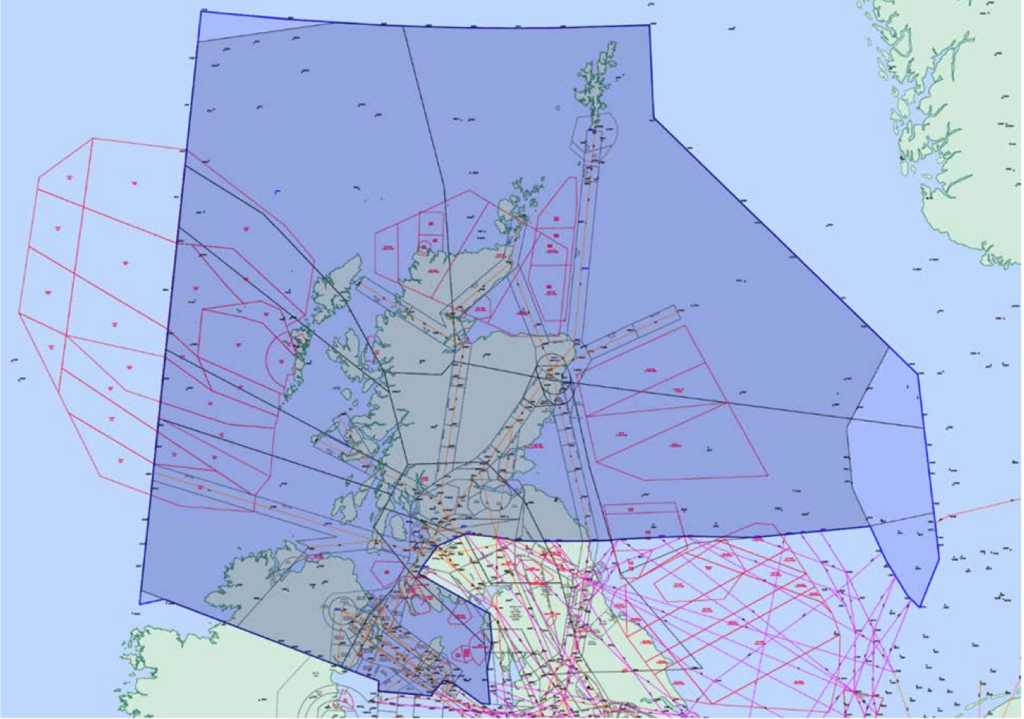
It is in northern UK and consists of 150,000 nm2 of airspace over the North Sea, Scotland, North Atlantic, Northern Ireland and a small portion of northern England – so within the Scottish UIR, London UIR and Shanwick OCA, and affecting the route network over some international waters. There will also be FRA in the London UIR within the region known as the PEMAK Triangle and TAKAS box.

This airspace accommodates up to 2000 flights a day and supports around 80% of transatlantic traffic.

The Free Route Airspace is H24 and between FL255-FL660.

You can find the full info on the relevant airspace here, including dimensions and how it links with other high seas airspace.

Where else is this happening?

You might want to take a look at the Free Route Airspace implementation taking place across the rest of Europe as well. This has been going on a little longer, and large areas of Europe already have it implemented.

They are also working on cross-border activities which may create even more direct routings in the future.

Norway’s AIC A03/21 published Oct 2021 provides info on the operations between the FRA in the Finland FIR, Copenhagen FIR, Polaris FIR, Riga FIR, Sweden FIR, Tallinn FIR (known as the NEFAB FRA meaning the North European Functional Airspace Block) and, of course, the Scottish FIR. These are known as the “Borealis Alliance”. (Here’s a link to the Borealis Alliance Presentation, if you want to find out more about the background and current stages of the overall project.)

Norway’s AIC tells us that flights routing through these airspaces will be eligible for Free Airspace Routings if they have a planned trajectory within the following vertical limits:

  • DK-SE FAB FRA FL285-FL660
  • NEFAB FRA FL095-FL660 (EETT/EFIN FIR FL095-FL660, EVRR FIR FL095-FL660, ENOR FIR FL135-FL660)
  • EGPX FRA (FL255-FL660)

Additionally, if you are routing to/from the UK FRA to the NEFAB FRA then you are going to have to file some intermediary waypoints because they have a lack of radar cover there. These Entry/Exit points are ATNAK, ALOTI, BEREP, GUNPA, KLONN, NINUN, ORVIK, PEPIN, PENUN, RIGVU.

There is additional information for flight planning in there so we recommend reading it through, and heading to the relevant ANSP for any of those countries if more info is needed.

Anything else to know?

While cross border operations are in place for much of it, the interface between Shanwick OAC and Reykjavik OAC will not change.


More direct routings across Europe

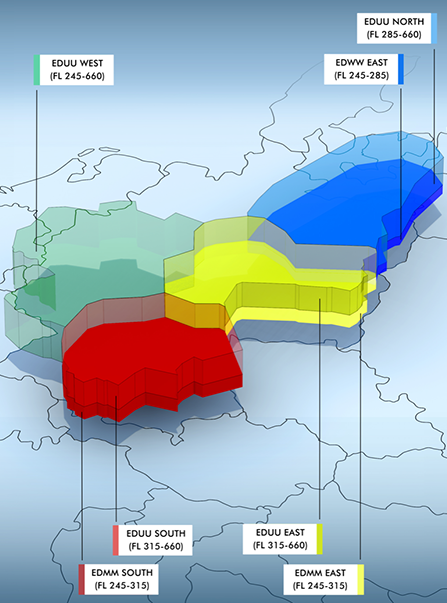
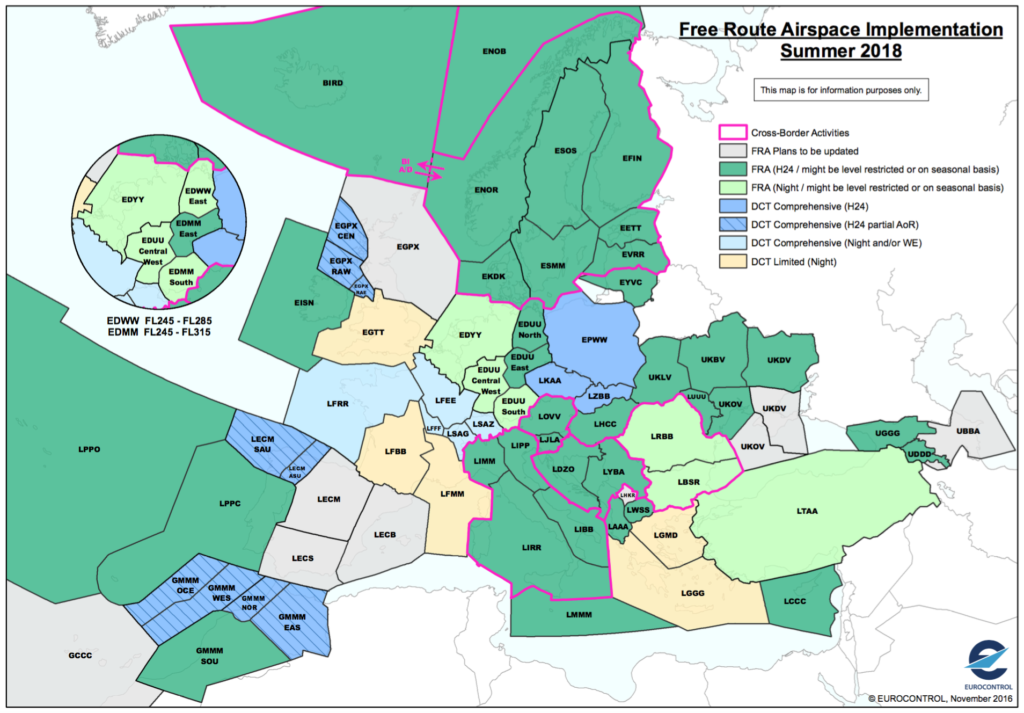
Sectors of airspace over southern Germany are ahead of schedule with plans to bring in Free Route Airspace (FRA). With effect from 1st March 2018, FRA will be implemented in the EDUU/Karlsruhe UAC, EDWW/Bremen ACC , and EDMM/Munchen ACC above FL245.

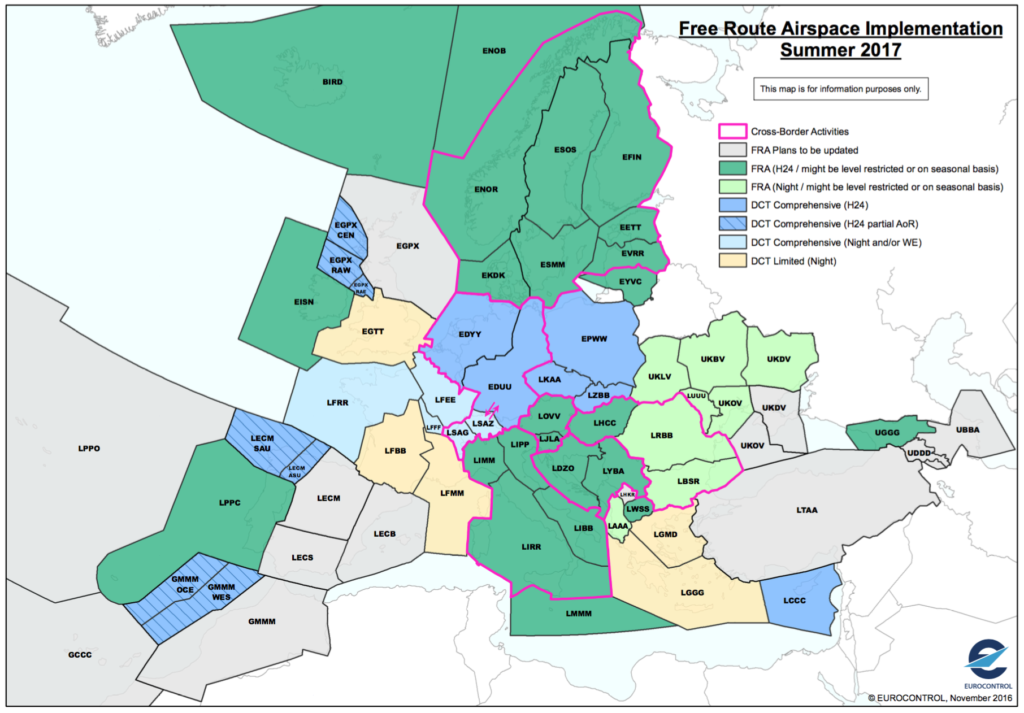
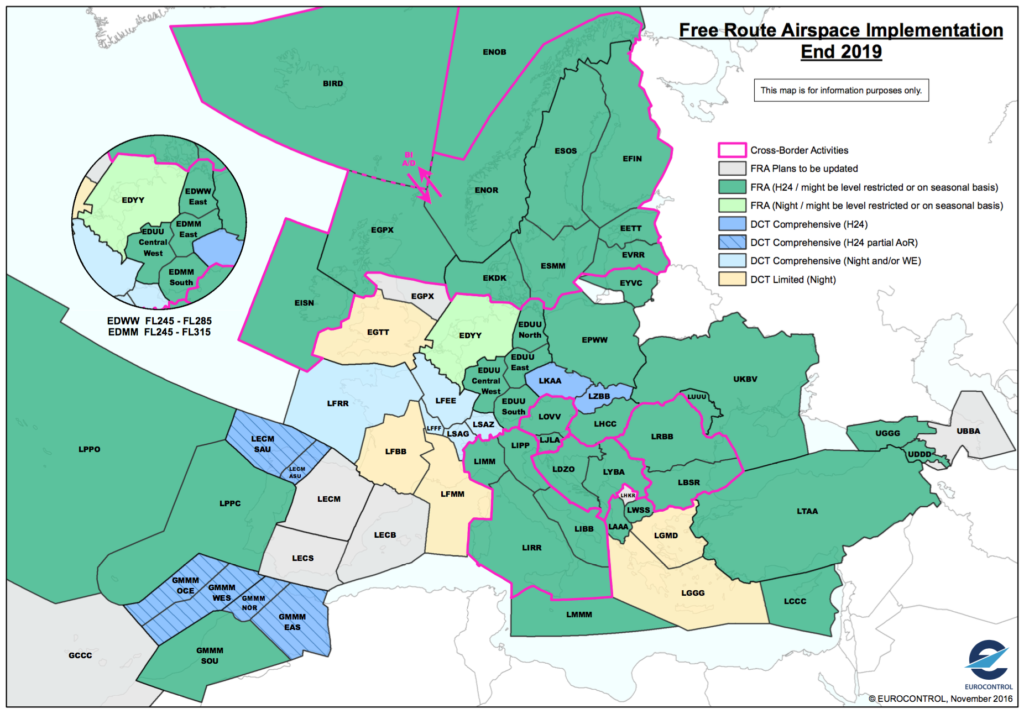
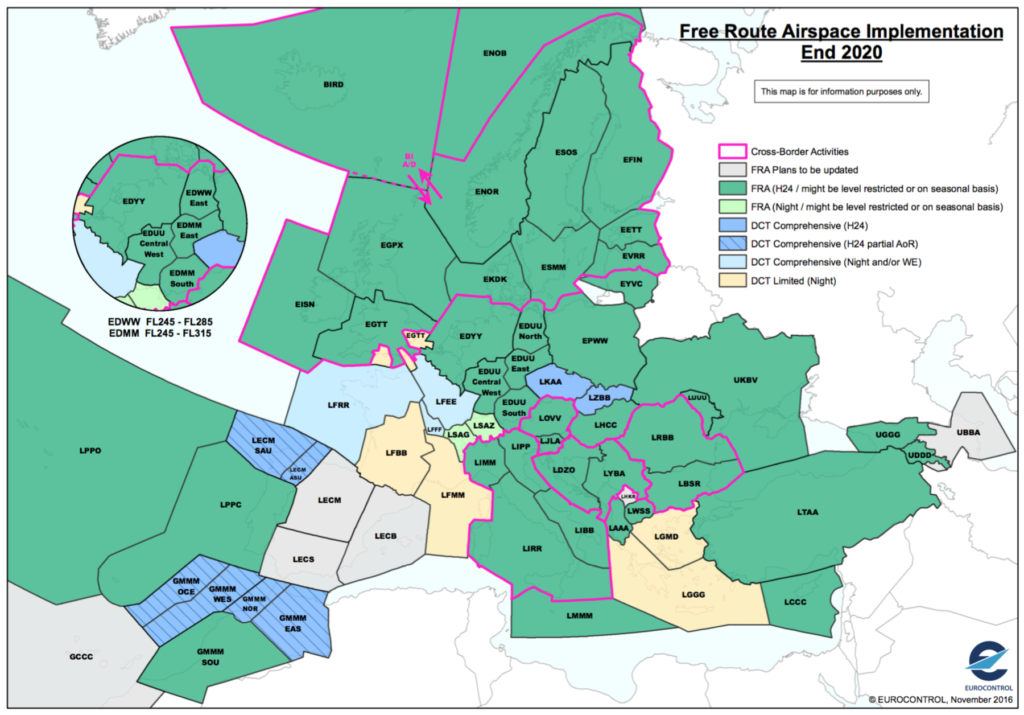
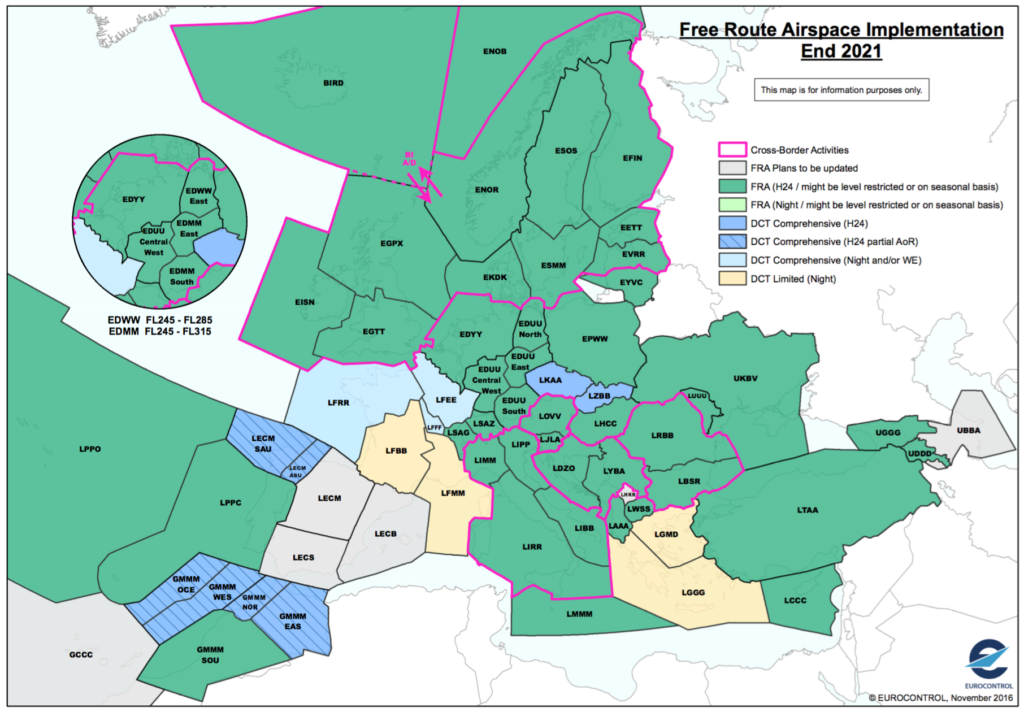
By the end of 2019, most European airspace is expected to have implemented Free Route Airspace, with all airspace having this type of operations by 2021/2022.

We like the idea of Free Route Airspace – direct routing is the way of the future. We also like cool maps. Thankfully, good old Eurocontrol have provided us with some great ones, showing where Free Route Airspace currently exists, and where it will be implemented in the future:

For everything you could possibly want to know about FRA in Europe, check out Eurocontrol’s page on it here: http://www.eurocontrol.int/articles/free-route-airspace