Lithium Battery Fires, New Safety Alert: What Are The Rules For Part 91?
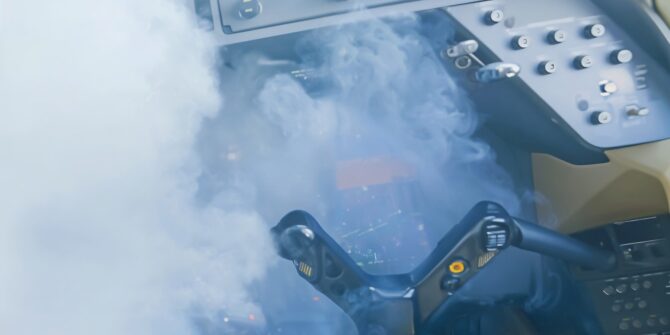
The risk of lithium-ion battery fires on aircraft is on the rise, with vapes, power banks, and laptops identified as the main culprits.

The FAA has reported a sharp rise in incidents, with some sources noting two thermal runaway events per week. EASA also raised concerns, issuing a new Safety Bulletin on May 27.

While rules are strict for Parts 121 and 135, private flights under Part 91 face fewer restrictions. Arguably, private jets are more at risk, and we’re doing less to protect ourselves.

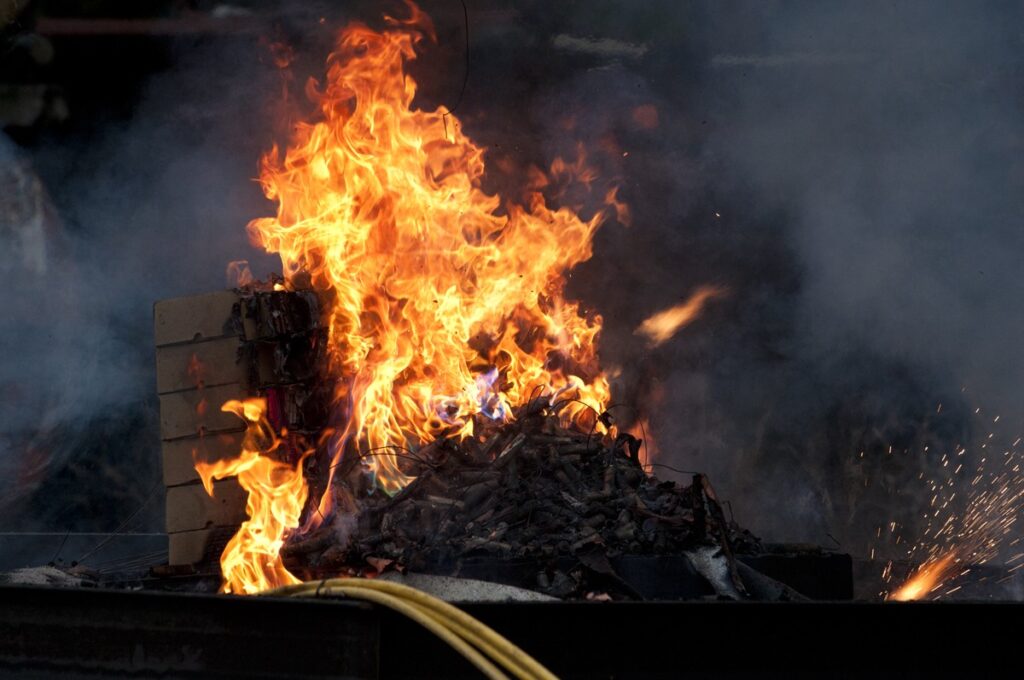
  • Business jets are smaller. A lithium-ion battery fire can quickly fill the cabin with thick, toxic smoke – up to 10 cubic meters from a single laptop battery in just two minutes. History has shown that smoke inhalation often causes the loss of an aircraft in a fire before the fire itself.
  • Fewer crew members.With only one or two pilots and often no cabin crew, response capability is limited.
  • The passengers we carry. Biz jet passengers often carry multiple personal electronic devices which increases fire risk. Some passengers may disregard or not correctly follow safety rules.
  • Less safety equipment.Compared to airliners, biz jets typically have fewer fire suppression tools and less protective gear on board.
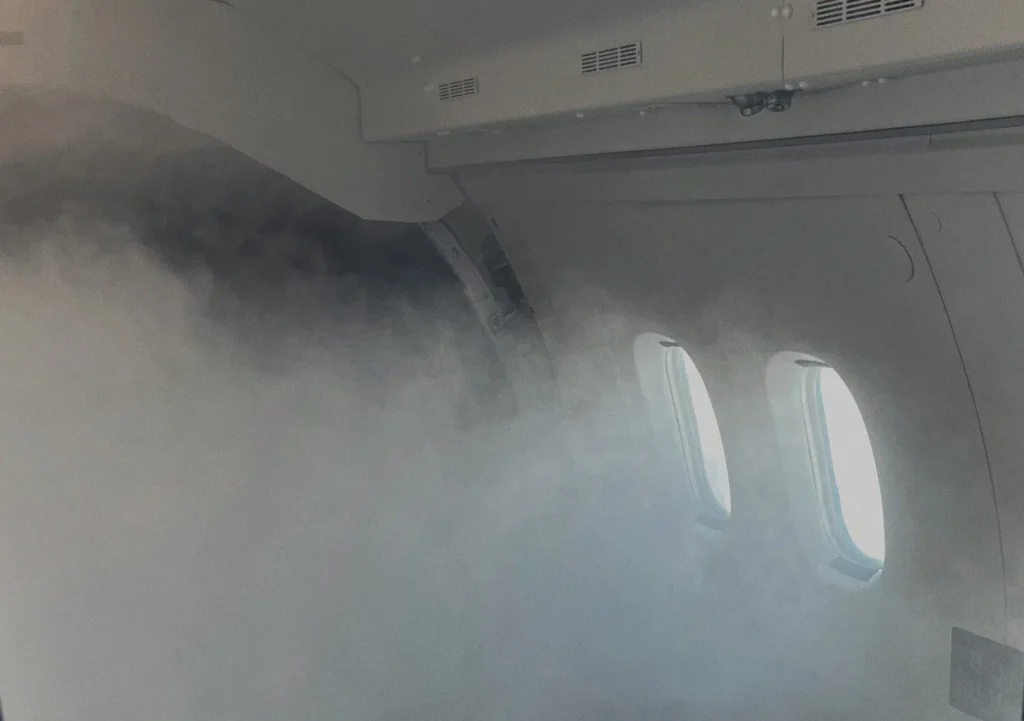
Lithium battery fire smoke contains an unbreathable mix of chemicals including corrosive irritants like phosphorous oxide and hydrogen fluoride.

It seems clear that for the few rules that exist for Part 91 operations, we must be aware of them, and stick to them. And it may come as a surprise to some operators that these rules are more strict when you fly internationallyeven privately.

So here’s a rundown of what you need to know.

A word about lithium-ion batteries

If you’re already familiar with a Wh rating, feel free to skip to the next section. But to understand the rules properly, it helps if you’re familiar with it first.

Watt on earth is a watt-hour (Wh)?

When we talk about how dangerous a lithium-ion battery could potentially be, we talk watt-hours. It is a measure of how much energy a battery can store and use. Think of it like the amount of fuel in a tank – it simply tells us how much power (watts) it produces over time (hours).

It also directly proportional to fire risk. If something goes wrong, all that energy can be released as heat and gas. The more in the tank, the bigger the fire.

The higher the Wh, the hotter the flames, the thicker the smoke, and critically – the harder it is to put out.
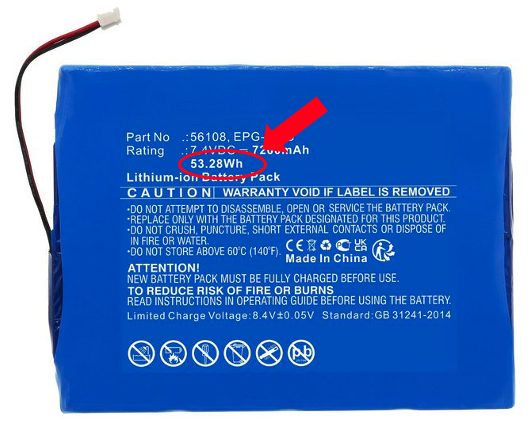
Check the battery label for its Wh rating.

Righto, onto the rules for US Part 91.

Part 91

For domestic flying in the US under Part 91, the rules for lithium-ion batteries are pretty simple.

If the batteries are being carried for personal use, Part 91 operators are (almost) entirely exempt from the US D.O.T. HAZMAT regulations that apply to commercial flights. But it’s not a free-for-all.

The PIC is still prohibited by law from carrying hazardous items onboard an aircraft in a way that might endanger people or things. This includes knowingly carrying defective batteries or packing them in a way that is dangerous or irresponsible.

Baseline safety guidelines still apply, including FAA Advisory Circulars (AC 91-78, AC 120-76D) -along with relevant Safety Alerts for Operators (SAFOs). Deviation from these can expose the operator/PIC to legal liability in the case that something bad happens.

Here’s a summary of those:

Installed batteries (in devices):

Carry these without restriction if they’re properly secured within the equipment, show no visible damage (like swelling or leakage) and are turned off.

Spare batteries:

These must be carry-on.

  •  Little ones (100Wh or less): There’s no limit on the number carried, but each one should be protected from short-circuits (case, sleeve, taped terminals or original packaging).
  • Bigger ones (101 – 160Wh): FAA guidelines say no more than two per person. These must be individually protected using the same precautions above.
  • Biggest ones (161Wh+): Not allowed without full HAZMAT compliance and operator approval. Requires UN spec packaging, shipping papers, training etc. BE CAREFUL – some higher end power banks exceed this limit.
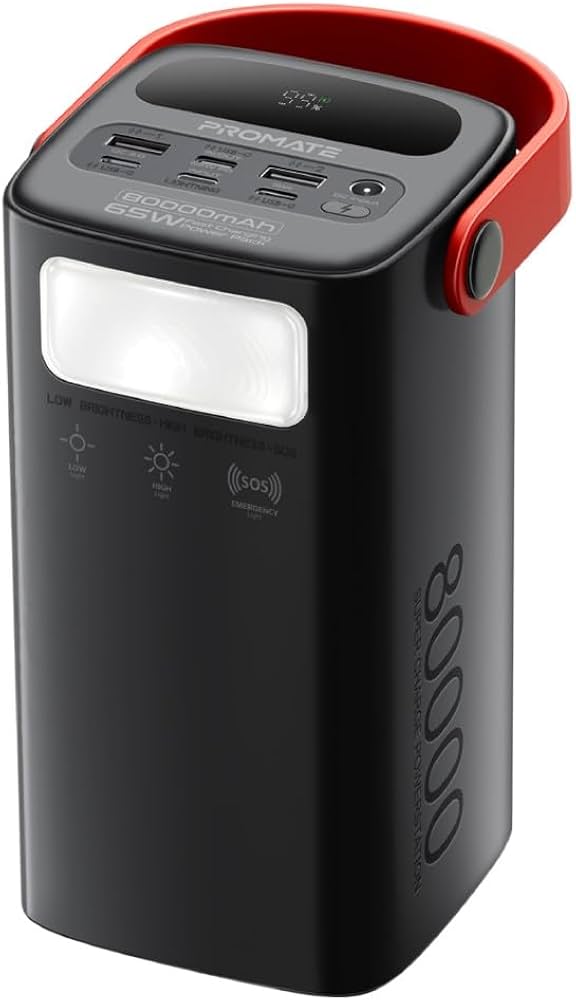
Power banks are treated as spare batteries – this unit is equipped with a battery that exceeds 290Wh.

International operators beware!

Here’s where things get a little tricky.

Once you leave the US, some authorities no longer recognize the distinction between Part 91 (private) and other commercial flights.

Foreign authorities may enforce local rules for the batteries you carry – regardless of your Part 91 status. These are usually based upon IATA Dangerous Goods Regulations. Reportedly, this includes China, Thailand, Korea, India and the UAE.

In other words, what was acceptable in the US may not be once you’re abroad.

Foreign handlers may refuse to load spare batteries that don’t comply with IATA standards, while customs and ramp safety officers may demand battery specs and proper packaging – especially for devices like power banks, drones, camera gear and e-bikes. Devices may be confiscated if they do not comply with local guidelines.

The best solution? Just comply with IATA standards from the outset.

Where do I find these regs?

If you want to get technical – they’re defined in ICAO Doc 9284 (ICAO Technical Instructions for the Safe Transport of Dangerous Goods by Air), and further refined under the IATA Dangerous Goods Regulations.

These include packing instructions, required documents, limits of watt hour ratings, the quantity of batteries, labelling and distinctions between passenger and cargo aircraft.

Three million pages of DG-related dread building? Worry not. We’ve put together a quick checklist of requirements/suggestions for Part 91 operators to help them stay out of trouble when carrying batteries outside of the US:
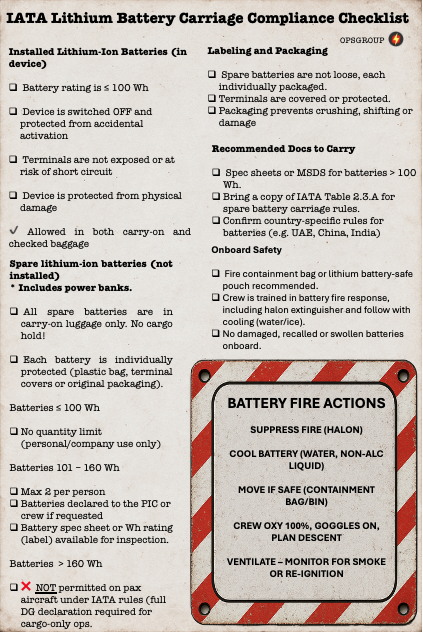
Click to download PDF.

Fire containment

You might already have fire containment bags onboard, but there are other types of containment devices worth considering.

Some of the newer hard-sided designs offer features like hands-free collection, blast protection for the user, and the ability to inject water to help interrupt thermal runaway. Check out this one!


These boxes aim to reduce the risk to crew during an incident and address some limitations of soft bags, which can be difficult to use safely without two people – a challenge on smaller aircraft operating under Part 91 or 135. With recent incidents showing how violent lithium battery fires can be, having an effective containment method onboard is increasingly important.

Don’t forget to report

For Part 91 private flights, the US FAA requires operators to report any case of battery fire, smoke, overheating or thermal runaway aboard an aircraft within 72 hours. The form for this is DOT 5800.1.

ICAO may also require a report if the event qualifies as a serious incident or accident. You are not required to report directly to IATA – it’s only voluntary.
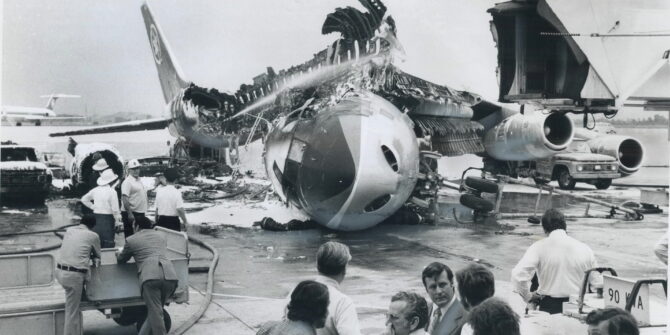
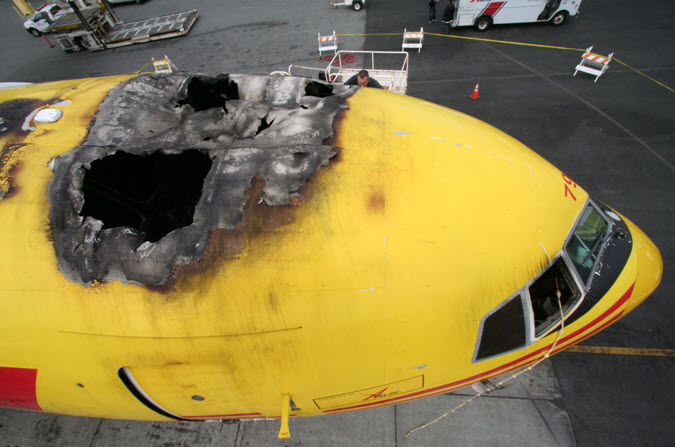
Fire Onboard: A Pilot’s Worst Fear?

Ask a pilot what their worst fear is and one of the responses you will probably hear the most is FIRE! Ironically, an aircraft’s engines only actually work when they are “on fire” so not having a fire “onboard” could be problematic…

But a fire in the cabin or cargo hold is a rather different deal. So, here is a look at what many consider to be one of the most challenging and concerning problems they could encounter in-flight.

For those who don’t think it is that scary.

A CAA study back in 2002 looked at aircraft crashes due to fires onboard and discovered a rather fearsome statistic – the average time it took for an aircraft to become catastrophically uncontrollable was under 20 minutes. Various fire tests saw that a fire allowed to spread through the aircraft’s overhead area could become uncontrollable in just 8-10 minutes.

The average time for a crew to get their aircraft onto the ground was around the 17 minute mark.

So, not much time to spare.

The infamous Nimrod ditching (a favourite CRM example of decision making) shows how quickly a fire can disable an aircraft.

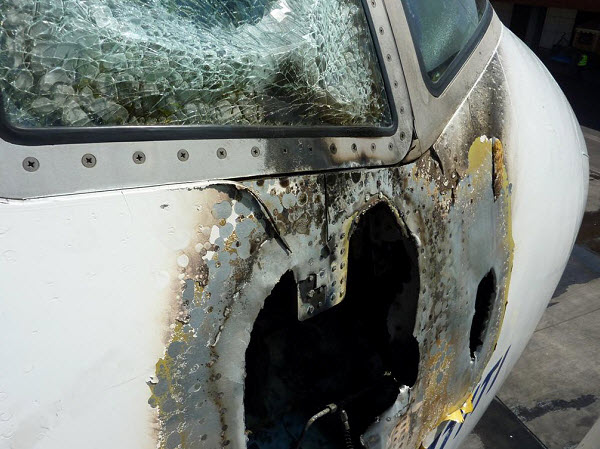
The problem is aircraft are built to burn.

Well, not literally, but there is a significant amount of flammable, combustible and generally burnable bits onboard. Add in the fact there are very hot bits (the engines) linked to big chambers full of fuel and the risk of an un-contained fire suddenly seems a lot worse.

Un-contained being the important word here.

Engines have fire identification and protection systems in them. So do cargo bays. So do cabins for that matter (Cabin Crew make wonderful fire detection and fire suppression systems). Aircraft interiors, and cabin fire fighting procedures, and the monitoring of Dangerous Goods transit have also developed significantly over the last decade or two.

So, the means to prevent or control fires before they become uncontrollable have increased.

Unfortunately, though, so have the number of devices coming onboard which could start a fire in the first place.

Lithium Ion batteries burn hot. They are hard to put out, and every passenger on your flight probably has at least one, probably nearer three of them (phone, second phone, computer, tablet, smart luggage, spare power banks, watches, electric toothbrushes…)

And of course phones are not the only potential fire hazard onboard. There are ovens (hot), hydraulic fluid (thankfully not in the cabin, but very flammable), electrical things (seats, tvs, lights), waste bins (in toilets for hiding illegally smoked cigarettes in), oxygen systems (a food delicacy for fires) and a multitude of wires.

An FAA study from 1995 to 2002 found reports of nearly 400 wiring failures. 84% of these were burned, loose, damaged, shorted, failed, chafed or broken. And this is probably not a representative number given how many might go unreported.

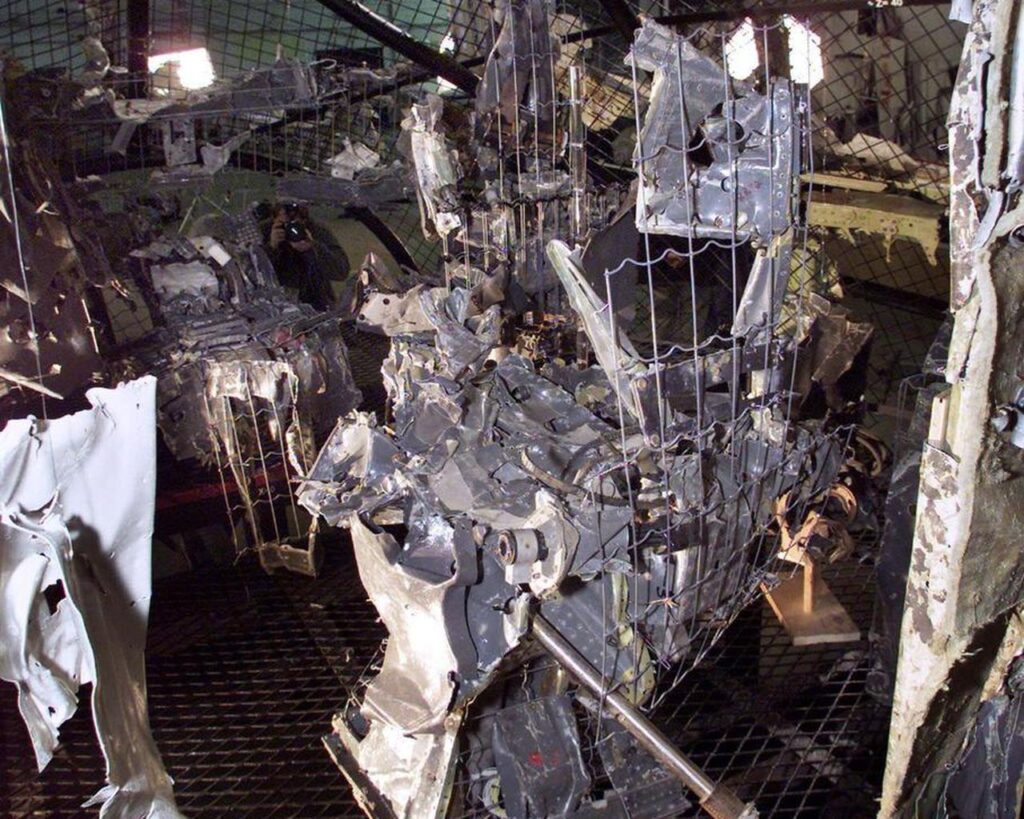
The Swissair accident was due to faulty wiring, with a secondary prominent factor being the flammability of materials that ignited and propagated the fire. The crash occurred just 16 minutes after the first alert message.

Let’s take a look at what can burn in the cabin.

Seat coverings, blankets, cushions, other furnishings, clothes… basically everything inside the cabin can burn.

In 1993 a Northwest Airlines B727 had a fire in the cabin and it turned out they were using 100% polyester blankets. Polyester actually melts more than burns, but it gets really hot when it does and tends to set alight to everything else around it. The incident led to the FAA developing new fire performance test methods and criterion for all blankets.

Interesting fact: Emirates actually make their economy blankets out of recycled plastic bottles. 28 of them per blanket.

Actually, the burning ability of everything onboard is now monitored.

Since 1990, aircraft interiors have had to comply with a maximum total heat release of 65 kilowatt minutes per square meter, and specific optical smoke density of 200. Basically burn less, burn less hot, and put out less smoke if they do burn.

The current rules for what everything should be made of, and how burny/smoky/toxic they can be are contained in FAR/JAR/CS 25.853.

Crew training is important as well.

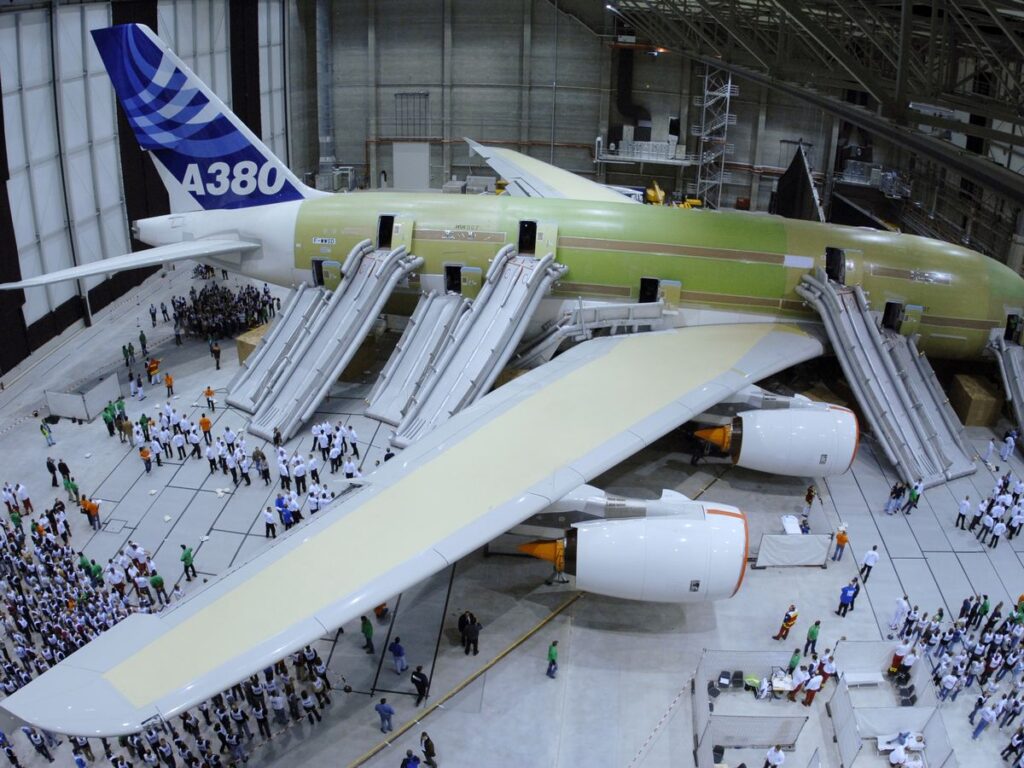
The training and ability of the crew to both fight the fire, and evacuate the aircraft is strictly monitored. The FAA require that an airplane can be evacuated in 90 seconds. For big commercial aircraft (these are Boeing stats) this means the slides have to be able to inflate within 10 seconds (15 if it is a big wing slide), and they need to be able to support 60 people sliding down at once.

It doesn’t take into account the huge heap of people at the bottom of the slide, but once they are out and away from the fire all bets are off.

But accidents still happen.

Between 1990 and 2010 there have been 18 major accidents involving in-flight fires which resulted in fatalities. During the 1990’s, the US saw, on average, one flight a day diverting due to smoke; and a report by IATA suggests there are more than 1,000 smoke related events annually.

That’s about 1 in 5,000 flights which is a pretty big number when you consider how many flight you will do in your career, or how many movements there are worldwide every day.

In 2010, a UPS B747 freighter crashed in Dubai following a main cargo deck fire which ultimately led to loss of control of the aircraft. The pilots were incapacitated earlier however due to the rapid build up of smoke in the flight deck.

What to do. The important bit.

1. Troubleshoot.

Finding the source should be a top priority. That means working out where the smoke is coming from.

If it is coming from something avionics related then you are going to want to switch it off. If it is something in the cabin then it might be locatable, reachable and extinguishable. Don’t forget to get your crew to check the lavs.

2. Communicate.

One of the biggest challenges in dealing with a fire in the cabin is the communication between the cabin and the flight deck.

  • Ensure there is a communicator in place who can pass messages to you and keep you updated.
  • If you are trying to establish the severity of the situation, ask open, non-leading questions:
    • “How much smoke?” could lead to “lots/loads/not as much as you’d see at a rock concert in the 60s…” . Instead, try “How many rows of seats can you see?”
  • Establish whether they can see where the smoke is coming from, if they can get to the source, and if they can put it out:
    • Ask about the colour, the smell, and while troubleshooting make sure you leave enough time for them to identify a change (after turning stuff off or on).

3. Keep flying!

Don’t forget to keep flying – one pilot should focus on the fire procedures (or on the comms with the cabin) while the other flies the aircraft! This probably means aiming for an airport.

Declare an emergency – this can be downgraded later if the situation improves, but get the support you need early on.

If there is an autoland option you might want to set up and plan for that in case the smoke in the flight deck builds up too much.

4. Don’t forget…

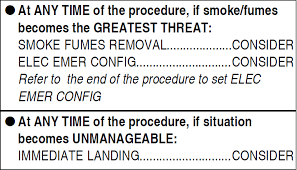
You have two procedures – one for sourcing and “fighting” the fire, and one for dealing with smoke (and fumes). If you need to, suck that smoke out!

On the ground.

Your Ops Manual will have a required RFF category for airports. However, this is based off the equipment available at an airport (and the response time). A Captain can chose to disregard this if the only option does not meet their RFF requirement.

The emergency isn’t over until you and the passengers are safely off. If the cabin is filling with smoke then a top priority is getting those engines switched off so your cabin crew can evacuate. If in doubt, evacuate!

Depending on where the fire is (and how the wind is blowing) you might need to avoid evacuating through certain doors. Getting folk away from the aircraft is critical. The main injuries resulting from the Emirates B777 accident in Dubai were some inhalation from passengers and crew, and heat stroke from the firefighters – it took 16 hours for them to bring the fire under control.

What to do earlier…

1. Have a plan

This means knowing what airports are around that you could go to if you suddenly, urgently need to. 

  • Check the weather and Notams en-route.
  • Have something in the box ready (if it is a difficult airport to route to, or there is airspace to avoid, or if a straight in visual might not be an option).

2. Know what equipment you have onboard.

Know what it is, where it is, and how to use it:

  • Halon: Great for electrical fires, not so good for you. If you are using this in the flight deck, get a smoke hood or oxygen on first.
    • Remember PASS: Pull the pin, Aim at the base of the fire, Squeeze the handle or lever, Sweep it about from side to side like an aggressive elephant.
    • EASA are recommending the removal and substitute of Halon Extinguishers because of their mean effect on the environment, and also on people.
  • Oxygen masks: If there is smoke in the cabin, don’t drop these thinking it will help your passengers breathe better. Oxygen + Fire = not a good result, and their masks are not designed to keep smoke and fumes out anyway.
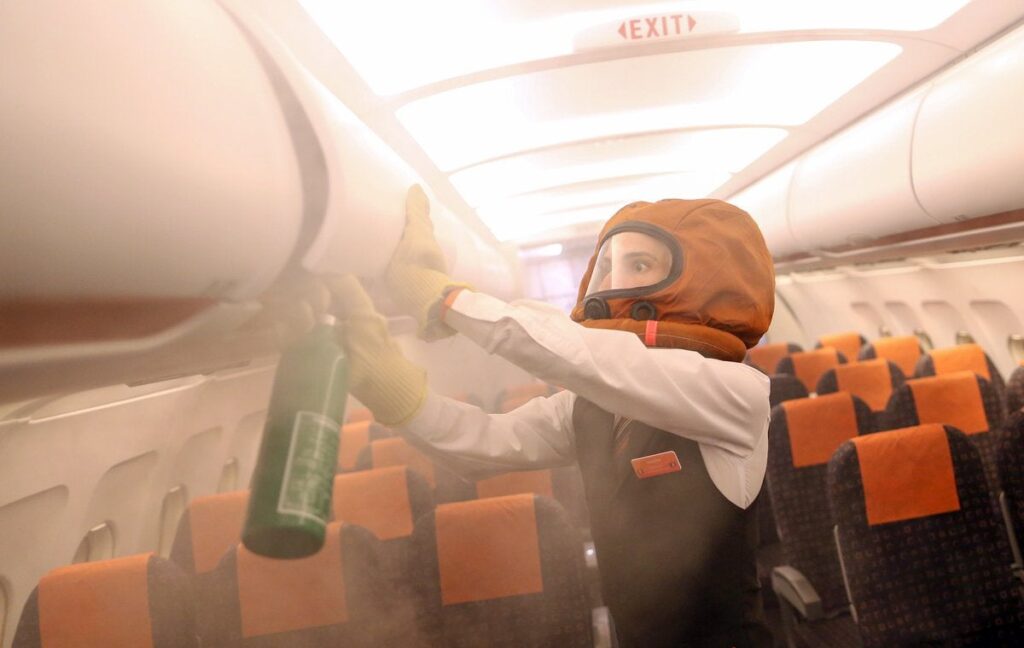
  • Smoke hood: You look like a weird spaceman in it, and sound like Darth Vader, but this is a very important bit of equipment.
    • If you are on the ground and evacuating, use this before doing the cabin checks.
  • Fire Sock: For putting things in. Usually has some gloves nearby for picking the hot burning thing up with.

False Alarms

These do happen.

An IATA study saw 2,596 reports of fire/sparks/smoke or fume occurrences. Of these, 20% were false warnings, which meant 11% of the in-flight diversions were due to false warnings. 50% of cargo compartment fire warnings were also false.

Air spray is a common culprit for causing false alarms in toilets.

But – if you get a fire warning, treat it as real unless there is some very, very obvious something to suggest it is not. 

FIRE!

They critical thing is to be prepared. Have that airport option in mind, know where to find the procedures (and familiarise yourself with them), and make sure that if it does happen, you and your team are ready.

A fire onboard is a time issue. Being prepared and ready will hopefully give you those extra minutes that could make a big difference.

Burning desire to read some more?


Red Sky at Night, Aviator’s Fright

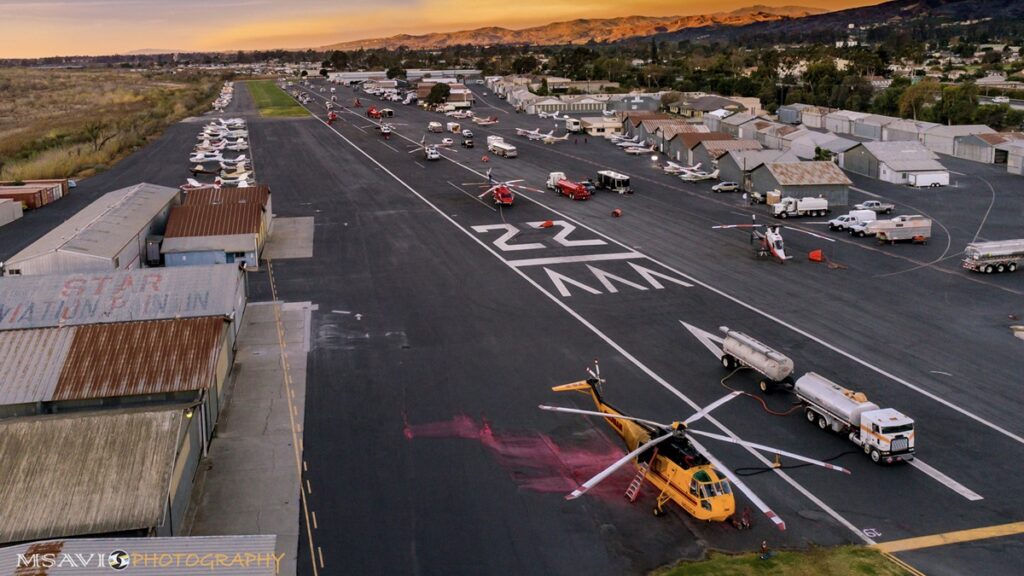
Summer in the Northern Hemisphere means a few additional challenges for aviation, particularly in the USA – Hurricanes (which we wrote about here) and Wildfires.

You probably read ‘Hurricanes’ and think yeah, I get that, but fires?

Wildfires do pose a fairly major risk to aviation though, so we thought we’d take a quick look at what those risks might be and what the forecast is for the 2021 Wildfire season.

Too hot to handle.

Wildfires are prevalent across the US during the hotter summer months, typically running from May through October.

Looking back to previous years, California saw 13 fires in 2019, but over 30 major ones in both 2018 and 2017. The 2018 fires led to over 1.8 million acres of land being burned. 2020 saw the first ‘rain free’ February (in San Francisco) since 1864 and the drier months, and warmer spring resulted in some of the worst wildfires in California’s history. 

The outlook for 2021 is not much better. 

There have been extended dry periods with over 90% of the West now in drought conditions. There have also been record high temperatures in the Pacific Northwest, Northern Rockies and northern Great Basin with warmer than normal conditions forecast for the summer. Add to that an increase in lightening activity and you are left with a recipe for significant wildfire risk.

In fact, the figures so far for 2021 are already at a ten year high.

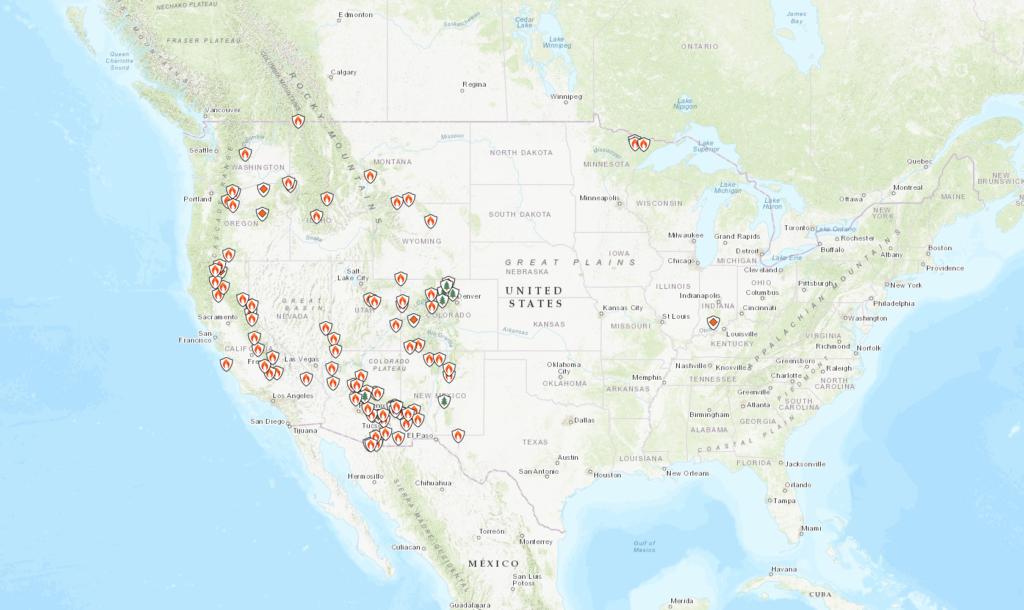
Where can you monitor the fires?

There are multiple sites which track and monitor wildfires. This is a particularly good one and will link to specific info on the major fires.

But the risk to aviation is often not from the fires themselves. The big hazards comes from:

  • Smoke
  • Increased traffic levels, diversions and ATC capacity
  • Changes to localized weather conditions.

Out of the frying pan and into the fire.

Major airports generally have good protection from wildfires, and are a distance away from areas which will readily burn. However, smaller and more remote airports may not and damage to infrastructure, or disruptions to ground transport has a knock on effect. Fires also lead to power outages which impact services at the airports.

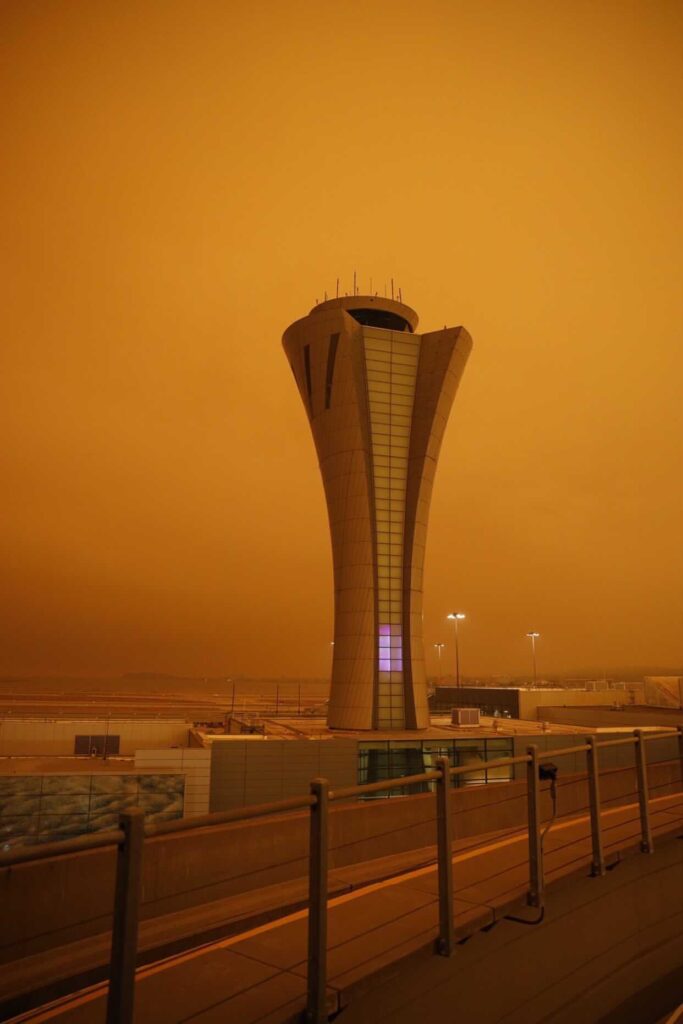
The major hazard comes from smoke though, and this can cause significant disruptions through reduced visibility.

Smoke has been known to reduce visibility to around 200m. In 2005 all four major airports in Honduras closed because of limited visibility from wildfires. In 2010, the visibility at KBOI/Boise Municipal Airport reduced from 10 miles down to 1 3/4 miles in just 9 minutes after a shift in wind direction carried smoke from nearby wildfires into the airport vicinity.

KSFO/San Francisco has also experienced delays and cancellations due to smoke from nearby Butte Country wildfires.

While Sonoma Country airports faced multiple closures in 2019.

Then there is the reduced Air Quality.

The health hazard this poses to ground workers means airports may find themselves understaffed and reduced resources lead to reduced services, which lead to more disruptions for aircraft and operations.

The smoke hazard isn’t just at ground level.

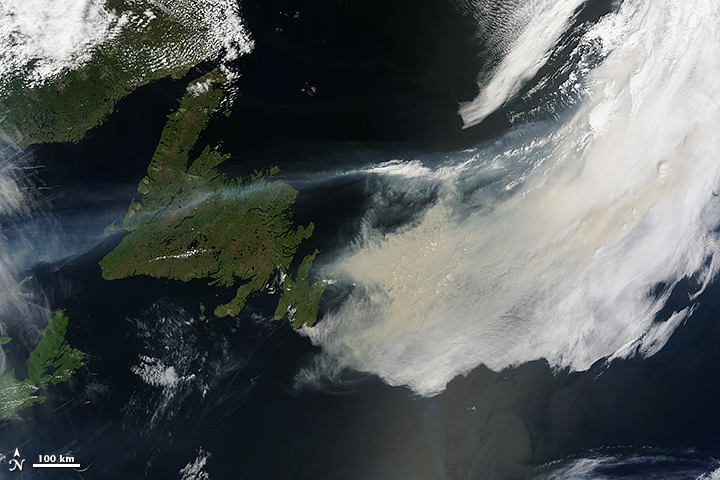
In 2013, a NASA satellite captured images of smoke from Canadian and Colorado wildfires which extended over the North Atlantic, and in 2020 an aircraft diverted into CYYT/St John’s after smelling fumes in the flight deck which were attributed to wildfires (again in Colorado).

What’s cooking.

Disruptions at airports lead to increased traffic levels requiring ATC support for diversions.

Smaller, regional airports have less capability for dealing with the impact of nearby wildfires, and when small regional airports in areas like Oakland, San Jose, Silicon Valley which have a high density of private jet traffic close, this can mean a lot of diversions happening very suddenly, and where they go can becomes an issue.

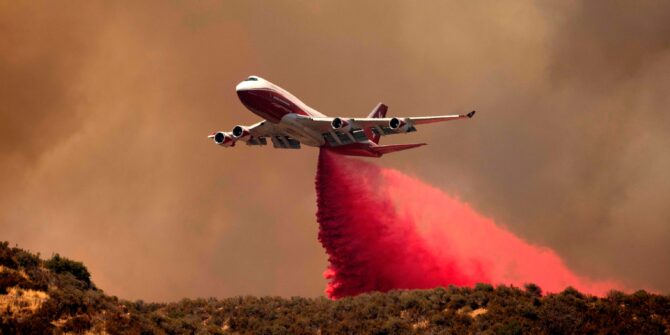
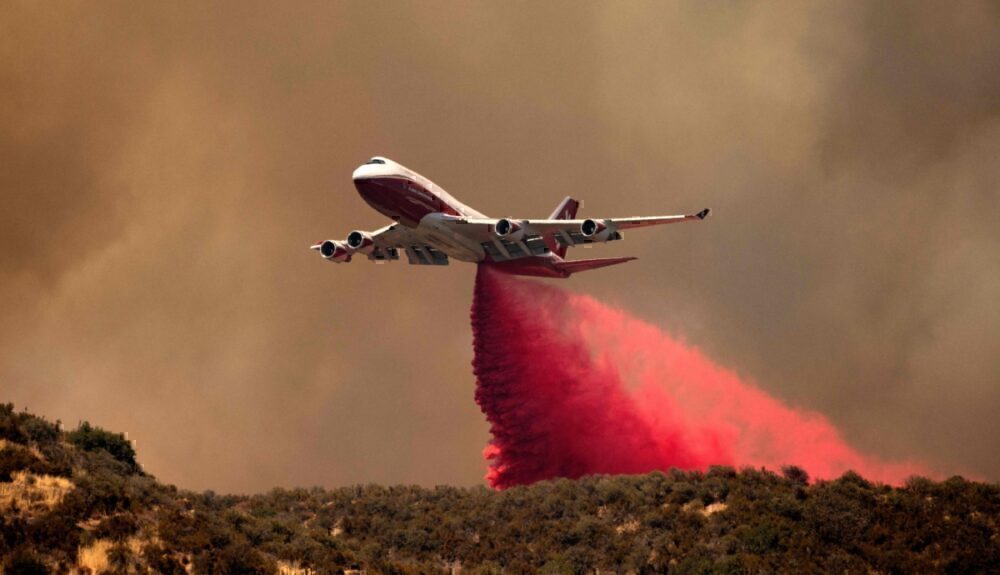
In addition to diverting aircraft, there is the firefighting aircraft to factor in as well. They might operate low-level, but they are not small and they need to operate from somewhere and this is added pressure for ATC.

MD-10s and BAE 146s are commonly used. The world’s largest is a B747 Supertanker which can carry up to 19,600 US gallons of fire retardant or water.

TFR zones are set up for major fire zone areas to allow for safe movement of the firefighting aircraft. You can check these here.

Where there are fires, the risks of incidents increases and between 2000 and 2013 there were 298 wildfire firefighter fatalities in the US. 26% of these were caused by ‘aviation associated’ activities which occurred across 41 separate events involving 42 firefighting aircraft. Three of these were midair collisions.

Pyromania.

Wildfires can impact the weather environment as well.

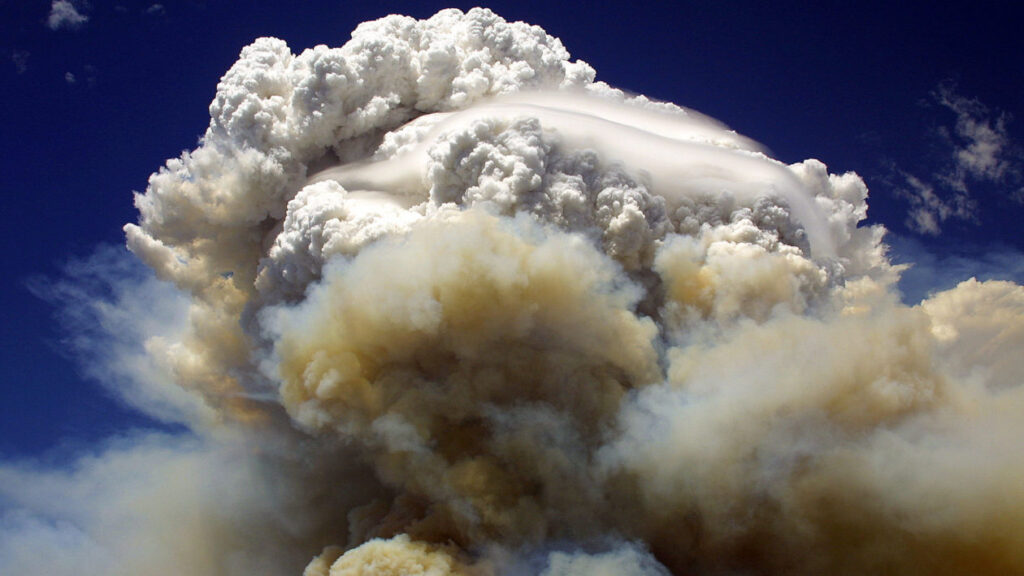
When large enough, Pyrocumulus cloud (also called Flammegenitus clouds) filled with rising ash and aerosols can build. These aerosols often carry a charge that increases the likelihood of lightning and with that an increased chance of fires spreading rapidly.

The “Station Fire’ of 2009, which burned more than 160,000 acres just outside of Los Angeles, also produced a convective column estimated to reach around 23,000 ft. Other majors fires have produced ones reaching as high as 40,000 ft.

These huge clouds are similar to cumulonimbus, only without rain. But they still contain significant up and downdrafts and can result in localized wind shear from gust fronts. The change in ground temperatures can result in significant thermals and large temperature gradients can result in significant localized vertical and horizontal winds.

There are ways to help.

Check those TFRs and check the wildfire maps. If you are operating into an area showing significant activity, consider how much busier ATC might be, and remember to check the capacity at your airport destination.

Report fires when you see them. Early notification of developing fires means the authorities can deal with them quicker, before they grow out of control.

Consider other ways to help. If you have an aircraft available, consider using it to help with evacuation flights. Airlines pulled together in 2016 following some major fires in Canada, and helped evacuate more than 80,000 residents. They also helped them bring their pets out safely. Be warned – you will have a tear in your eye after reading this one so open at your own risk!

The Forecast

There is a full seasonal outlook published here. But for a quicker summary of the 2021 Wildfire Forecast:

  • Alaska has ‘normal’ fire potential through summer and into the fall.
  • The Northwest is expected to experience significant and above average fire potential into September.
  • Northern California and Hawaii also have above normal significant fire potential expected.
  • Southern California will be at high risk through September (although this is ‘normal’ for the region).
  • The Northern Rockies region is expected to be above normal through August and September.
  • The Great Basin is expected to see increasing fire potential through August and possibly into September
  • The Southwest is expected to remain normal.
  • The Eastern Area is expected to be normal.
  • The Southern Area is expected to be below normal.

Wildfires pose a significant risk to aviation operations. They also pose a huge risk to those living there, the infrastructure and the economy. The Fire Fighter pilots are an extraordinary bunch of aviators and we wish them the best for this year.

There is a very interesting podcast available here if anyone wants to hear more about what their ‘Day at Work’ involves.