Gabon Military Coup: Airspace Reopens
Update: 4 Sep 2023
Air borders in Gabon have reportedly been reopened following last week’s coup. The UK FCO have posted an update here. From a security standpoint, not much has changed though – the situation is still volatile, and scheduled carriers continue to avoid landing at FOOL/Libreville. Military action by neighbouring countries is still a possibility at short notice.
Original Story: 31 Aug 2023
- There was a military coup in Gabon on Aug 30. The military group dissolved institutions, cancelled the Aug 26 election results, and closed the country’s borders until further notice.
- Heavy gunfire was heard in the capital, Libreville, during the coup attempt, but the situation was calm in the capital and across the country as of Aug 31.
- Notams were vague, but several sources reported that Gabon’s airspace was closed, along with all airports in the country.
Airport and Airspace Info
Notams were published for Gabon under the FCCC/Brazzaville FIR code, advising that the country’s air, sea and land borders are closed:
FCCCYNYX
(A0913/23 NOTAMR A0907/23
Q)FCCC/QXXXX/IV/NBO/E/000/999/0043N01655E 999
A)FCCC B)2023-08-30 16:10:00 C)2023-09-02 23:59:00 EST
E)FOLLOWING THE CURRENT EVENTS IN THE REPUBLIC OF GABON,THE AIR,LAND
AND SEA BORDERS ARE CLOSED FROM THIS DAY ON THROUGHOUT THE NATIONAL
TERRITORY)
These Notams might not show up on conventional Notam search engines (the FAA one, for example, does not show them), so you have to use the ASECNA Notam search instead: https://ais.asecna.aero/fr/ntm/notam.php
It wasn’t 100% clear from the Notam if the airspace was closed for overflights, but several sources including Royal Air Maroc and the Netherlands Government said that the airspace was closed.
Where are we talking about?
Gabon sits in the middle of the FCCC/Brazzaville FIR:
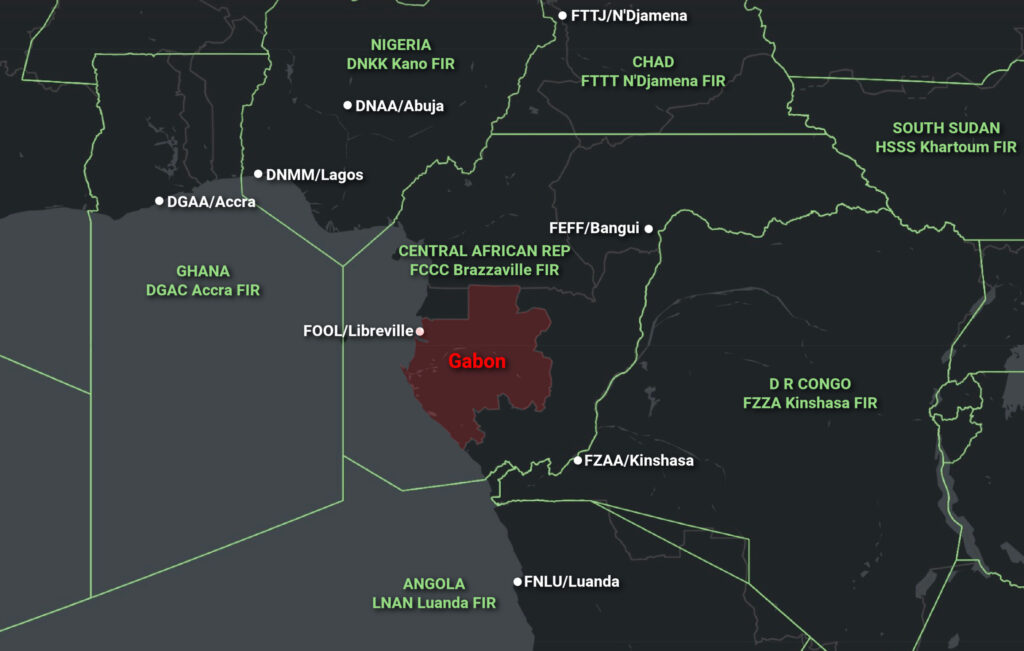
Overflights of the FCCC/Brazzaville FIR outside of Gabon were not affected.
For overflights of Gabon itself, most operators avoided the airspace. In the ASECNA AIP, there is a Contingency Plan for routes through the Libreville UTA, although this didn’t seem to be activated at any stage.
Here’s what that looks like:
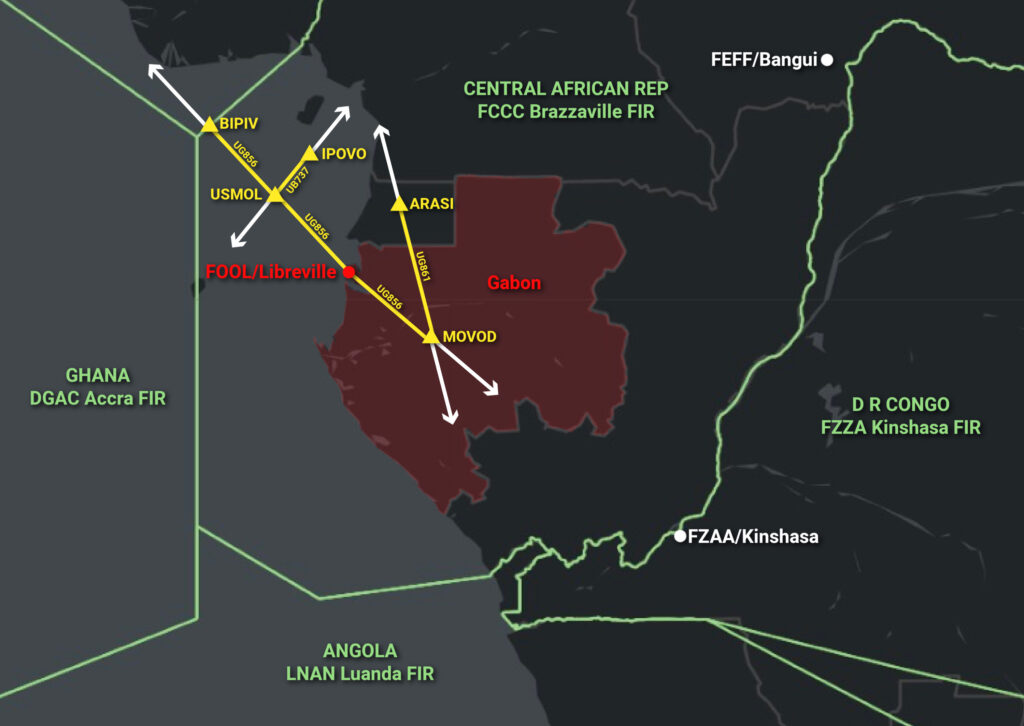
Contingency Routes through the Libreville UTA.
- (UG856) BIPIV/MOVOD FL290, FL390 SOUTH-EAST BOUND
- (UG856) BIPIV/MOVID FL300, FL400 NORTH-WEST BOUND
- (UG861) MOVOD / ARASI FL340, FL360 NORTH-WEST BOUND
- (UG861) MOVOD / ARASI FL330, FL350, FL370 SOUTH-EAST BOUND
- (UB737) IPOVO / USMOL FL280, FL320 SOUTH-WEST BOUND
- (UB737) IPOVO / USMOL FL270, FL310 NORTH-EAST BOUND
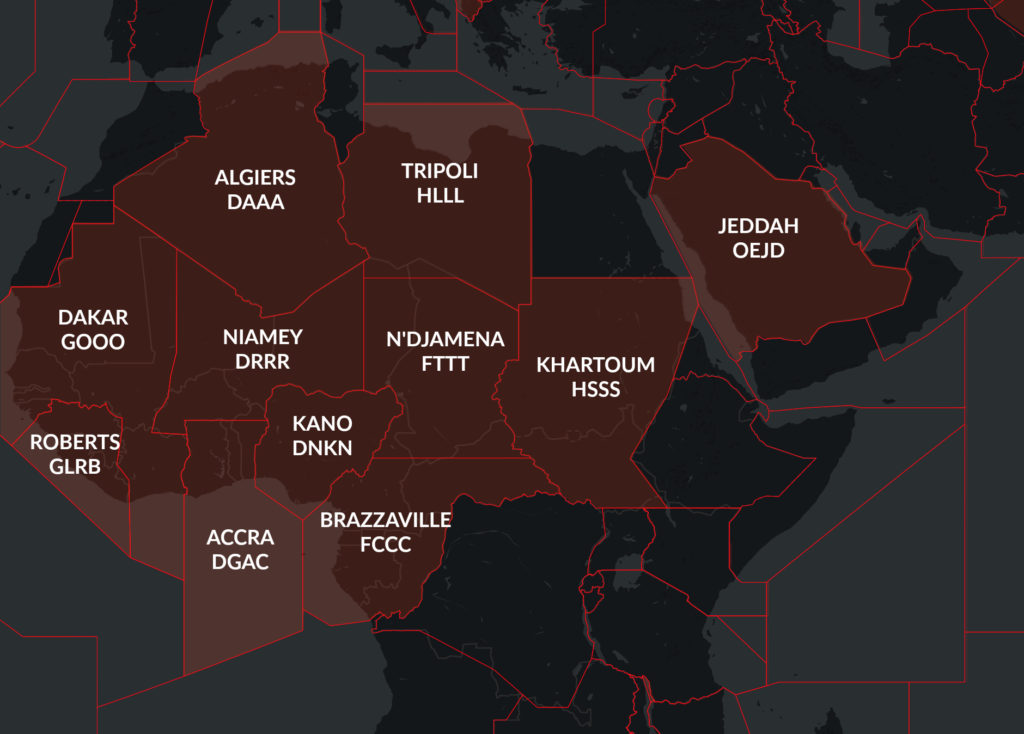
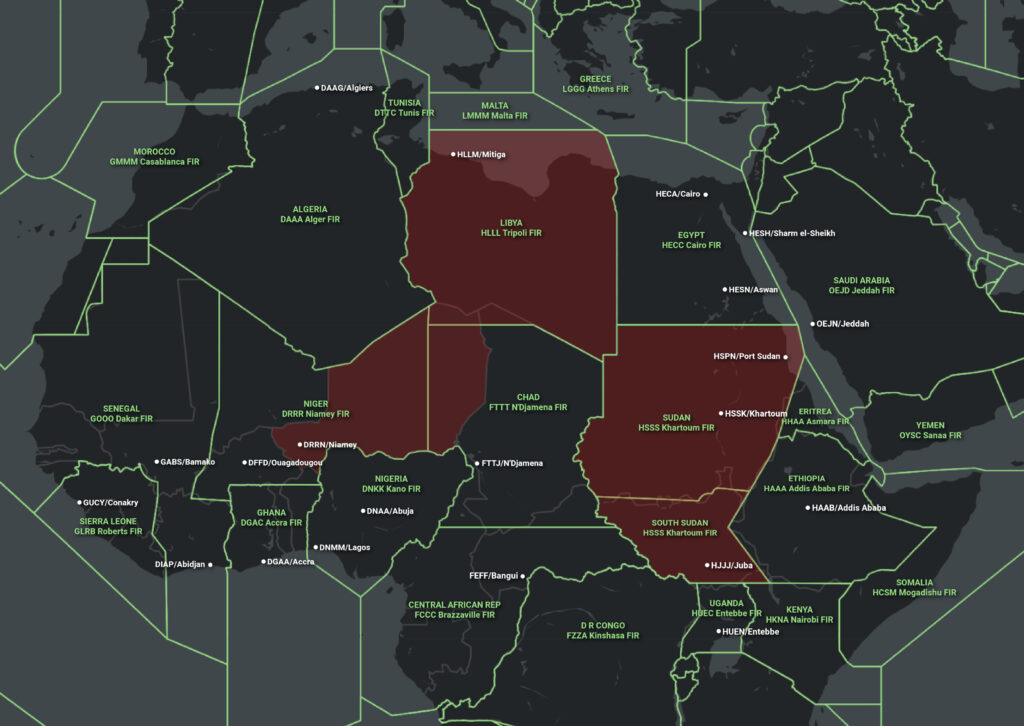
Note that with the ongoing closure of airspace in Niger and Sudan, plus the airspace risk in Libya, this has already created challenges for traffic routing through Central Africa:
- Niger: Airspace remains closed to all civilian flights following a military coup in Aug 2023. More info.
- Sudan: Airspace remains closed to all civilian flights following a military coup in April 2023. More info.
- South Sudan: Air navigation services remain suspended above FL245 following the coup in Sudan. More info.
- Libya: Flight ban for US and UK operators (several other countries have warnings in place) due to risks associated with the civil war that has been ongoing since 2014. More info.
We’re continuing to monitor the situation closely. If you have any updates to share, please contact us at news@ops.group.