Santorini Shaking: State of Emergency In Effect
Key Points
- Santorini and neighboring islands are currently experiencing what is described as a ‘seismic swarm’ of earthquakes.
- Nearly thirteen thousand have been recorded in the past twelve days.
- A state of emergency has been in effect since the largest tremor of 5.1 struck the island on Feb 6. Large numbers of people have evacuated.
- Experts suggest this may be a precursor a larger event, including a possible volcanic eruption.
- The US Embassy has issued a new warning advising extreme caution before travelling there.
- At time of writing, local agents report no damage to the airport.
An Active Earthquake Zone
Greece is one of the most seismically active regions of Europe.
It occupies part of something known as the ‘Hellenic Subduction Zone.’ Not dissimilar to the Pacific’s notorious ‘Ring of Fire,’ here shifting tectonic plates create numerous weaknesses in the earth’s crust.
The source of the current trouble is found near Anydros – just 16nm northeast of Santorini. The earthquakes began on Jan 31 and have progressively worsened which may be cause for concern.
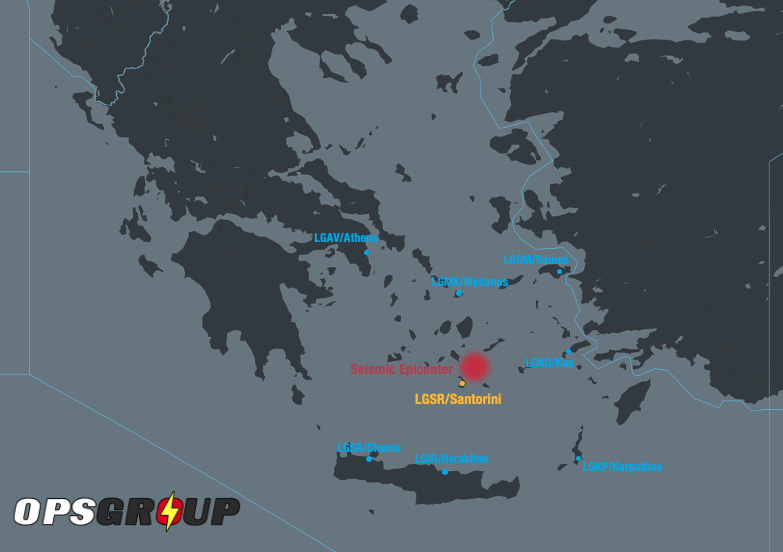
The largest yet occurred on Feb 6 and was felt as far away as Athens, Crete and Türkiye.
State of Emergency
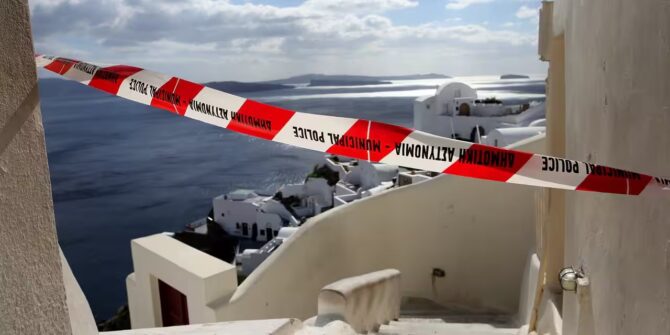
Following the events of Feb 6, a state of emergency was declared and will remain in effect until at least March 3. This includes an instruction to immediately evacuate coastal areas in the event of stronger earthquakes due to a tsunami risk.

A state of emergency is in effect until at least March 3.
On Feb 7 the US Embassy issued a new warning for Santorini and the surrounding islands. They advise extreme caution if travelling there.
Airports
The seismic events are occurring in a relatively constrained area of the Aegean Sea between Santorini itself, and the island of Amorgos.
As such, LGSR/Santorini is the primary airport to be impacted. At time of writing, several local agents have advised the airport is open and operating normally.
However, the situation is inherently unpredictable. If a larger quake occurs, a sudden closure of the airport is possible.
This may be preventative due to the evacuation of staff (including ATC), or more severe in the case of damaged infrastructure including instrument approach equipment, movement areas and the runway itself.
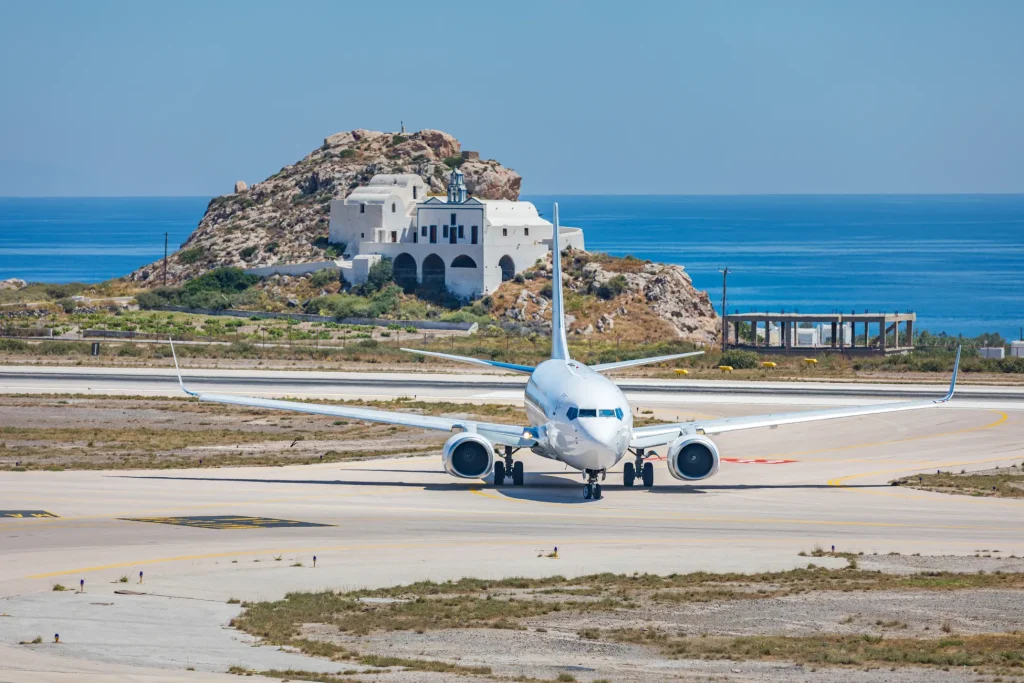
At time of writing, LGSR/Santorini is open and not reporting damage.
For inbound aircraft a solid contingency plan right now would be to carry healthy alternates such as LGMK/Mykonos, LGIR/Heraklion, LGSA/Chania or even LGAV/Athens.
If you must go to Santorini, we recommend stop and goes only to minimize time on the ground.
Should the airport close, damage assessments can take hours or days to complete. Any aircraft on the ground may be stuck there for an extended period of time. Crew recovery options may also be limited during rescue efforts.
What will happen next?
Experts are undecided. A typical seismic pattern usually consists of larger earthquakes (mainshocks) followed by smaller ones (aftershocks).
The pattern in Santorini is different. Some seismic events don’t consist of one single major event. Instead, a region can experience a wave of smaller quakes over a period of weeks or months. This is phenomenon is known as ‘swarms.’
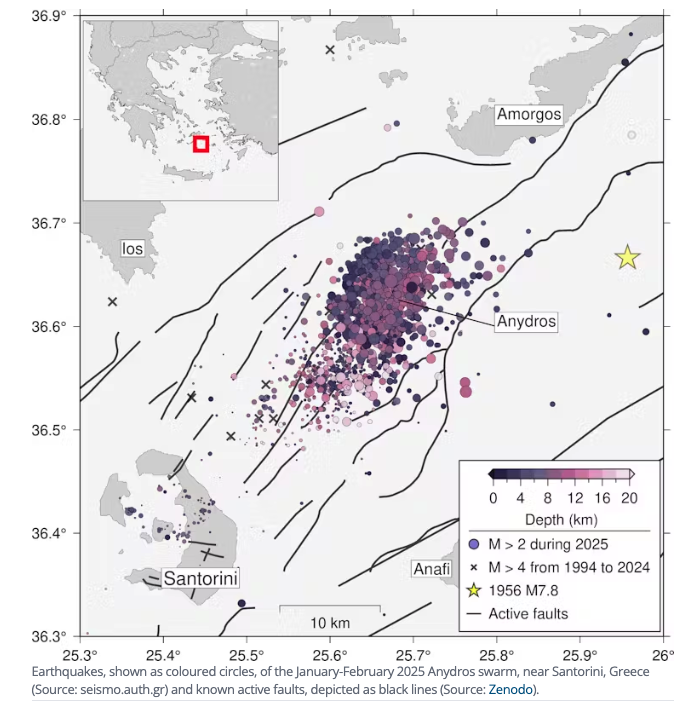
Santorini may be experiencing a different kind of sesimic event called a ‘swarm.’
On the other hand, other scientists believe recent events may be a precursor to something larger – the figure being widely thrown around is a ‘six’, defined on the Richter Scale as a strong quake with potential to damage well-built structures with strong to violent shaking near the epicenter.
We will continue to monitor the situation in Santorini and report any changes to aircraft operations as they become apparent.