China Airport Alternate Restrictions
There are a multitude of Notams advising that certain airports in China are not to be used as alternates. Here is a list of those to look out for so you can plan and ensure your flight is not impacted, and a few others we thought worth mentioning.

The Notams

The ‘unavailability’ Notams, give or take slightly different dates, all say this – 

AD NOT AVBL FOR INTERNATIONAL ALTN FLIGHT(INCLUDE HONG KONG, MACAO AND TAIWAN FLIGHTS) EXCEPT EMERGENCY FLIGHT.

So don’t plan to use as an alternate, an en-route fuel or tech diversion, or anything else that wouldn’t be classified as an emergency.

The Airports
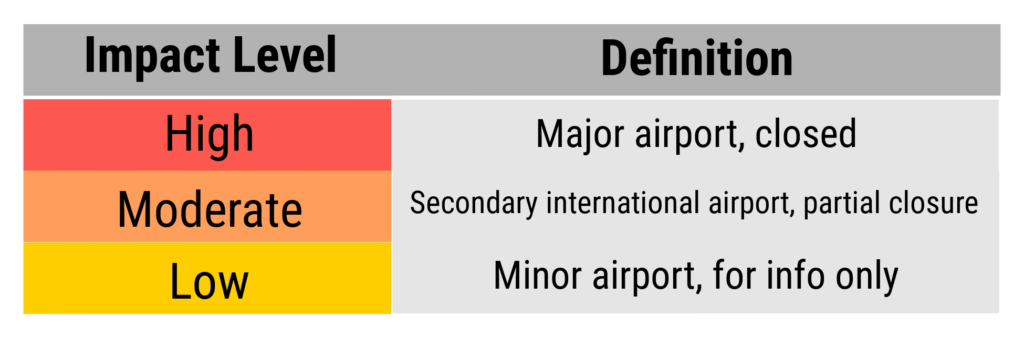
ZJSY/Sanya International – 12/31/2021

G2993/21 Sanya Phoenix International serves the Hainan region – the southernmost province of China (on the island).

ZSWH/Weihai – 12/09/2021

F6913/21 This is not a major international airport, Weihei lies on the eastern coast, north of ZSPD/Shanghai  Pudong beside the Yellow Sea and is the closest Chinese airport to South Korea.            

ZSNJ/Nanjing Lukou – 12/31/2021

F6912/21 A secondary international airport, this maybe used as an alternate for ZSPD/Shanghai Pudong. ZSHC/Hangzhou remains available, as does ZSSS/Shanghai Hongqiao (see below).

ZSSS/Shanghai Hongqiao – 12/19/2021

F6888/21 Only runway 18L/36R is unavailable, runway 18R/36L remains open and has both ILS CAT I and RNAV capability, and is 10,827’ (3300m) length.

ZSOF/Hefei Xinqiao – 01/18/2022

F6798/21 This is a secondary international airport service the Hefei region, inland from Shanghai.

ZBTJ/Tianjin Binhai – 02/28/2022

E3619/21 Runway 16R/34L is not available to any large (B747, A380) aircraft except if an emergency special transportation.

ZLIC/Yinchuan Hedong – 12/09/2021

L1155/21 Another minor international airport. It is unlikely you would feel this a an alternate as it has limited international operations. Hedong serves the autonomous Ningxia Hui region to the north east and lies in close proximity to mountainous terrain.

ZWKC/Kuqu Qiuci – 01/31/2022

W0547/21 This is a domestic airport serving the Xinjiang autonomous region and would not be recommended as an alternate.

ZWWW/Urumqi – 12/30/2021

W0500/21 Urumqi is one of the primary enroute and emergency diversion alternates for the Himalayan region flights into China. Taxiways A and B (so both main taxiways) are closed due maintenance, as is runway 07/25.

However, it remains available for emergencies, but it is not clear how much notice would be required.

ZHHH/Wuhan Tianhe – 12/31/2021

G2452/21 Wuhan is closed for all except emergencies due to stand shortages only.

ZUUU/Chengdu Shuangliu – 12/26/2021

U3453/21 Chengdu is a major international airport in central China. The airport remains open, but is not available for BizAv flights wishing to park overnight unless you are based there, or its an emergency.

ZLXN/Xining Caojiabao – 12/02/2021

L0900/21 Although an international airport, this primarily only serves domestic flights into the region. ZLLL/Lanzhou would be the closest major international airport, and this remains available.

ZPPP/Kunming – 01/31/2022

U3133/21 Kunming is also restricted in parking and not available for overnight parking to any BizAv aircraft unless based there or landing due emergency.
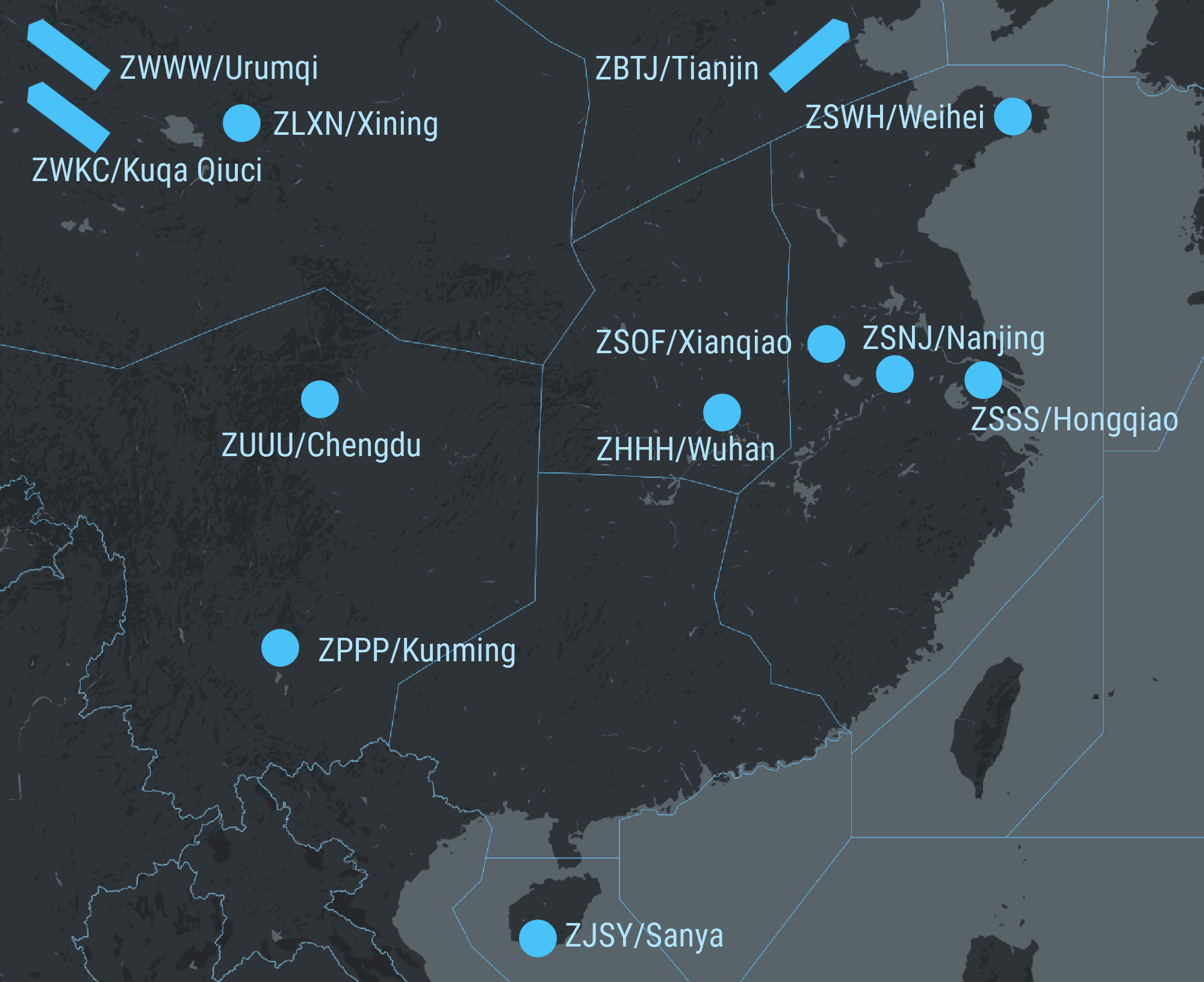
Some situational awareness on where these airports are located

Diverting in China

In general, diversions in China can be problematic if you head somewhere unplanned – and by this we mean not on your flight plan.

Much of the airspace is governed by the military which can result in delays for you while ATC coordinates with them. Take extra fuel for dealing with things like not getting the flight level you wanted, en-route weather deviations, random re-routes and delays with re-clearances if you do need to divert.

China also have stringent ATC procedures and hand out fines for errors, and occasionally impose restrictions for repeated errors so know the country rules and regs, including their contingency procedures as these differ to ICAO.

China have been known to impose “do not commit to destination” policies on some operators – this basically means they expect you to have enough fuel to not get into a low fuel situation at your destination airport. If you are going to, they expect you to divert to your alternate instead (which my result in you committing to that so look at that weather well in advance).
Intercepted: What You Need To Know

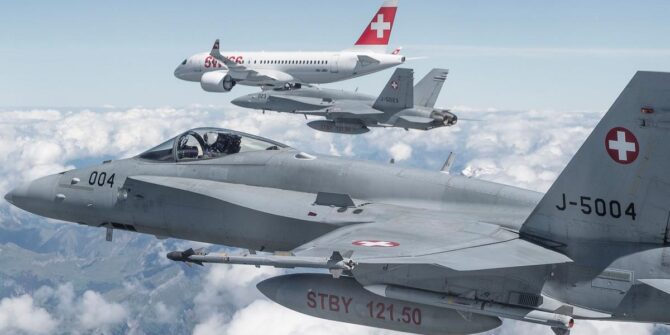
There are several reports that amidst the events surrounding the forced diversion of Ryanair Flight 4978 to Belarus last month, at least one MiG-29 was scrambled to intercept and escort the 737 to Minsk airport.

While military interceptions of civilian airliners are very rare, they can happen and for serious reasons. Which poses an important question – if a jet were to appear off your wing tip tomorrow, would you know what to do?

Each interception is potentially hazardous which is why ICAO publish rules and procedures (Annex 2) that both military and civilian aircraft should be following to minimise the risk. Each state is responsible for its own airspace, but where possible they should be following ICAO’s guidelines. For crew this includes knowing the actions to be taken and the visual signals to be used.

Here’s a break-down of what you need to know.

Why do they happen?

ICAO are very specific – an interception should be avoided and only used as a last resort. ATC must try and establish communications with you first. The primary reason is that they haven’t been able to talk to you.

There are lots of simple reasons why this can happen – usually a wrong frequency or perhaps they’ve forgotten to hand you over. In this instance they will try and contact you on 121.5 (which is one reason we monitor Guard), or via another aircraft. If that fails, ATC have a problem. You’re flying through their airspace and you’re not talking. It is not clear what is happening on board.

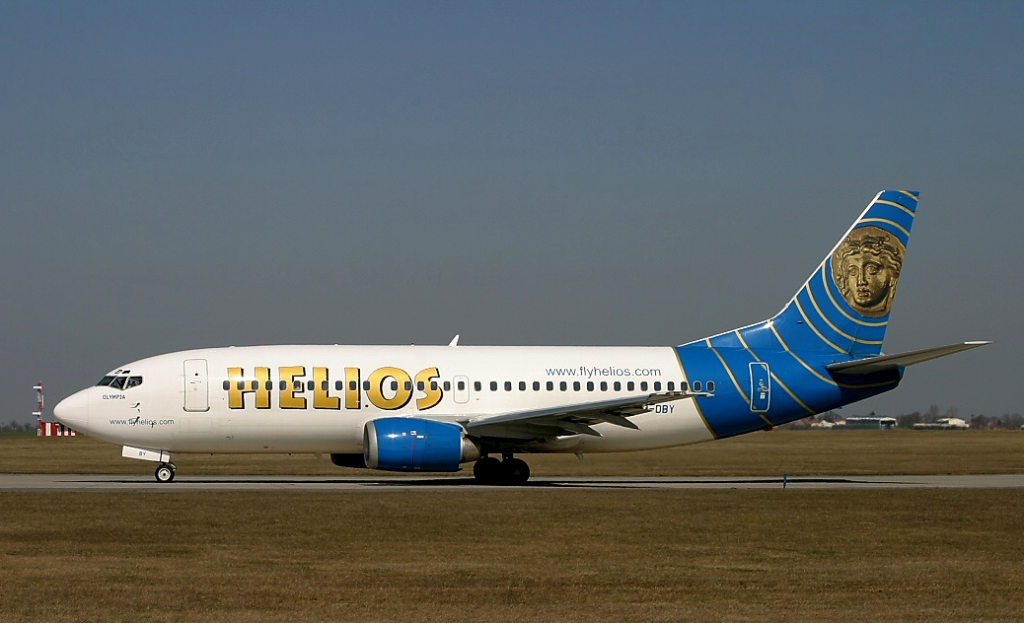
Incapacitation is a biggie, the crew may have fallen asleep or perhaps something more serious has happened as Helios 522 tragically reminds us. Or the aircraft may have been hijacked. Either way, they need to get someone up there to check things out.

What will they want us to do?

One of three things, depending on what the problem is. They’ll either want to identify you, communicate with you or re-direct you. The latter may be because you have strayed off-course or busted some kind of restricted airspace. Far less often it is because authorities may believe you are involved with illegal activity (such as drug smuggling) or or you are for some reason hazardous to other aircraft.

The Interception Manoeuvre.

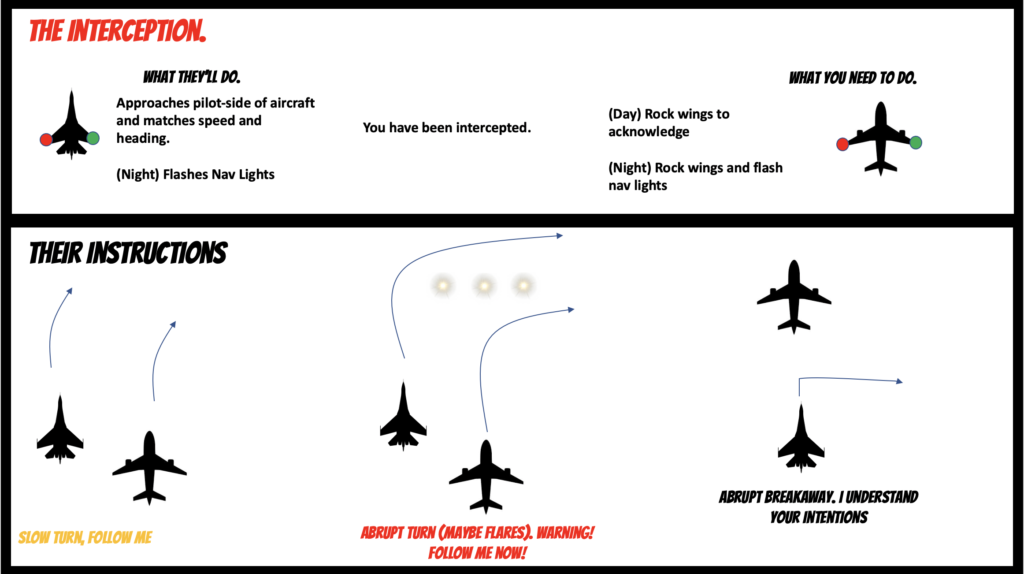
ICAO have a standard procedure for military aircraft to follow to minimise startle factor for you and decrease collision risk. A standard interception will take place in three phases, here’s how it works.

Phase I.

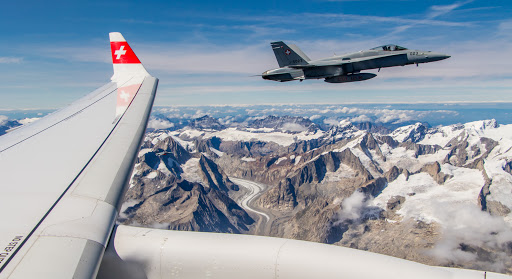
Intercepting aircraft should approach you from astern (behind). They will disable pressure reporting on their transponders – not to hide from you, but to avoid triggering a nuisance RA. They should still be visible on your TCAS but only as a TA. The lead aircraft will take up a position on the left, ahead and slightly above at a distance so as not to cause startle and to be clearly visible to the captain. It is likely there will be an accompanying aircraft which will remain behind you throughout. They will be trying to contact you on guard frequency (121.5) using the callsign ‘INTERCEPTOR’ or ‘INTERCEPT CONTROL.’

Phase II.

The lead aircraft will close slowly with you but not closer than needed to establish communications. All other aircraft will remain well clear of you.

Phase III.

What happens next depends on the situation. If they have finished their interception (they have identified you, re-established your comms with ATC or understand your intentions) they will perform a break away procedure to clear you.

Or they may need to divert or re-route you. In which case they will remain in position and clearly visible at all times.

What you need to do in the flight deck.

Stay calm. You’ll likely be startled. Slow it down and remember the following:

  • Notify ATC (if possible). Make sure you have 121.5 active, the volume turned up and that your headset or speaker is working. Try and establish contact with them. Listen out for the callsigns above.
  • Select Mode A on your transponder and squawk 7700 (unless ATC tell you otherwise). If you have ADS-B or ADS-C onboard, select the appropriate emergency function.
  • Communicate (more on that below).

How do we talk to them?

The primary way they will want to talk to you will be in plain English on 121.5.

If they can’t raise you on that, they will use visual signals which is why they need to get so close to you.

There are ICAO standard signals used across most member states (including the US) that you need to know (or at least know how to find quickly). Here’s how they work:

When they want you to land.

If they can’t talk to you and want you back down on the ground they will direct you to an airport, turn on their landing lights, lower their gear and begin to circle.

If you intend to land you should lower your own gear and land. If the airport is inadequate, you should continue to circle 1000 – 2000ft, raise your gear and flash your landing lights until your escort re-directs you some place else.

What about if their instructions contradict someone else’s?

According to ICAO, if you receive contradictory instructions from other sources you should continue to comply with those from the intercepting aircraft.

Their duty of care.

You have to do as you’re told, but they should be looking after you. ICAO are very clear that nothing can be done during interceptions to unnecessarily put your aircraft or its passengers at undue risk. So, when they are requiring you to land, it is important to know they must take care to ensure your safety.

Firstly, they should not divert you to an airfield which is unsafe for your aircraft type. For civil aircraft this means the runway must be equivalent to at least 2,500m long at sea level, and have a bearing strength that is strong enough. The surrounding terrain must be suitable to allow for a safe approach and missed approach.

They must also take steps to ensure that you have sufficient fuel and if possible the airport they want you to land at is published in the relevant AIP.

Finally, they should give you sufficient time to prepare for the landing, including giving the crew a chance to check landing performance and brief.

Should I be worried about being shot at?

Seeing a fighter on your wing is an intimidating sight. But the use of weapons is very unlikely, especially if you are complying with instructions or are obviously unable to respond. ICAO have asked all contracting states for a commitment that all measures will be taken to refrain from the use of weapons (including to attract attention) as they endanger the lives and safety of everyone on board. However, that’s not to say they can’t be used. So the best defence is always to follow instructions.

Military interception of a civil aircraft is extremely rare.

While the diversion and alleged interception of Ryanair last month raises valid concerns throughout the aviation community it is important to remember that ICAO’s procedures have been designed to minimise risk across a broad range of scenarios. It’s important that we stay aware of them and how to apply them.


Greenbacks and Greenland – $3000 to file as an alternate

Trans-atlantic operators who have been putting RALT/BGBW or RALT/BGSF on their flight plans have been receiving hefty invoices post-flight.

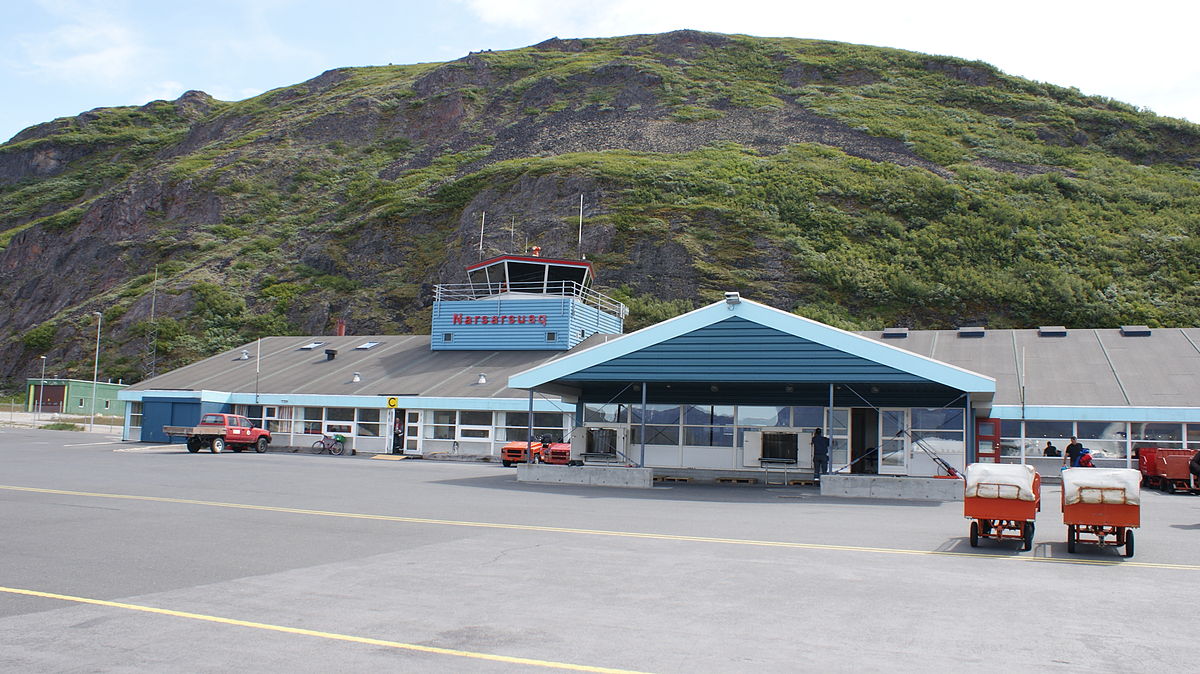
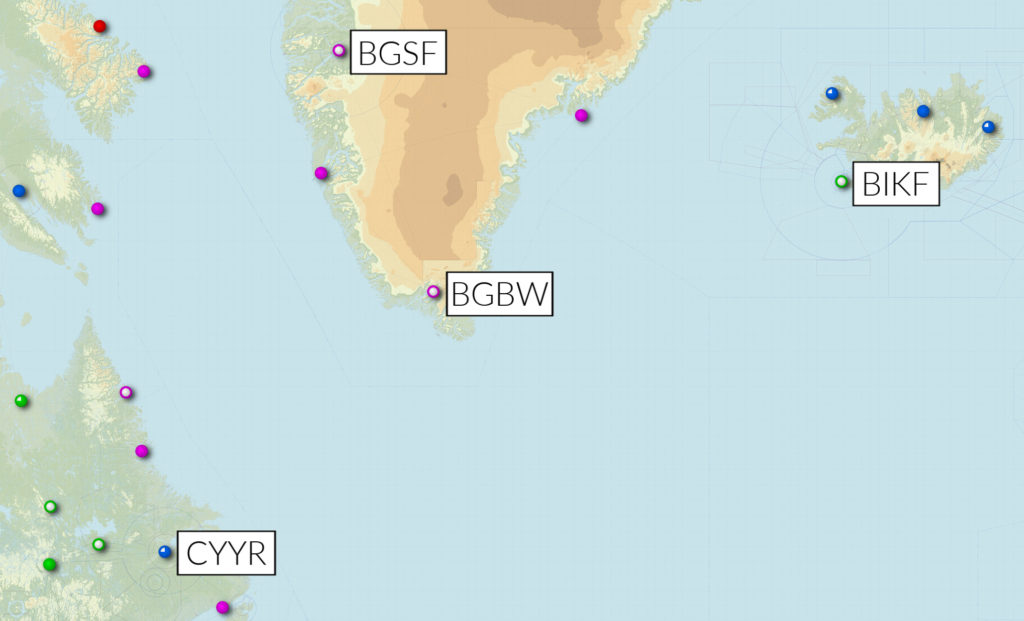
Both BGBW/Narsarsuaq and BGSF/Kangerlussuaq are popular airports to use in flight planning as an emergency divert and for ETOPS, as they are perfectly positioned right in the middle of the big empty chunk of nothing that exists between the east coast of Canada and Iceland.

Both airports are open Mon-Sat 11-20z (8am-5pm local time), and completely closed on Sundays and on public holidays (watch out for these sneaky ones!).

So if you file a flight plan with either as alternates from Mon-Sat 11-20z, you won’t get charged.

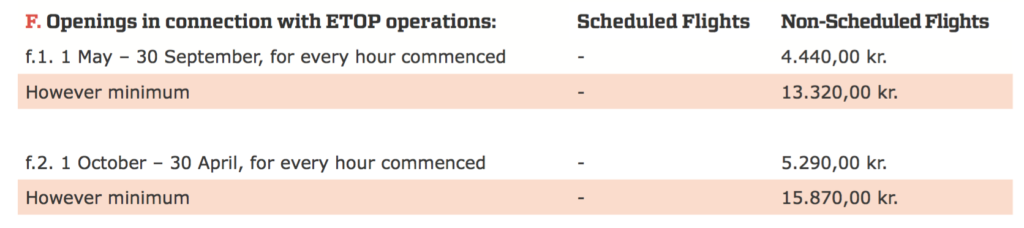
But outside these hours, you will get charged. It gets slightly complicated here: the charges in the box below apply when they stay open for you to use as an ETOPS alternate at any time that they are closed (which is between 20-11z), but there’s an extra 10% charge on top of that for any time they are closed and fast asleep in bed, (which is between 00-08z). Got it?

Important to note: these get charged even if you don’t actually divert to BGBW/BGSF. 15,870 Danish Krone equates to $2585 USD!

If you want them to stay open for you to use as an ETOPS alternate, you need to put RALT/BGBW or RALT/BGSF in your flight plan – they’ll see it, and will stay open for at the times you need. But bear in mind that if they’re closed already at the time you file your flight plan, they won’t see it! So they prefer you to do it properly and arrange everything in advance by email: get in touch with them at PPR@mit.gl

If you get an invoice from a company called Global Aviation Data A/S, unfortunately it’s not a scam email – they are the guys who work with Greenland Airports to collect the monies owed when operators request these airports to stay open for them.

The really interesting thing is this – if more than one operator asks BGBW/BGSF to stay open for them at the same time, the costs are not shared between these operators – they both have to pay the standard fees! That’s great news for the Government of Greenland, who will be getting paid multiple times by different operators for BGBW/BGSF to stay open at the same time!


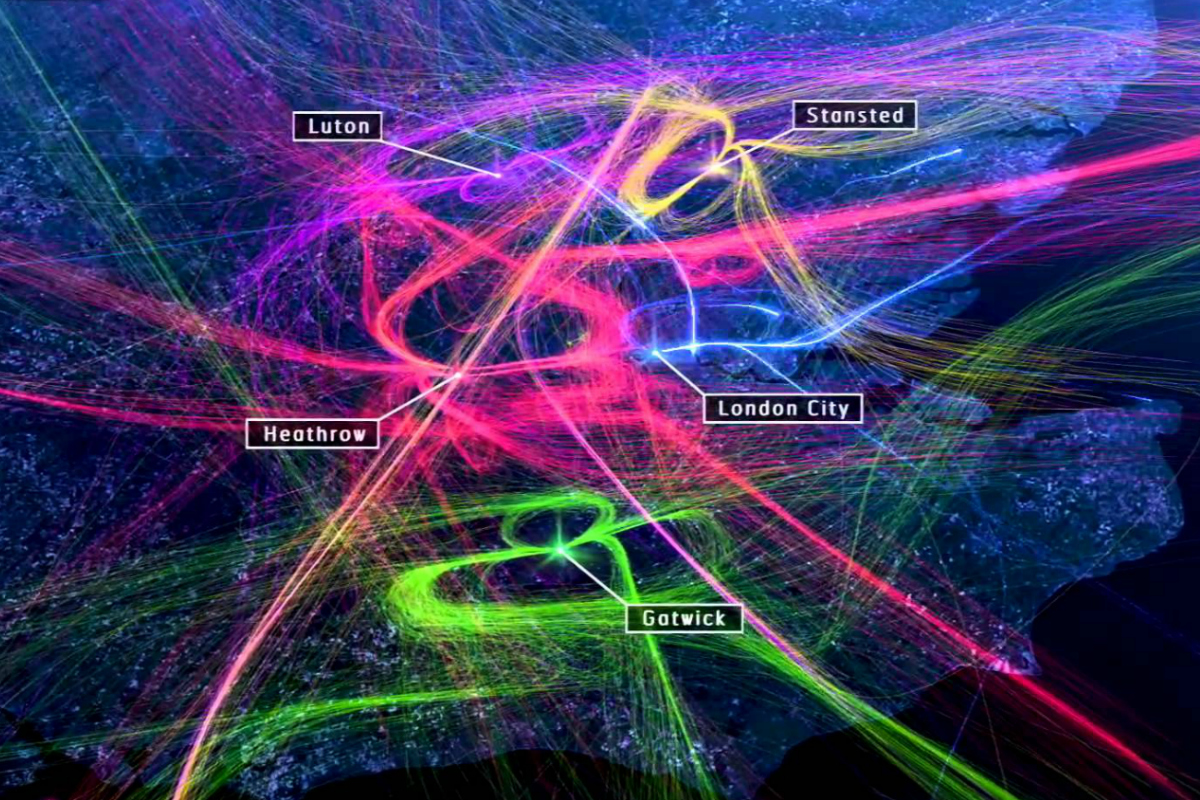
The diversion dilemma over London

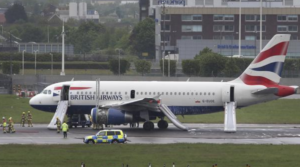
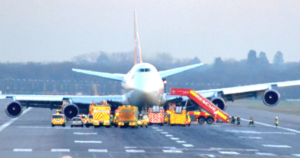
A few months back an Air Canada A330 suffered a hydraulic failure as it started it’s Atlantic crossing from France to Canada. The crew decided to turn back and wanted to divert to EGLL/London Heathrow – this was denied.

Since then, other reports have been received of other aircraft requesting similar non-emergency diversions over the UK and them being denied. We understand the “non-acceptance of diverts” policy is in place for EGGW/Luton, EGSS/Stansted and even as far away as EGHH/Bournemouth. It is important to note however that if you declare an emergency (PAN/MAYDAY) – then all bets are off and you can divert wherever you like.

This week we saw EGGW/Luton go as far as publishing a NOTAM to that effect.

A2663/18 – DIVERTS SHALL ONLY BE ACCEPTED FOR ACFT THAT HAVE DECLARED AN  EMERGENCY.

So what’s going on?

We understand it’s a mix of things.

  1. With the heavy summer traffic situation all across London (which is being compounded by the various curfew and overnight flight limitations) it seems that the major airports don’t want an aircraft landing and disabling their runway.
  2. We have heard specific concerns stating that there is nowhere to park overflow aircraft. One aircraft might be manageable but multiple during peak disruption maybe not so easy.
  3. Some Opsgroup members have reported that the main driver of this policy at EGGW/Luton and EGSS/Stansted may be down to ‘their fear of adverse publicity on social media’ regarding aircraft sitting there waiting to go somewhere else and passengers tweeting away the problems with the airport and its facilities.
  4. Luton also put forward the argument that they do not want to interrupt the home-based operators by allowing other operators in. However, at the same time they are automatically denying home-based operators a diversion unless you declare an emergency.
  5. Border Control has also bought into the argument, especially at EGSS/Stansted, saying their manning levels can’t cope with an influx of extra passengers at short notice.

There are a whole host of other factors at play which make diversions in the London area a headache, particularly at night time. Opsgroup member Diego Magrini from Jet Concierge Club sums it up nicely:

“Minor airports close early in the evening, for example EGSC/Cambridge, EGTK/Oxford, EGLF/Farnborough, EGWU/Northolt. These would all be very good alternatives, but become unavailable pretty early. Let’s be honest: no business jet want to divert to EGLL/Heathrow or EGKK/Gatwick (costs, slots, friendliness, etc), and most cannot go to EGLC/London City due to training and approval. This is of course on top of Heathrow and Gatwick not accepting diversions most of the time, or not having slots available. Some airports outside London, although open and accepting traffic, do not have an FBO presence during the night, and this cannot be arranged at short notice for a diversion. Combining all of this in the very short timeframe of a diversion can be very tricky!”


There is a cool video that shows just how busy London does get on any given day….

If you have any further knowledge or recent experience to share, please let us know!

Extra Reading


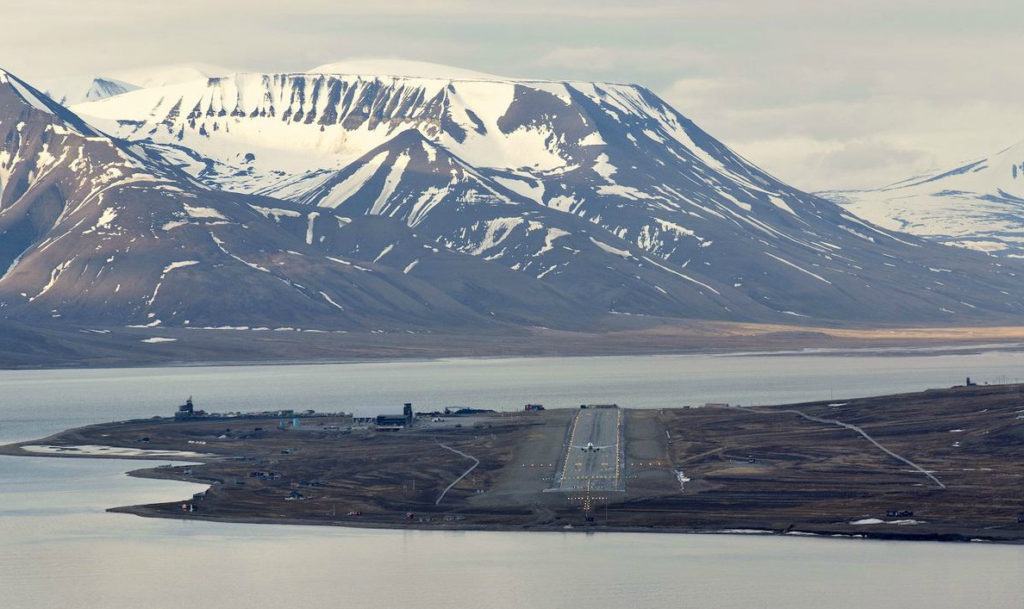
ENSB: No more direct flights, emergency diverts still OK

This is now officially a domestic airport – international arrivals are no longer permitted.

We asked the Norwegian CAA the million-dollar question: can ENSB still be used as an ETOPS or emergency enroute alternate?

Their response: “ENSB now being a domestic airport, it shall not be used as an alternate airport in normal flight planning, but in case of emergency, medical – or flight safety related, the airport may be used.”

In other words, if you are planning a Polar flight and want to use ENSB as an ETOPS or emergency enroute alternate, you can. 

We also spoke with the ATC tower at the airport: they confirmed that you can still use ENSB as an emergency divert, and they have someone there on duty H24. The normal RFF category is 8.

So why has the airport been downgraded from international to domestic?

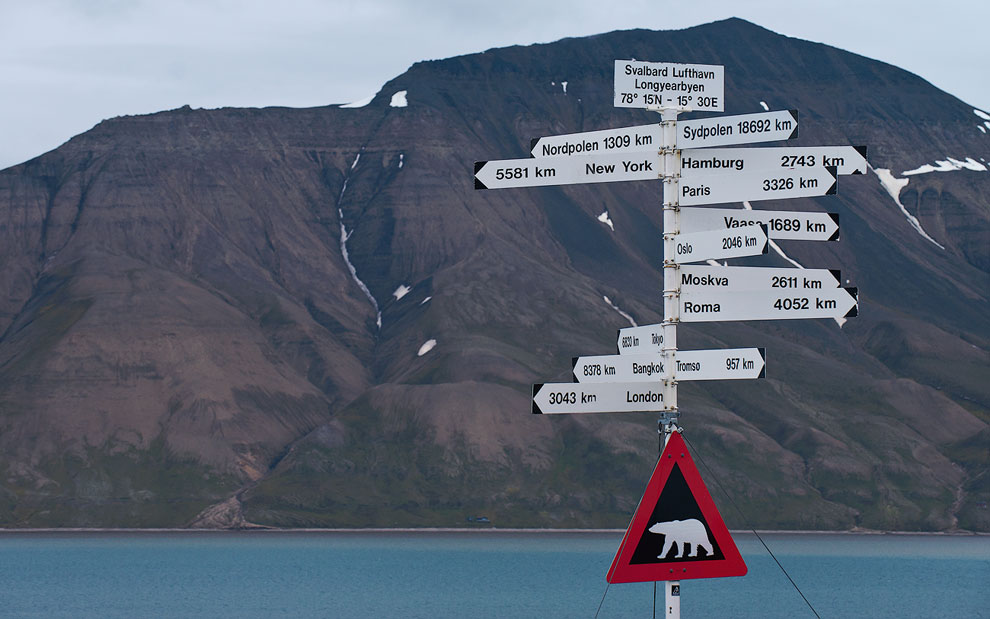
It seems it has something to do with the authorities desire to limit the amount of charter fights operating directly to Svalbard. Now, if you want to go there you will first have to go to one of Norway’s international airports to clear customs, and then continue on to Svalbard as a domestic flight. The Norwegian CAA say direct international charter flights may still be allowed “in the interests of tourism”, but it seems this will be the exception rather than the rule.

Interestingly, you can still fly to ENSB direct from Russia, as they have a separate agreement from 1974 regarding the use of  the airport – which is unaffected by this new rule.

Even more interesting is that when you get to Svalbard, if you decide to leave the main town of Longyearbyen, it is a legal requirement to carry a gun, and to know how to use it – they’re not joking about those polar bears.