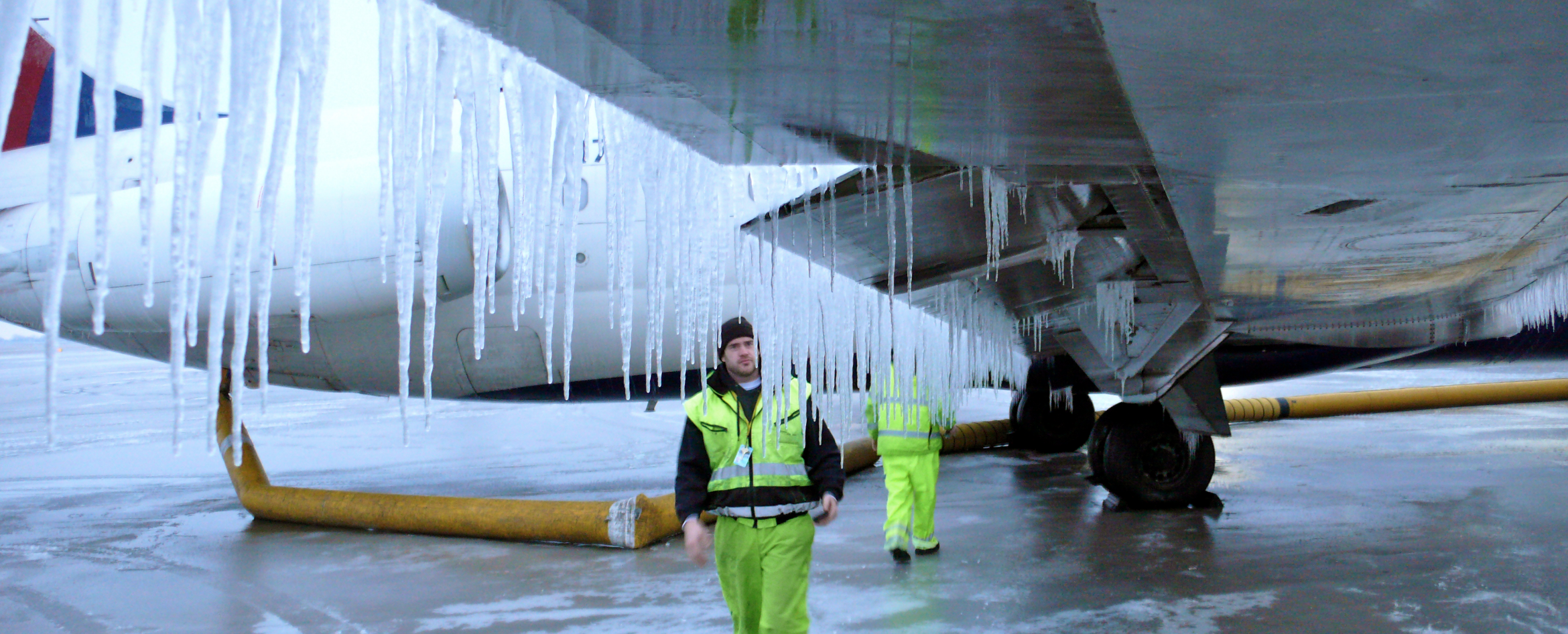
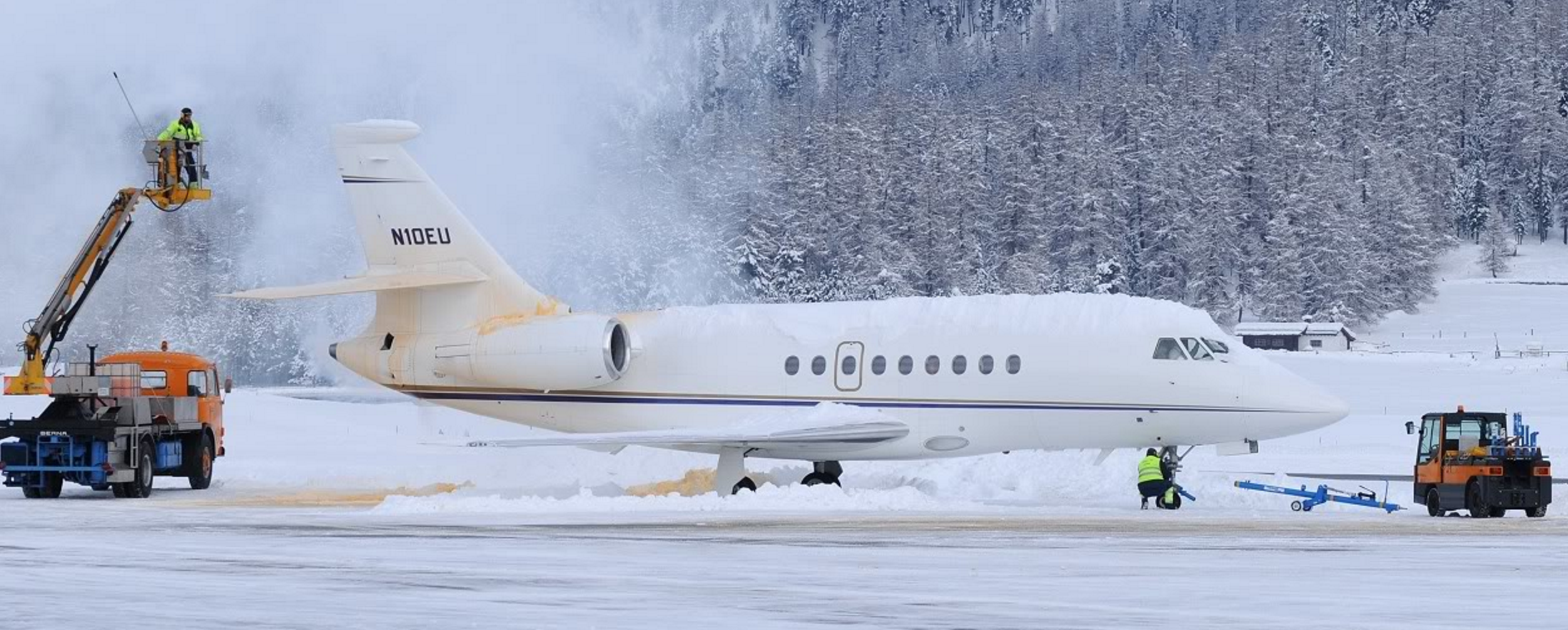
Winter is Coming: Updated Holdover Time Guidelines

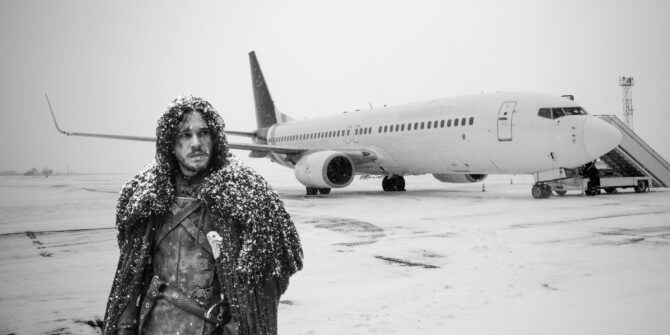
Sorry, the GoT reference still hasn’t grown old. Anyway, every year the FAA & Transport Canada releases a new set of Holdover Time (HOT) guidelines for the winter season. The one for winter 2022 is available here. So if you want to update your de-icing procedures, manuals, and training in line with the guidance from the feds, here’s what you need to know…

What’s changed?

They’ve added some fluids and removed some fluids which are really good for middle speed aircraft. So basically, check what fluid is being used on your aircraft, confirm it is a good one for your aircraft Vr, and then make sure you use the right table.

Standard Winter Ops 101.

Type II generic holdover times have increased (because they removed a fluid called Beijing Something or other that was holding them back). How much by? A few minutes here, a few minutes there, mainly in the -3 °C and above (27 °F and above) section.

They also did a load of tests which means you now get HOTs for very cold snow (cold enough to turn your legs to ice blocks if you accidentally step into it because its colder than -14°C cold). This applies to a bunch of new Type II and IV fluids and is great because that’s the sort of stuff you’re going to want to escape from for sure.

Double check those tables!

If you’re heading into the generic fluid tables then that’s fine but you actually need to make sure the Type II or Type IV fluid is listed in table 55 or 57.

It might seem a little contrary to the point of a ‘generic table’ but there we go. If it isn’t in the table, and if it doesn’t have its own specific table, then chances are you’re in some dodgy airport where they’re spraying you with homemade, bootlegged moonshine and it might not be very safe.

Freezing Fog.

There are changes to the HOTs for FZFG if it’s mixed with ice crystals or mist. Same for snow mixed with ice crystals.

My opinion: You need some pretty trustworthy Met officer telling you exactly what is out there to start getting this specific. If in doubt, always go with the most limiting and then take a good look before taking off!

A note on a note.

You can takeoff up to 90 minutes after the start of fluid application with a few conditions. This isn’t a new change, this has always been the case, but still worth mentioning.

Small Hail.

This hasn’t changed but it is a confusing one so they’ve added a new note on it. It says this (give or take one or two inaccuracies):

  • GR in the Metar means small hail, which means hail less than 1/4 inch… if you’re in the US.
  • Outside the US, small hail is anything less than 5mm, and is reported as GS. If it says GR that means big hail (5mm or more). Don’t get them mixed up.
  • If it doesn’t specify intensity then use the moderate ice pellets or small hail times.
  • If you aren’t sure and don’t have a tape measure then send your FO out and check the bruise sizes when they return.

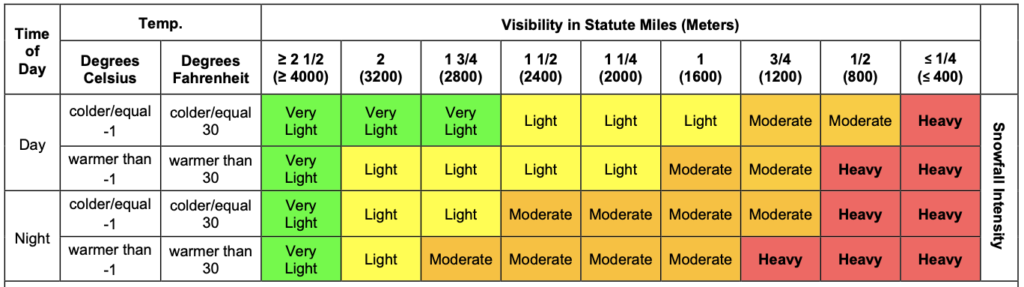
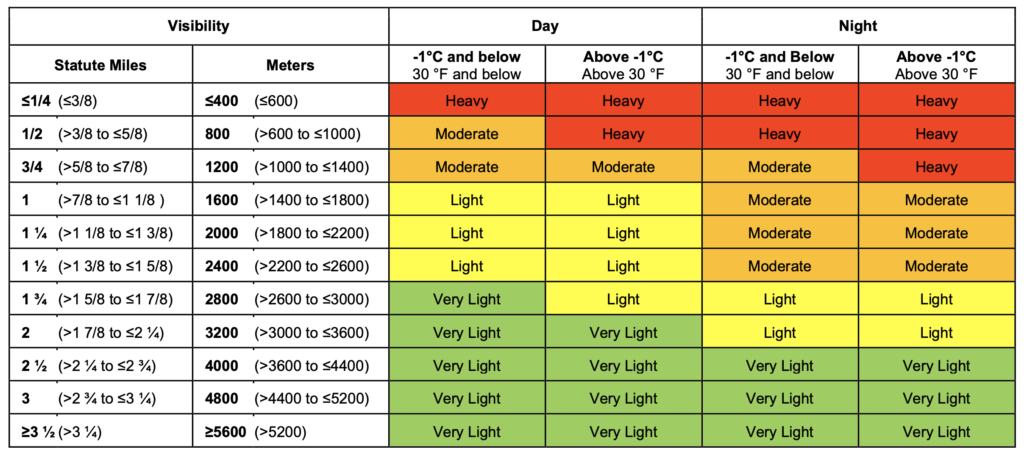
‘Snowfall intensities as a function of prevailing visibility’.

You know the one – they use it in your yearly Winter Ops sim to try and catch you out by overcomplicating which table you want to use and hoping you forget or get confused and then they can enjoy lecturing you on it during the debriefing…

Anyway, it has been changed, reformatted and updated. Compare them at your leisure. We like the new one much better.

Old.

New.

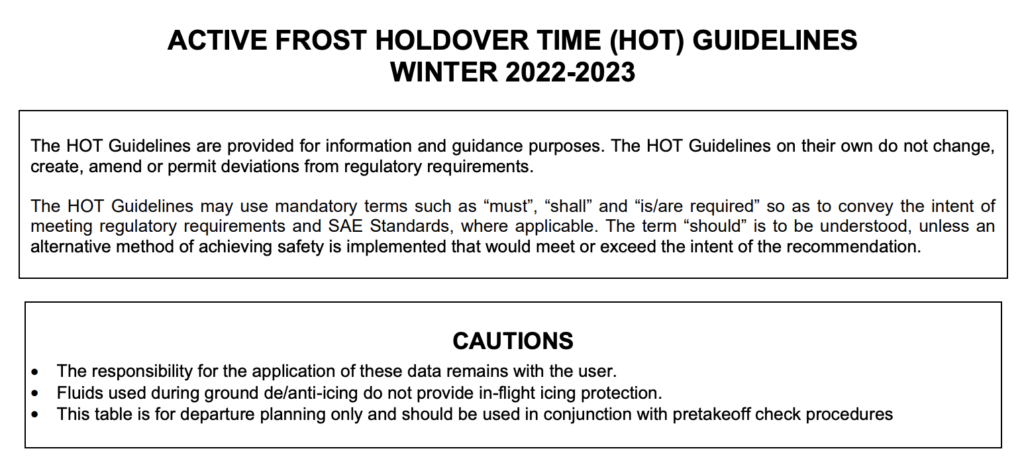
Must, shall, required, and should…

The document has these new disclaimer sheets at the start of each section:

In case you aren’t familiar with these nuances of aviation lingo, here you go:

  • Must: Really no grey area. You gotta do it no question, no bending, no ignoring. Just do it.
  • Shall: A little bit more ambiguous – not quite the same level of necessity but a strong assertion of importance!
  • Required: More a regulatory, meeting standards sort of a thing. If you want to two step de-ice then some de-icing fluid is required. You can try without but won’t get very far…
  • Should: A wonderful word but don’t get carried away – it’s more of a “really should unless you really can’t” rather than an “only if you fancy it” sort of a meaning. So a shall *unless you have a good reason not to.

A final thought.

Don’t forget GRF changed in November 2021. You might not have operated in conditions needing a runway surface condition assessment since then so it’s worth a quick read of what it now looks like.

Also, thanks to Avioscribe for this handy video on the main highlights and changes to the Holdover Time Guidelines for Winter 2022-2023. Trying to compare the two documents was a mission we weren’t prepared to undertake and you’ve done a spot on job.


Rolling the dice with de-ice

Snow might look lovely on a Christmas card, but on the wing of an airplane (especially if it is the wing of the airplane you’re about to go fly in, and especially if it is 3am and you’ve got a long flight ahead of you) then I think we can all agree it is less ‘pretty winter frosting’ and more ‘horrid winter frustration’.

Snow, ice, sleet, hail – basically anything made out of really, really cold water means one thing – delays! Sorry, I meant to write de-icing there.

Feeling frosty

There are a few reasons why folk feel frosty about de-icing. First, it is a bit annoying – it does often mean delays. It also means extra things to think about, work out, and worry over. De-icing is an extra, and often slippery step, in an otherwise nicely structured turn-around.

Secondly, it is pricey. De-icing and anti-icing fluids are expensive stuff. For a small private jet you are probably looking at about $1200 , and more like $15000 for a large airliner. The call out fee alone is generally a few hundred bucks, and although we all have safety as a priority, most of us have called the de-icing rig out only to watch them spray copious amount of fluid all over the place while we wonder whether that little patch of frost on the wing really wouldn’t have melted off as we taxied out.

Lastly, and maybe not one everyone worries about, but anything with glycol in it creates high level of biochemical oxygen demand. What does that mean? Well, just that it is a bit bad for fish or anything that lives in water and likes to breath oxygen. So it ain’t the friendliest stuff for the environment.

Let’s be honest though, point 2 (with a bit of 1 thrown in) are probably the main reasons why we sometimes wait, fingers crossed, and fuel pumps a-swilling in the hope it just melts off before we go.
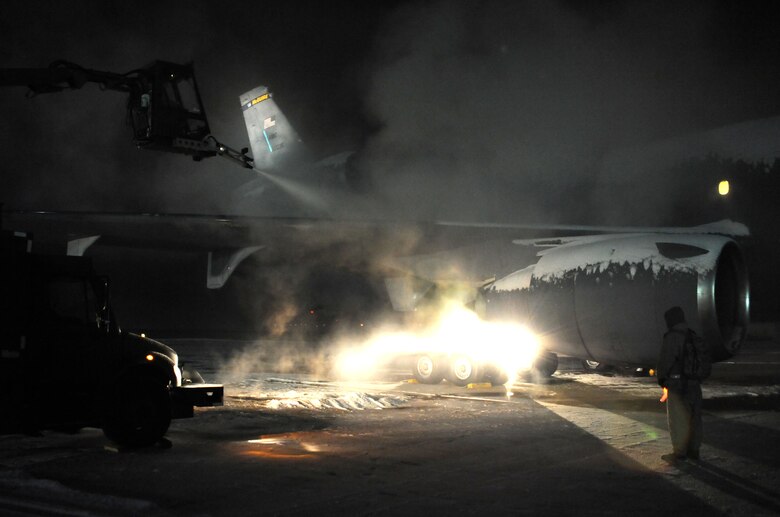
De-ice-iding to go

There is of course a big reason why we do need to de-ice. We are all fairly well aware of it – safety! Or more specifically – performance! Because a little bit of ice means a big bit of (lost) lift. (Don’t worry, not an icy accident movie, just a video of a poor de-icing decision).

Let’s re(snow)cap on it

Most airlines and operators apply something close to a “clean aircraft” policy, which means that all critical surfaces should be clear of contaminant.

Simple – see something on a bit of the airplane that’s used for getting the airplane up in the air? Get if off before you go. This rules applies to bits like the wings, the horizontal stabilizer, and don’t forget in the engines – ice shedding after a prolonged taxi in wintery weather is going to help shake off any chunks of ice clinging to them.
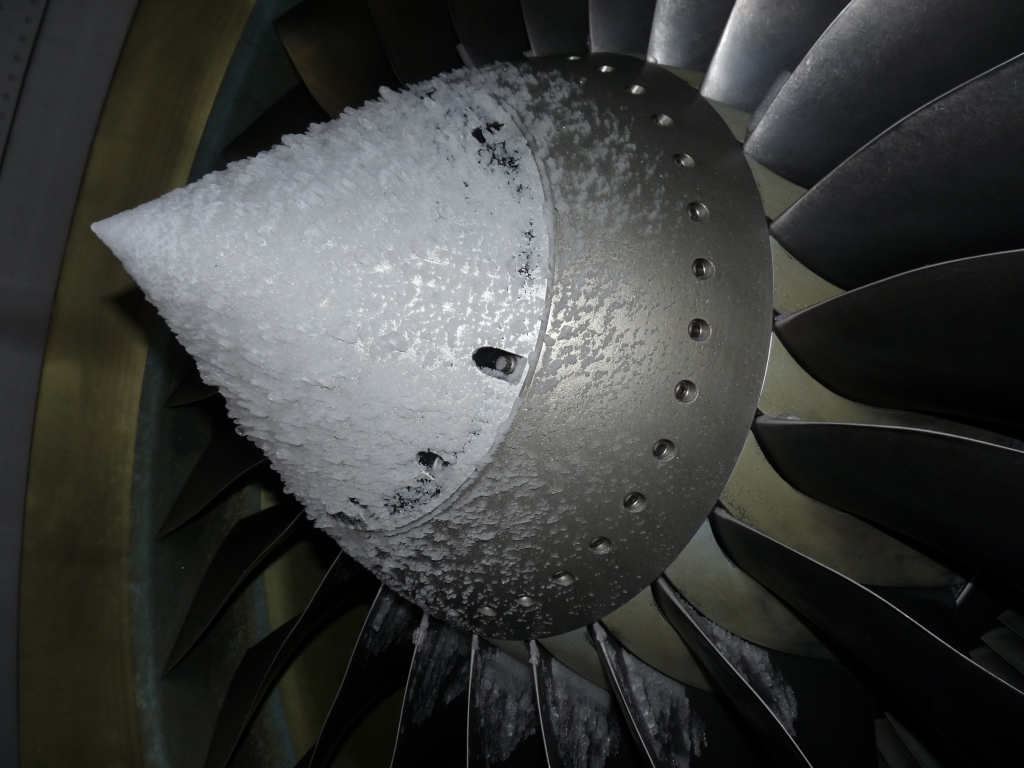
Back to those critical surfaces though – if you see a bit of frost (less than 3mm thick and so you can see the paint markings through it) underneath the wings? That’s ok. 

Look out for clear ice – not always very visible (being clear and all).

So, step 1 in the “Do I need to de-ice?” decision making process is pretty straightforward:

  • Is there ice or contaminant anywhere on the airplane?
  • Is it more than a little bit of frost on the underside of the wing?
  • Is it more than really thin layer that won’t melt once warmer fuel is added in, or with the airplane sat out in the sunshine?

If you answer ‘Yes’ to any of these than you probably need to de-ice. If you’re not sure, get a second opinion from your co-pilot or engineer.
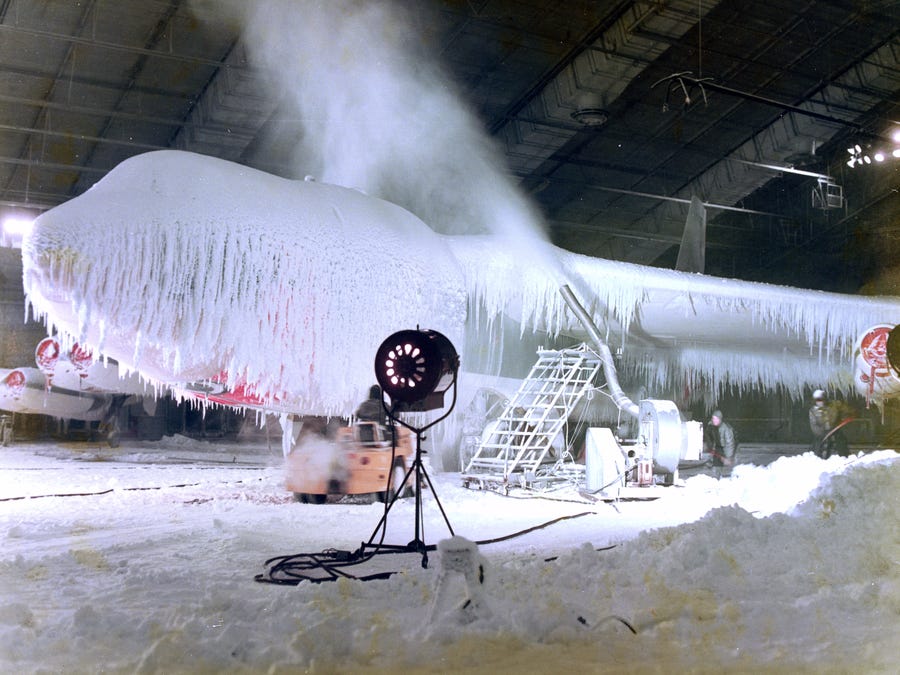
Snow idea if you need to anti-ice?

De-icing is the process of getting any contaminant off. Sometimes blowing hot air is enough, sometimes a Type I fluid is used to melt it off. This one-step process is fairly quick and unless there is a big old queue you probably won’t delayed too much.

Anti-icing comes in when there is a chance ice and stuff will build up again. So if you send the FO out on the walk around and they return red nosed with icicles on their eyebrows then you probably need to anti-ice as well. Simple in theory: de-icing takes it off, anti-icng stops more getting on.

So what options do we have for this, aside from wrapping the airplane up in a giant woolly sock until it is time to take-off?

Well, you have four types of de-icing/anti-icing fluid options open to you. Not all airports will carry all options so if you think you need something specific, check with an agent before heading there. These four fluids are all typically made out of ethylene glycol or propylene glycol, with a bunch of thickening agents, wetting agents, corrosion inhibitors, colors and some UV-sensitive dye thrown in.

  • Type I ain’t gonna give you much of a holdover time, but its useful for clearing stuff off. If applied heated it does provide some anti-icing protection as well. It is usually orange. The good thing with this stuff is it is thin and shears off easily so there is no restriction on your rotation speed.
  • Type II is clear or strayed colored and needs at least 100knots rotation speed. Its pretty common to see this being used either 100% or diluted to 75%, and as part of a two step process.
  • Type III is less common. This yellowy green fluid as a much lower rotation speed requirement – just 60 knots – so its good for smaller, slower aircraft.
  • Type IV is your good ‘n’ thick stuff, great for longer hold over times, less great for aircraft that rotate slower than 100 knots.

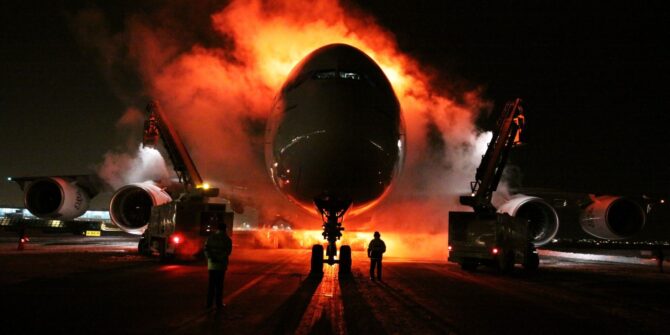
Our top tip: Let your passengers know you’re going to de-ice. If they haven’t seen it before, having dinosaur like rigs pull up to the airplane, or seeing the windows fog up with thick smoky smoggy fluid has been known to panic one or two..
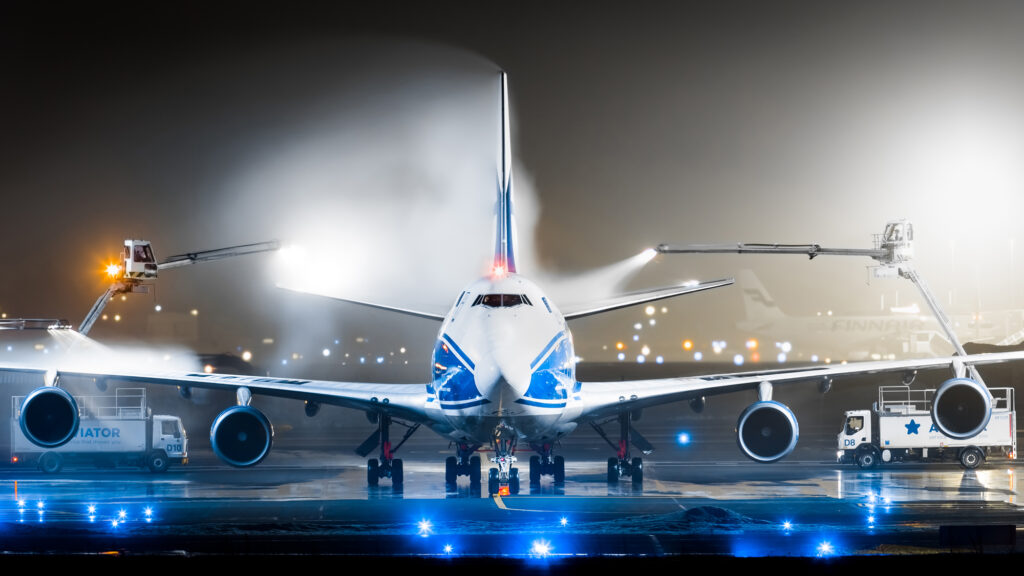
HOT Stuff

Your HOT – ‘Holdover Time’ – is what we really worry about when we need to anti-ice. There is no definite “this fluid will last this long” calculation. Instead we have tables for checking how long you’re probably ok for, depending on a few factors:

  • What sort of fluid was used.
  • Whether it was diluted.
  • What is going on outside.

The table is going to give you two times – a minimum and a maximum, and your best bet is to take the minimum one and if you reach it, take a look at your critical surfaces and see what is going on with the fluid. Actually, a pre-departure contamination inspection is mandatory in most cases. If its look ok (really looks ok) then you’re good to takeoff. Exceed that though and you’re going to need to taxi back, clear it off and start over.

In nasty conditions, keeping an eye on the fluid and the hold over times is super important. There are actually no published HOTs for anything more than light freezing rain. Snow pellets and hail also get messy because these sticky morsels and strong and like to stick to anti-icing fluid, instead of getting melted by it.
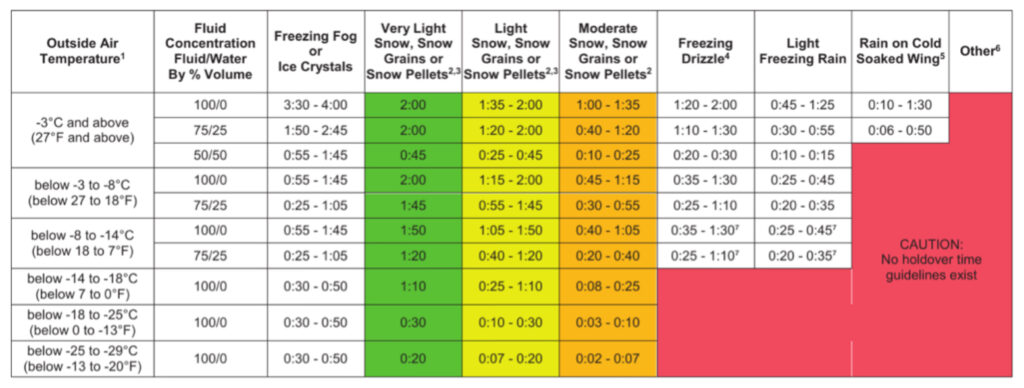
If you are looking at rain or light freezing rain on cold soaked wings then your HOT could be as low as 9 minutes. If you have snow pellets or snow grains bouncing off the windows, and it is colder than about -14°C (so anywhere in Canada, Russia etc in the midst of winter), then these blighters are going to reduce your HOT to as little as 1 to 2 minutes (good luck getting anywhere in that time!)

Hitting the hold over time might suck, but there isn’t much you can do about it except call the cabin for another, stronger coffee, and settle in for a long, cold flight.

Another top tip – check those HOTs and if they are unrealistic then wait for the weather to clear, ask for remote de-icing, go for a different fluid dilution… whatever you do don’t ignore it though and think it’ll all be ok.
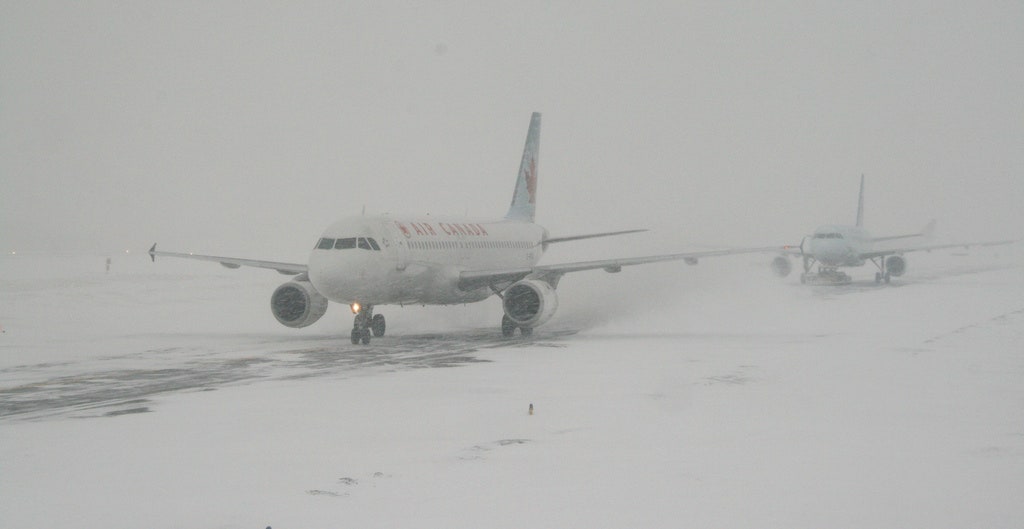
Messing with your schedule

Back to Point 1… or was it 2? The one about delays and messing up of your schedule. Winter weather is going to mean delays. There are no two ways about it. The extra steps added into our pre-flight process also raises the risk of forgetting bits we need to do. So here is a handy checklist of items to remember to remember:

  • Flaps – we usually leave these up for the de-icing process, and to avoid picking up any chunks of ice during the taxi. Don’t forget to set them before you try to take-off.
  • Control checks – often recommended that you do these after de-icing to make sure there are no sticky fluids gumming up your flight controls.
  • The gear – if you are taxiing though slush and sludge then check that performance and if possible, leave the gear down just a little longer to let all the pieces drop off before retracting.

The future looks cold

So de-icing delays aren’t going away anytime soon, but there are some interesting technologies out there being trialled.

Our favorite is this one – originally developed as a de-frosting method for cars, it could eventually be applied to aircraft too. It works off the principle that ice actually has an electric charge, so the idea is if you pass a big charged-up electrode over a frosty surface, it will remove it.

This isn’t a totally new idea either, inflight de-icing technologies are also starting to look at using electromagnetic induction over traditional heating methods to prevent ice build up.

Until then, all we can do is buy a big cup of coffee from the airport, prepare for a long wait, and remember to “keep it clean” (and safe).

Fancy reading a bit more?

Winter Is Coming

Well, we have a question for you.” The New York Center controller seemed amused.

“Go ahead,” I replied, my voice made uneven by the moderate turbulence we were bouncing around in. As I answered, I cast another look over my shoulder at the ice on the wings. The Dash-8 boots were doing their job, at least for now. The aircraft took on a bit of shudder as the props flung ice unevenly off of the blades.

The Center controller delivered the news with a mixture of ironic humor and pity. “Williamsport wants to know if you want them to plow the runway. They say they are closed currently. They have four inches of snow on the runway, but there is a hard crust of ice on top.”

I quickly retrieved the flight release and rifled through the six foot paper scroll to find the NOTAMs. Nothing about the airport being closed, thank Zeus. At least I didn’t miss something big like that. Dispatch should have known—but here we were, halfway between Philadelphia and Williamsport, in and out of freezing rain. I eyed the fuel gauges critically. Plenty left to get there and fly back, if need be. At least there was that.

“Well yeah,” I told the controller. “Plowing the runway would be helpful.”

That night ended with a circling approach to minimums through a narrow valley in light freezing rain mixed with snow. The First Officer flew the approach perfectly, and thanks to the superior stopping power of the Dash 8 we had plenty of slick runway left to play with. Just another Northeast U.S. winter night—par for the course from November until March.

Winter is coming. In some parts of the world, winter is already here and people are insistent on staying inside on top of their twin mattress. However, for pilots, they still have to brave the weather. Flying always brings challenges, but winter supplies extra problems that separates mere pilots from imaginative problem solvers. Problem solving must always be wrapped in a healthy rind of risk analysis. When things go bad in winter weather, they often go bad in a big way.

The accident record is filled with examples of the problems that ice and snow can cause. The American Eagle ATR in Indiana in 1994 was brought down by the crew’s lack of appreciation for the extreme effects of super-cooled large droplets (SLD). In 2005, Southwest Airlines slid off of the end of a slick runway at Chicago Midway. There have been icing induced loss of control events the world over and a few aircraft seem to slip off of the taxiway every winter. Sometimes, simply the additional worry and workload posed by extreme winter weather can add risk. A crew can find themselves rapidly being overcome by events, leaving little time to make decisions in a highly dynamic environment.

de-icing

Technology has come a long way in helping to mitigate the risks that winter can pose. There are now predictive charts for SLD that pilots can examine prior to flight. Deice and Anti-ice fluid technology has improved in past years; there are now three different types of fluid available for use, each tailored for a specific application. The holdover times (the amount of time that fluids remain effective) are revised on a yearly basis as formulations change and the science improves. Some airports are even experimenting with large heaters and infrared deicing technology. Predictive weather tools are much better as well, leading to proactive cancellations that allow aircraft to be positioned for relatively rapid system recovery once a major winter storm has passed.

But there are still problems … Even the best anti-icing fluids can rapidly lose effectiveness in the right conditions; temperatures near freezing with high humidity makes for large, wet flakes that can quickly saturate even the most robust Type 4 fluids and render them useless. Weather systems can capriciously change course with little warning, meaning the difference between a snow apocalypse and a mild dusting of white. Winter is expensive too, with deicing and anti-icing fluids costing more per gallon than jet fuel. Duty days get longer, crews get fatigued, schedules lag and dispatchers become swamped with work. There is nothing more expensive than operating a late airline, and late is often the rule rather than the exception when it comes to winter operations.

So, what is the key to safe winter operations? Planning is essential, but so is flexibility. Many airports have instituted gate hold programs for deicing operations, which helps prevent needless burning of jet fuel on the taxiway. Proactive assessment is key. Knowing the conditions at the destination prior to departure can mean the difference between a successful outcome and tens of thousands to dollars of expense for a divert to an alternate. Caution is the most important concept. Aircraft performance numbers are important, but takeoff and landing distance data should be taken with a grain of salt: it is not uncommon for conditions to vary significantly along the runway length, especially at smaller airports with limited snow removal capabilities.

Planning and caution can mean the difference between a successful, safe operation and having to have a crew have to get creative in the middle of the night. Winter is coming. Time to get ready.