High levels of Pilot Error with NAT RCL: New Briefing and Checklist
The number of pilot errors following the introduction of the new “No Oceanic Clearance” procedure is turning out to be far higher than expected. As a result, Gander have had to implement an evening Airspace Flow Program (AFP), restricting eastbound traffic.

Since December 4th, Oceanic Clearances are no longer being issued by Gander for eastbound flights, and a new procedure is in place using an RCL message to send your desired time, level and speed at the Oceanic Entry Point (OEP).

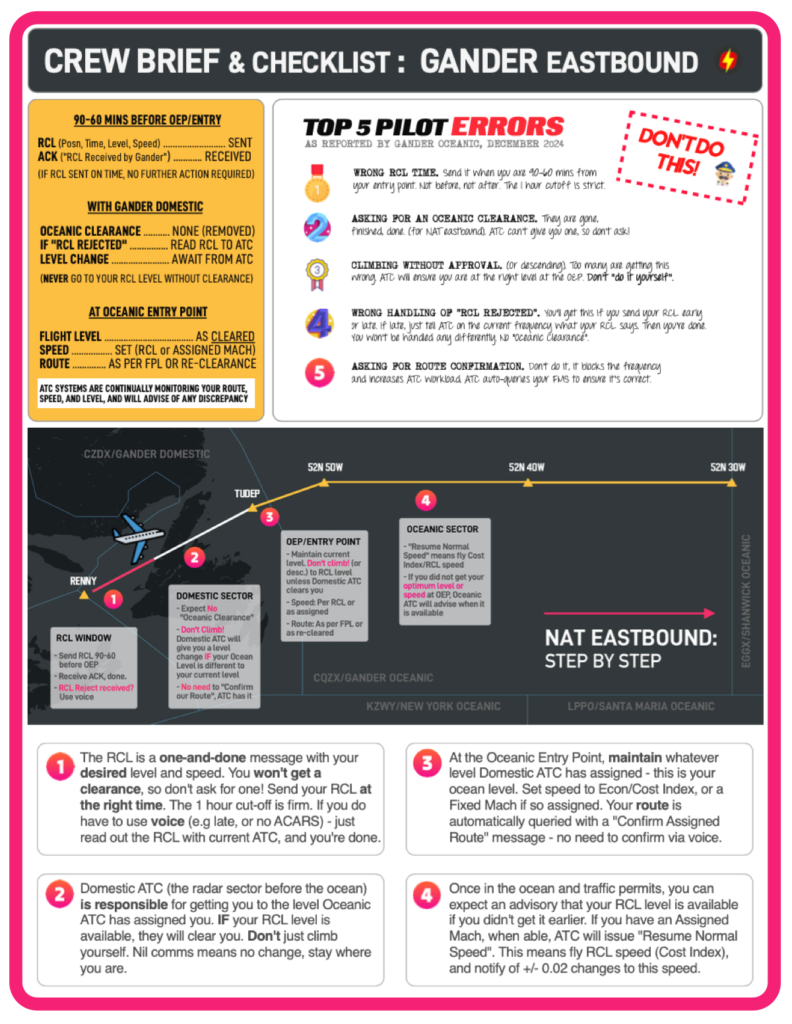
However, the very high level of non-compliance with this new procedure is surprising and troubling. Errors by flight crew fall into a number of different categories, but can be summed up in a “Top 5”, including sending the RCL at the wrong time, asking for an Oceanic Clearance, “DIY” level changes, wrong handling of RCL Rejected messages, and repeated voice requests for “route confirmation” blocking active ATC frequencies.

A new Crew Brief and Checklist has been published today, which you can download below. Please save a copy, and send to your crew and colleagues!
Download the Gander RCL Crew Brief and Checklist (PDF, 1Mb)


Top 5 Pilot Errors

  1. WRONG RCL TIME. Send it when you are 90-60 mins from your entry point. Not before, not after. The 1 hour cutoff is strict.
  2. ASKING FOR AN OCEANIC CLEARANCE. They are gone, finished, done. (for NAT eastbound). ATC can’t give you one, so don’t ask!
  3. CLIMBING WITHOUT APPROVAL. (Or descending). Too many are getting this wrong. ATC will ensure you are at the right level at the OEP. Don’t “do it yourself”.
  4. WRONG HANDLING OF “RCL REJECTED”. You’ll get this if you send your RCL early or late. If late, just tell ATC on the current frequency what your RCL says. Then you’re done. You won’t be handled any differently. No “Oceanic Clearance”.
  5. ASKING FOR ROUTE CONFIRMATION. Don’t do it, it blocks the frequency and increases ATC workload. ATC auto-queries your FMS to ensure it’s correct.


Notes on the RCL process
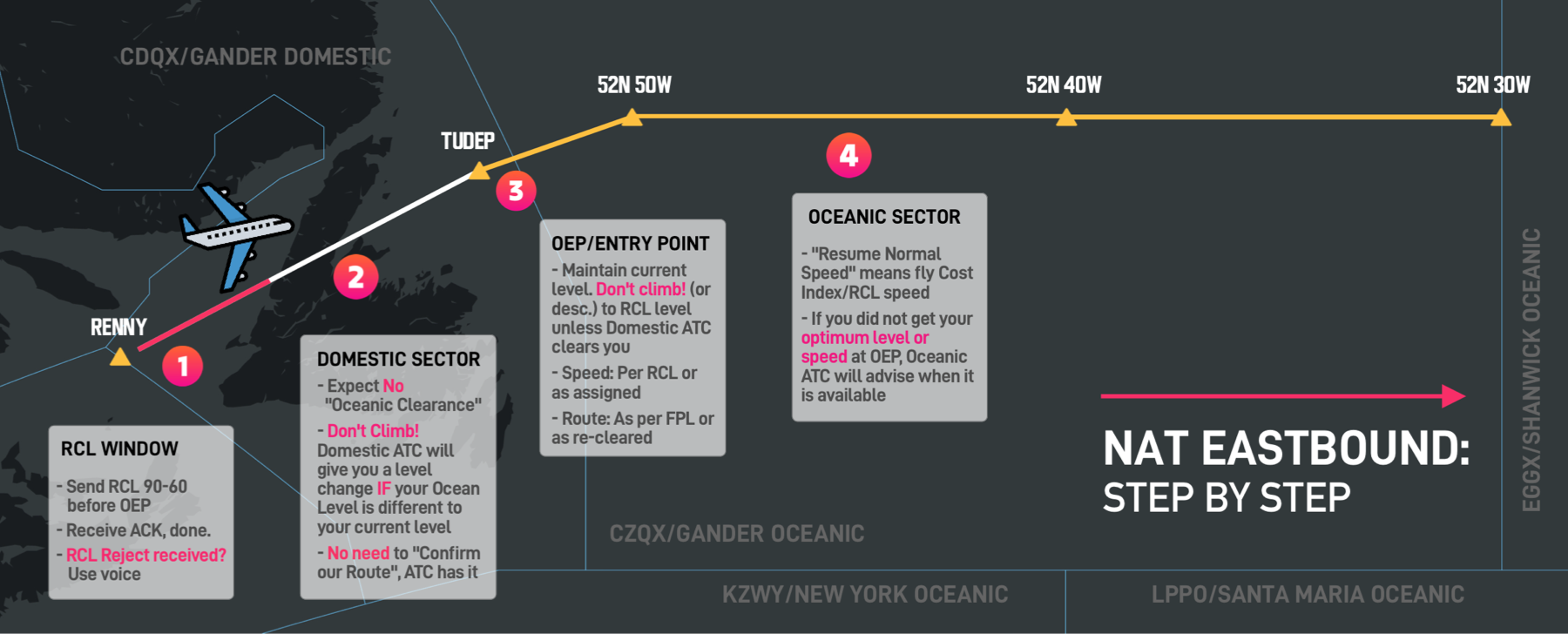
  1. The RCL is a one-and-done message with your desired level and speed. You won’t get a clearance, so don’t ask for one! Send your RCL at the right time. The 1 hour cut-off is firm. If you do have to use voice (e.g late, or no ACARS) – just read out the RCL with current ATC, and you’re done.
  2. Domestic ATC (the radar sector before the ocean) is responsible for getting you to the level Oceanic ATC has assigned you. IF your RCL level is available, they will clear you. Don’t just climb yourself. Nil comms means no change, stay where you are.
  3. At the Oceanic Entry Point, maintain whatever level Domestic ATC has assigned – this is your ocean level. Set speed to Econ/Cost Index, or a Fixed Mach if so assigned. Your route is automatically queried with a “Confirm Assigned Route” message – no need to confirm via voice.
  4. Once in the ocean and traffic permits, you can expect an advisory that your RCL level is available if you didn’t get it earlier. If you have an Assigned Mach, when able, ATC will issue “Resume Normal Speed“. This means fly RCL speed (Cost Index), and notify of +/- 0.02 changes to this speed.

Worried about getting it wrong?

Of course, it always makes sense to double check any uncertainties, but if you can keep it off the frequency, that’s very helpful for ATC. At the moment, there is a high volume of extra requests (which makes life hard for the controller). Remember one key point: ATC systems are continually monitoring your route, speed, and level, and will advise of any discrepancy. Your route in the FMS is queried by a UM137 message (“CONFIRM ASSIGNED ROUTE”), to ensure both you and ATC have the same understanding of your track, or random route acoss the Ocean.

If you’re not certain about how the procedure works, use the Crew Brief and Checklist (developed specifically for Gander Oceanic), and refer to NAT Ops Bulletin 2023_001 Rev 4, and NAT Doc 007.

Can you share? Please do.

The quicker we can get this information out to all NAT crews, the better. Please share with your flight department, fleet, or operation – just download the Crew Brief and Checklist and pass it on.


Questions? Can we help?

If you have a question about the new RCL process, just comment below or send us an email. We want to help make sure that we are all on the same page!




Two is Not Enough: New NAT Doc 007 (Version 3) – August 2019

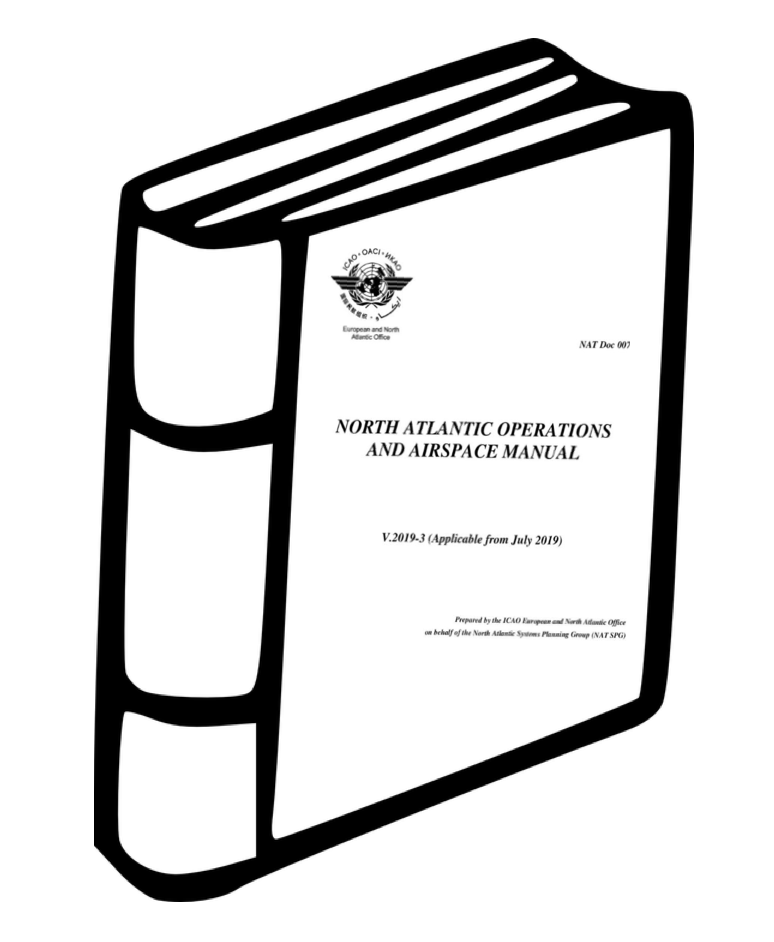
NAT Doc 007 is the Bible of the North Atlantic. It’s full of NAT goodness – all the specifics about how to operate your aircraft safely through the complex airspace of the region is here.

And there’s another new edition!

The NAT changes over the last few years have been coming thicker and faster than the sandwiches at Katz’s Deli on the Lower East Side. And now, there’s more. Effective August 7th, 2019, NAT Doc 007, Version 3, is the latest tome to digest. As aviation documents go, it’s written in pretty digestible language. There’s just a lot in it. But this is the first time we’ve had 3 editions of this in one year.

So, we’re going to start naming them after 007 Movies to keep track of them all. This is the “Two is Not Enough” edition.

NAT Doc 007, Version 3, 2019:
Download the full NAT Doc 007.

So, here are the three things that have changed this time:

1. We got new SLOP rules! This is a biggie. Instead of the three previous choices (0, 1, or 2nm), we now have Twenty One choices! More on this below.

2. 99 problems and Datalink is one. The short version: check that you’ve got the latest software update for your datalink.

3. The next datalink mandate (2C) is capped at FL410. This comes in January 30th next year. And so, the Checklist for Dispatchers is updated.

The new SLOP rules

Now, let’s take a closer look at the big change – SLOP (Strategic Lateral Offset Procedure). To get up to speed, check out our full article on SLOP – the how, and why (and where).

The change here is that instead of just being able to SLOP 1 or 2 nm right of track, (or fly the centreline), you go from these three choices to twenty one – you can use any one of 21 Micro-SLOP offsets. Specifically: 0.0 nm, 0.1 nm, 0.2 nm …. OK, you get it. All the way up to 2.0 nm Right of track.

Simple, right?

Not quite. It’s not yet fully clear which of the OCA’s have given the green light for this, even though NAT Doc 007 now says you should Micro-SLOP if you can.

But, phoning around the Oceanic Houses, we’ve got this to tell you:

1. Gander – you can micro-SLOP right now! An AIP amendment will follow soon.
2. Shanwick – you can micro-SLOP right now! A Notam will be published soon, and the AIP will be updated in Dec 2019.
3. New York – they will allow micro-SLOP from 12th Sept 2019, and will update the AIP in Jan 2020.
4. Santa Maria – you can micro-SLOP right now! Nothing published officially yet, but that’s what the good people from the oceanic control centre have told us.
5. Iceland – just like New York, they will allow micro-SLOP here from 12th Sept 2019 as well. When that happens, you will still not be allowed to SLOP below FL285 within the Reykjavik CTA (that’s the domestic part over Iceland, and the airspace over Greenland above FL195). We asked them to publish a Notam about this – and they actually did!! Check it out!
6. Bodo – Nothing official yet, but ATC say they “have no objections” to operators micro-SLOPing right now. (Currently, SLOP is only allowed here above FL285 within the OCA.)

That’s the current picture as of 1100z on Monday 19th Aug.

We will update this as soon as we get more info. Got something for us? Email us!


My first North Atlantic Flight is tomorrow – NAT Ops Guide (Updated 2018)

For the latest changes and updates on the North Atlantic, including our most recent Guides and Charts, use our NAT reference page at flightservicebureau.org/NAT.

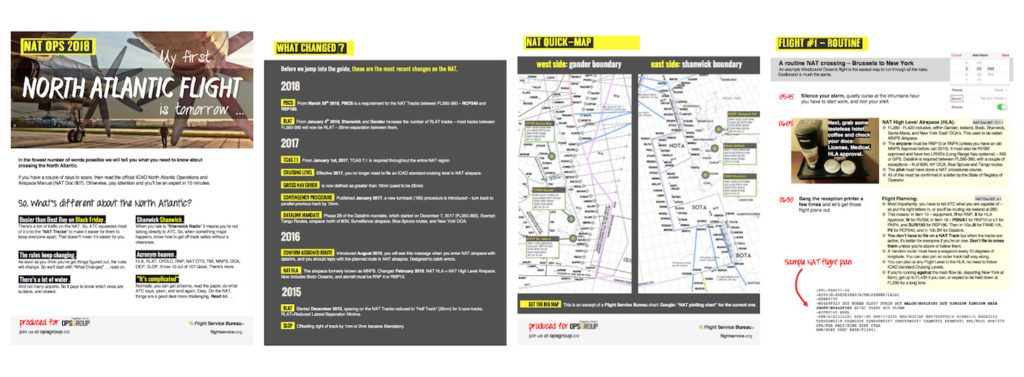
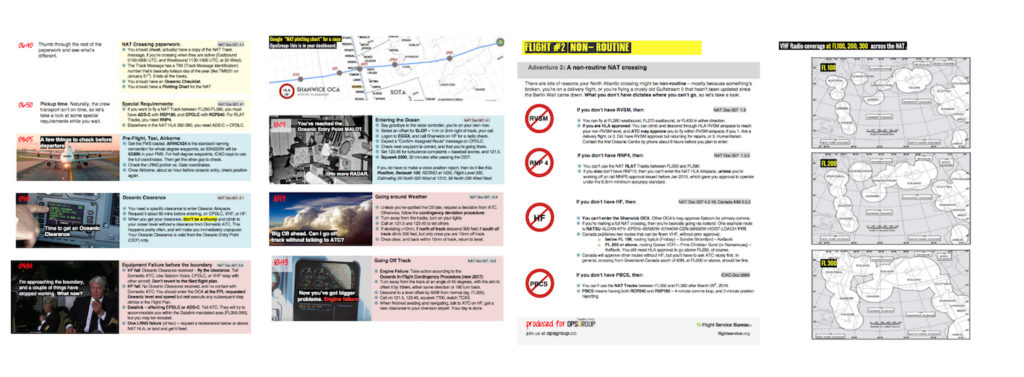
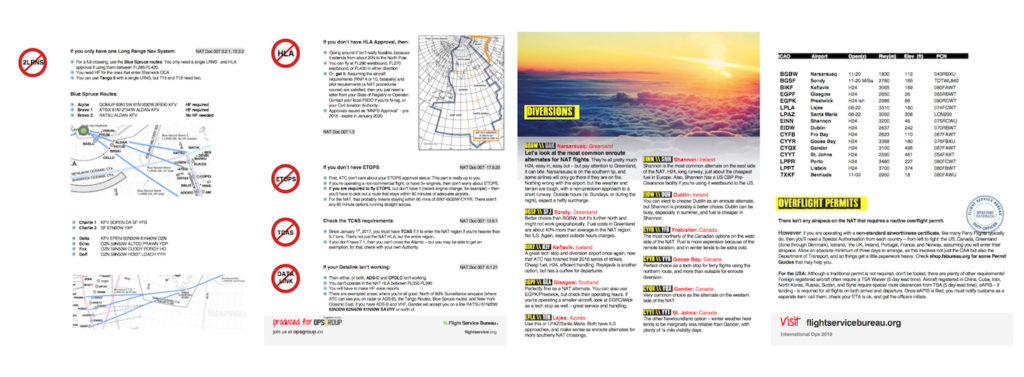
Of all the hundreds of questions we see in OPSGROUP, one region stands out as the most asked about – the NAT/North Atlantic. So, we made one of our legendary guides, to get everything into one PDF.  It’s called “My first North Atlantic Flight is tomorrow” – and now we’ve updated it for 2018!

Contents:

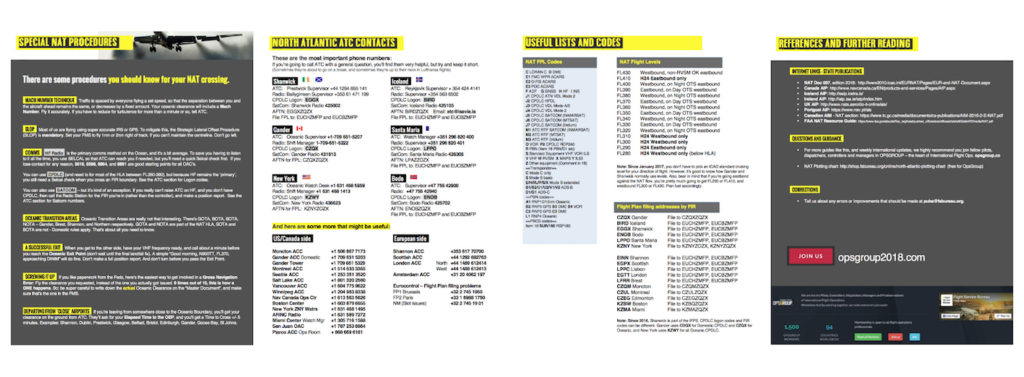
  • 1. What’s different about the NAT?
  • 2. Changes in 2018, 2017, 2016, 2015
  • 3. NAT Quick Map – Gander boundary, Shanwick boundary
  • 4. Routine Flight Example #1 – Brussels to JFK (up at 5.45am)

  • 5. Non Routine-Flights: No RVSM, No RNP4, No HF, 1 LRNS, No HLA, No ETOPS, No TCAS, No Datalink – what you can do and where you can go
  • 6. Diversion Airports guide: Narsarsuaq, Sondy, Kef, Glasgow, Dublin, Shannon, Lajes, Fro Bay, Goose Bay, Gander, St. Johns
  • 7. Airport data
  • 8. Overflight permits – routine and special

  • 9. Special NAT procedures: Mach number technique, SLOP, Comms, Oceanic Transition Areas, A successful exit, Screwing it up, Departing from Close Airports
  • 10. North Atlantic ATC contacts for Shanwick, Gander, Iceland, Bodo, Santa Maria, New York – ATC Phone, Radio Station Phone, AFTN, Satcom, CPDLC Logon codes; and adjoining Domestic ATC units – US, Canada, Europe.
  • 11. NAT FPL Codes
  • 12. NAT Flight Levels
  • 13. Flight Plan Filing Addresses by FIR
  • 14. Links, Questions, Guidance

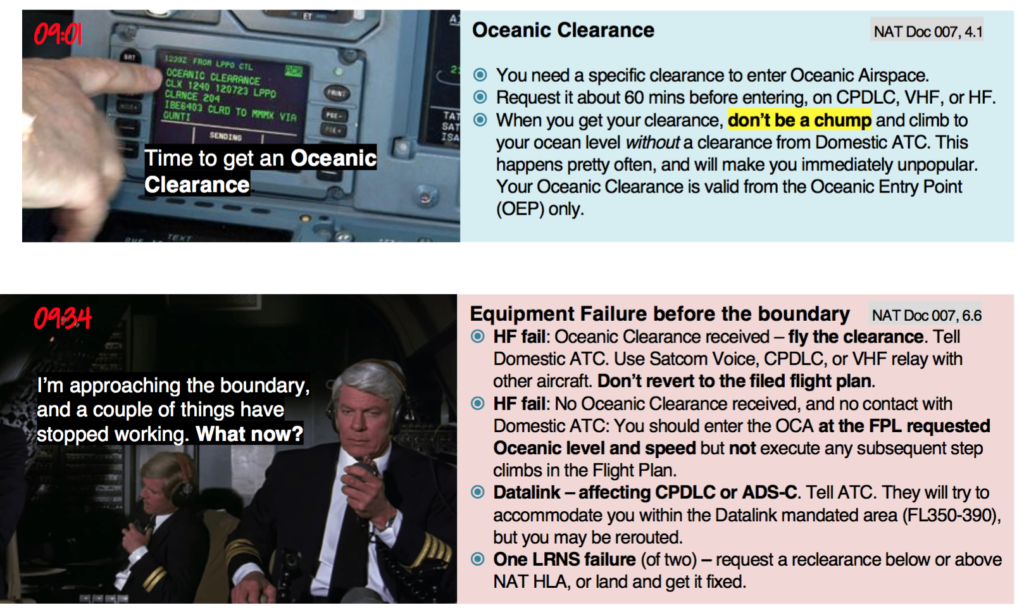
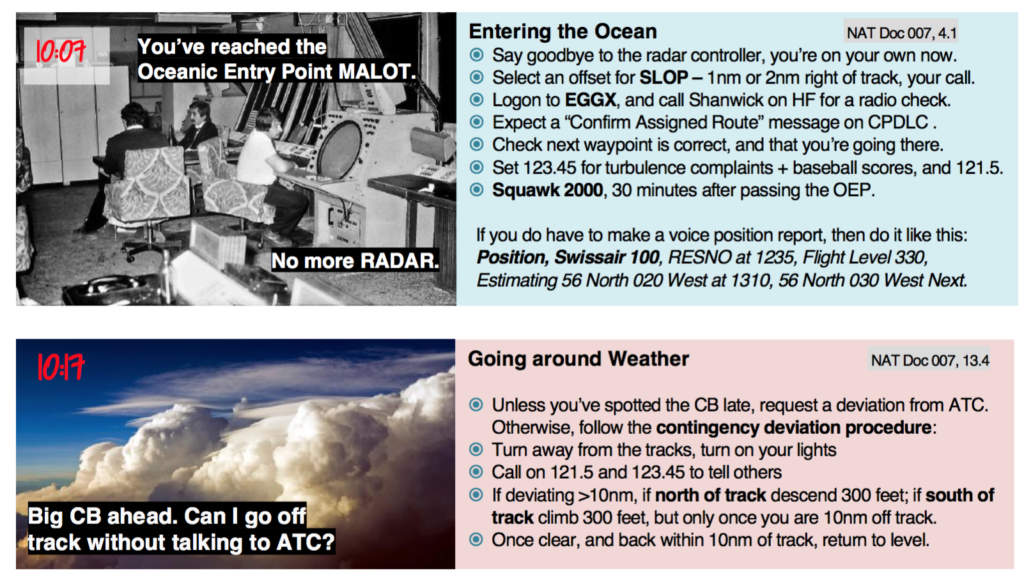
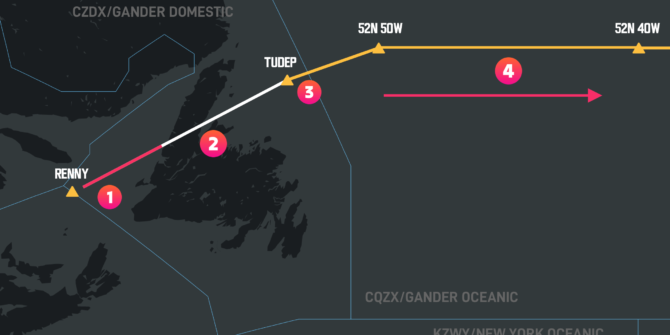
Excerpt from the Routine Flight #1:


Buy a copy ($20)   Get it free – join OPSGROUP

To get your copy – there are three options:

  1. OPSGROUP Members, login to the Dashboard and find it under “Publications > Guides”. All FSB content like this is included in your membership, or
  2. Join OPSGROUP with an individual, team, or department/airline plan, and get it free on joining (along with a whole bunch of other stuff), or
  3. Purchase a copy in the Flight Service Store!