Africa Airspace Risk: Jet Shot in Rwanda
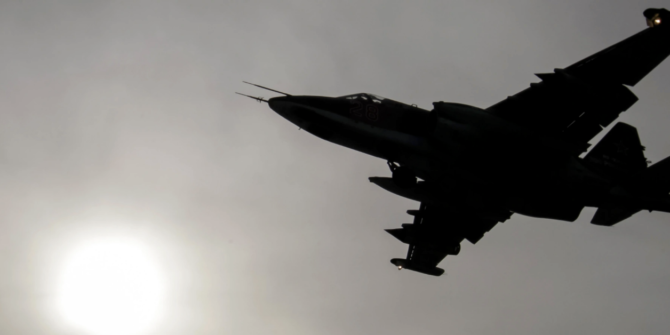
On Jan 24, the Rwandan military shot at a fighter jet from the Democratic Republic of Congo which they claimed had busted Rwandan airspace near Goma.

This has captured our attention for three major reasons:

  • There are no active airspace warnings for either the FZZA/Kinshasa or HRYR/Kigali FIRs.
  • The incident occurred at low level, but in an area of open airways.
  • The aircraft was hit in close proximity to an international airport.

This was a major escalation following months of conflict between the two countries – so much so that the DRC announced the shooting as an ‘act of war.’

Here’s a look at exactly what happened and what this might mean for risk to civil aviation operating into, or overflying the Central African region.

The January 24 Incident

During daylight hours, a Sukhoi-25 military jet operated by the Democratic Republic of Congo reportedly violated Rwandan airspace between Goma and Gisenyi, without a clearance.

There are several unverified videos circulating of the jet being struck at low level by a surface-to-air missile, fired from a MANPAD. These are small, light, shoulder launched anti-aircraft weapons

The jet landed safely but sustained heavy damage. The incident raises concerns because there are contradictory accounts of how the situation unfolded, debate over which side is responsible, and so a lack of reliable information over what the safety implications might be for civil aircraft.
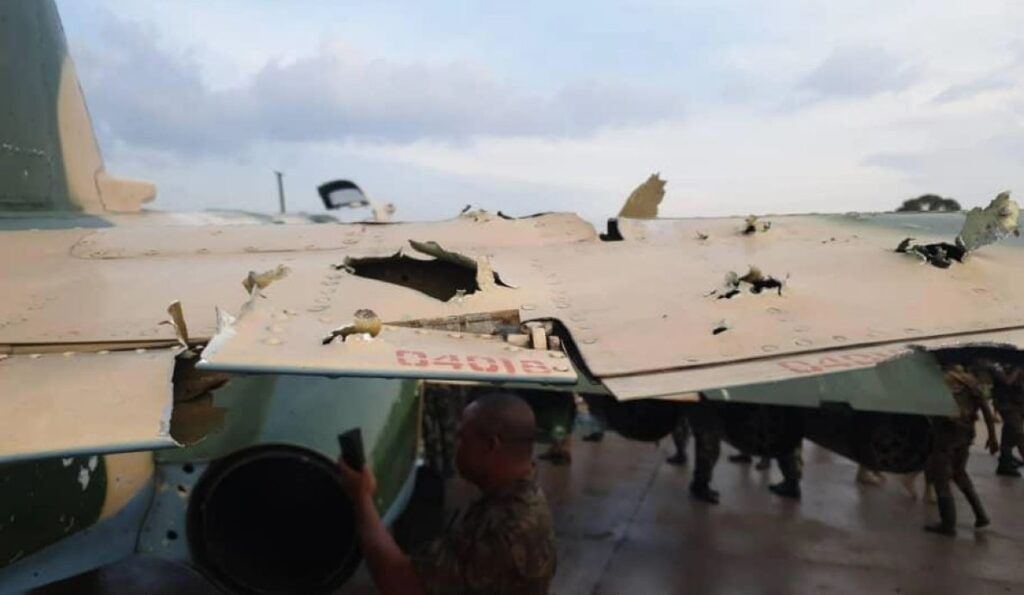
The jet was damaged but landed safely.

Escalating Conflict

This is the latest escalation of a conflict that has been worsening for months, and a strong indication that it may be putting overflying aircraft at risk as it grows – especially near the shared border.

In late 2021 heavy tensions erupted between the Democratic Republic of the Congo and Rwanda. An armed insurgency is underway in the DRC by a recently re-emerged militant group known as the March 23 Movement (or just M23 for short).

The DRC (along with the US and UN) have accused Rwanda of supporting M23, and in some cases even fighting alongside them. Although this hasn’t been proven.

The ethnic and political background to the conflict run deep and are beyond the scope of this article, but the bottom line is frequent skirmishes by both Congolese and Rwandan forces in each other’s territory.

Skirmishes on both sides of the shared DRC/Rwandan border have been reported.

Airways

The January incident happened near Goma – a city that lies on the DRC side of the border, and straddles the boundary between the FZZA/Kinshasa and HRYR/Kigali FIRs.

Several international airways run through the same airspace where the incident occurred.
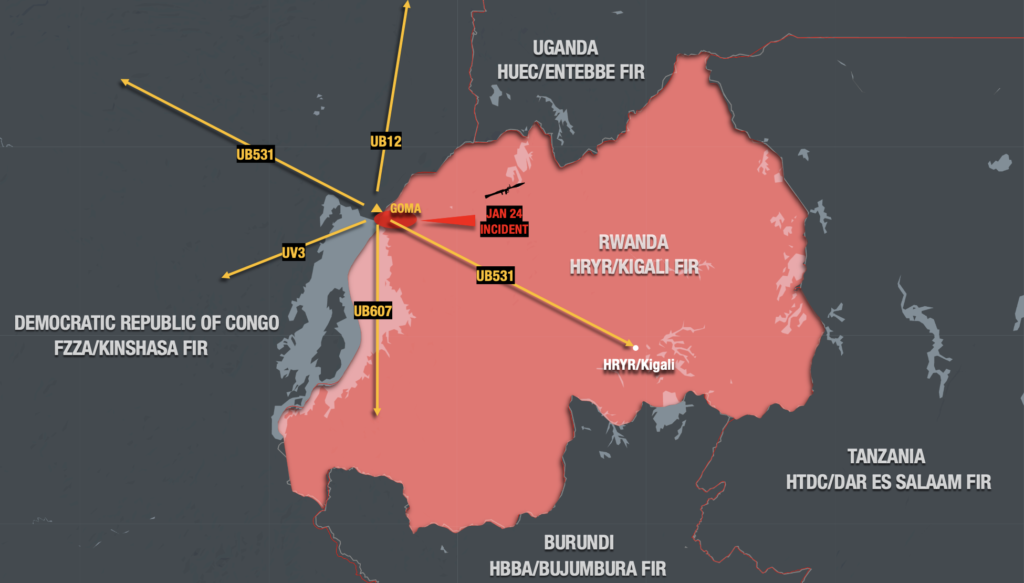
Also use caution on airways UM216, UA618 and UL442 away from Goma but which skirt the shared border where skirmishes have been occurring.

Is this a high or low-level threat?

Short answer, low – but there’s more to it than that.

Militaries from both sides, along with the M23 rebels, are all known to have anti-aircraft weaponry.

The most common is the MANPAD. They are easy to use, portable and require little if any training. They are unfortunately prolific throughout Africa in both legitimate and illegitimate hands – Rwanda and DRC are no exception. And the intent to use them is now clear.

They typically target aircraft flying low, and slow. Which means aircraft taking-off and landing are most at risk. However publicly available information indicates MANPADs can reach aircraft as high as FL250.

Anti-aircraft guns along with ballistic weapons such as rockets and other artillery are also known to be present, and are potentially dangerous to aircraft, once again at low level.

Neither side has shown any intent to actively target civilian aircraft. But there are several risk factors at play.

The DRC/Rwandan border is an active conflict zone, where military activity and the transport of troops and equipment is common. Aircraft surveillance in the area is rudimentary, and the conflict has become territorial not just on the ground, but now in the air too.

All the warning signs are there, only with no actual warnings.

Once again, mistaken identity has become the number one threat.

With this in mind, overflying jet traffic at higher flight levels are not at risk – if ops are normal.

The problem becomes if you need to descend or divert. And aircraft operating into the region’s airports are especially exposed. Extra caution needs to be taken at FZNA/Goma – the site of the January incident.

Official Warnings

There are none.

History has taught us that we need to be more responsive to airspace threats – a danger may exist or develop before states publish official airspace warnings or restrictions. All of that takes time. And if your flight is today, you need to know now.

We’ll continue to report on changes in Rwanda and DRC as they happen over at safeairspace.net – our conflict zone and risk database.
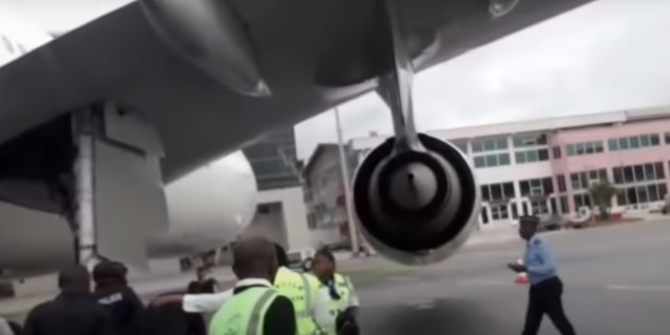
A330 shot at during Covid relief flight

An Air France A330-200 was shot at after landing in FCPP/Pointe Noire, on the evening of April 11th. The aircraft was operating a Covid repatriation flight, picking up passengers in Congo-Brazzaville, and planned to depart back to Paris via Bangui.

Two shots were fired during the incident, with one bullet puncturing the fuselage.

Initial reports made the incident seem quite disturbing, with differing versions of the story appearing in news media.

But, it turns out to have been a little less dramatic. It seems an altercation between a security guard and his boss led to him trying to fire his gun in the air, and hitting the aircraft was unintended.


Monday Briefing: Cuba Travel opens up, Chile Airport strike ends

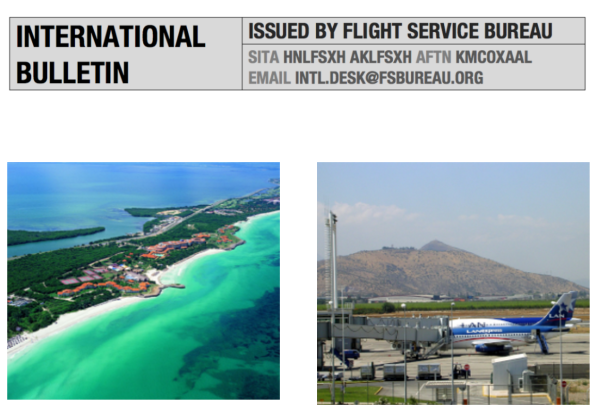
Cuba Travel opening up 21DEC Negotiations between the USA and Cuba on scheduled air services between the two countries are progressing at pace; meaning that we expect to see sanctions on private US Tourism Travel lifted as early as next March. See more below.

Chile Airport Strike ends 21DEC A four day strike was ended yesterday 20DEC in Chile by the Trade Union, as 3000 Airport workers across the country responded to the governments rejection of a pension plan. Several hundred flights were cancelled. Non-scheduled operations were largely unaffected, but the risk of further action remains.


HUEC/Entebbe ACC, Uganda. ATC in Uganda is reporting a significant increase in the number of flights entering their airspace without prior coordination from Sudan and Congo (Khartoum and Kinshasa FIRs). Regional ATC in Africa is known to be challenging, but this warning deserves attention. Crews should make all efforts to contact each FIR 10 mins in advance – HF 11300, or relay on 126.9 if unable.

KZMA/Miami FIR SpaceX announced Sunday it has pushed back its planned launch of a Falcon 9 rocket with 11 communications satellites to 2033 ET Monday. KZMA has issued NOTAM A1357/15 for launch. It will also affect the KZJX Jacksonville FIR and TJZS San Juan FIR. The FAA will also issue tactical advisories regarding the launch and will most likely restrict operation on AR6 and AR15.

EGGX/Shanwick have issued a reminder to flights operating on the “Tango Routes” (T9, T16, T213) that HF in all cases is required to operate here, and crews should be trained in the procedures. Request OCA Clearance 50 mins in advance. Primary/Secondary HF freqs: Southbound 6547/8879, Northbound 8879/6547.

LIPH/Treviso Fuel spillage on the runway has closed the airport until 1700Z today 21DEC.

Cuba and USA Reports in the international media last week indicated that an agreement between Cuba and the US is likely to be signed early next year, allowing up to 110 scheduled flights: 20 to Havana, 10 to each of the other 9 international airports in Cuba. At present, US visitors must still fall in to one of the 12 official categories for authorised travel; however, once scheduled services are in place, we anticipate this to be the leverage to remove the final hurdle for US citizens – visiting Cuba for tourism. The first flights will likely operate in early March.

It should be noted that there are no restrictions on the Cuban side. US Aircraft can land in Havana with a routine Landing Permit issued by IACC, and US Aircraft can overfly with a routine Overflight permit. We anticipate that the requirement for a permit will stay in place as this is routine in most Latin American countries, primarily to check Navigation Fee debts and Operator Profile.

Georgia and Ukraine On 18DEC2015, the EC announced that both Georgia and Ukraine meet requirements for being granted visa-free travel to the European Union’s Schengen zone. However, the European Parliament and the EU member states must vote in favor of granting Georgia and Ukraine visa-free travel before they are able to do so. Reports indicated that the decision could be put to a vote as early as 2016.

Haiti On 19DEC, election-related demonstrations across Haiti turned violent amid accusations of electoral fraud. Violent clashes led to the burning of several government buildings. Haitian police officers stated that they were trying to restore security to the country.

Space Weather/Polar Ops moderate an ongoing G1 geomagnetic storm expected for Mon, Dec 21. Please check the NOAA Space weather aviation dashboard for the latest actuals and predictions HERE.

PAZA/Anchorage ARTCC has a number of new procedures and systems in place effective 17DEC, including 30/30 RNP4 separation, an update to the Track Advisory program for westbound Russian Tracks, and standard routings. Check the current PAZA NOTAMs for complete information.

ZBAA/Beijing authorities have issued a red alert for high levels of air pollution and reduced visibility. The alert will be effective until 22DEC. According to China’s National Meteorological Center, air pollution levels are forecast to be slightly higher than those recorded from 06-09DEC.

EGLL/EGKK London Heathrow/Gatwick Airport train links will be disrupted over Christmas. The Gatwick Express trains will stop running for 10 days due to engineering works, with the last service of 2015 leaving Victoria station at 9.15pm on Christmas Eve and the first services of 2016 scheduled for 4 January. At Heathrow, the usual one-day closure on Christmas Day will be extended by three days. Neither Heathrow Express nor Heathrow Connect trains will run from London Paddington station during the period.

UBxx/Azerbaijan will become part of the IFPS (Integrated Flight Plan System) zone as of AIRAC 1601 on 07JAN2016. Azerbaijan will delegate responsibility for the provision of flight planning services for IFR/GAT flights within the Baku FIR to the Network Manager’s Integrated Initial Flight Plan Processing System. For more info see Azerbaijan AIC 01/2016 Series A, AIP ENR 1.10, AIP ENR 1.11 and NOTAM A0126/15.

UHPP/Petropavlovsk FIR Volcano Karmsky has recently been active with ash reported up to 15,000 ft and possibly affecting ops on R220. Please check for the latest Tokyo VAAC advisories.

The ICAO Council adopted a new tracking standard for certain international flights that requires crews to report their aircraft’s positions at least every 15 minutes. It will become effective in March 2016 and applicable 08NOV2018. The new requirement also will be formalized as Amendment 39 to Annex 6—Operation of Aircraft, Part I. Only aircraft with a maximum takeoff weight of more than 59,000 pounds and a passenger seating capacity of more than 19 are affected by the rule. Also, the requirement applies to over oceanic and other remote areas, and where air traffic service is obtaining position information greater than 15-minute intervals.

Christmas and New Years closures. Check opening times carefully during the next 2 weeks, as many major airports and FBO’s have closures, especially on 24, 25, 26DEC and 31DEC/01JAN.