Circling: Why Is It So Dangerous?

April 2026 Update:
It’s been three years since we originally published this article on the inherent dangers of circling approaches. New data from the Aviation Safety Information Analysis and Sharing program (ASIAS) – a big US aviation data-sharing system run by the FAA and industry partners – shows that we’re still getting these approaches dangerously wrong.
The report links circling to loss of control and CFIT accidents among Part 91 and 135 operators, with 17 fatalities between 2008 and 2023.
Here’s what they found, and why it still matters.
The ASIAS report.
The study used real-world accident data along with FOQA reports to analyse circling-to-land accidents and incidents, not just theory. The bottom line is that circling approaches are still catching crew out. They keep showing up in loss-of-control, CFIT, and unstable approach events. And the pattern is consistent.
What’s actually going wrong.
The big one – leaving circling area. Crews are ending up outside of the protected areas by either flying too wide, too far or too fast. Once you’re outside, there’s no more obstacle clearance. It’s safety critical that you know your approach category, and the circling area that applies i.e. PANS OPS or TERPS. If you’re not familiar with these terms, we cover them in detail in the original article below.
The unstable approach ‘chain’ rarely starts with just one mistake. A typical sequence might include being high or fast, leading to a rushed visual segment and unstable approach. From there, continuation bias can take the controls leading to attempt to salvage a landing, rather than go-around.
Ever heard of ‘the six P’s?’ Chances are we’ve all grappled with it at one stage or another in our careers: ‘Prior Preparation Prevents P*** Poor Performance.’ It’s crude way of saying we fly better when we are prepared. The ASIAS report identifies that poor set up before circling is leading to accidents. This includes inadequate briefing, no clear plan for the manoeuvre and no defined escape/go-around point. In other words, crew are ‘figuring it out’ while already low.
Our eyes play tricks on us. Circling at night or in reduced visibility, sloping terrain, black hole effect and even workload at low levels makes it easy for us to misjudge distance, height and turn radius.
Worryingly, this isn’t just about accidents. The data also shows numerous unstable circling events that didn’t end a crash. So the risk is bigger than accident stats suggest.
Practical Takeaways
Circling isn’t routine, treat it as high risk. If there’s a straight-in option, take it. If you do need to circle, it’s essential to plan it properly before you start, stay within the circling area and if’s not working, go around. At night or in marginal VMC the risk increases dramatically.
Original Article:
Here’s a startling statistic – according to the Flight Safety Foundation, straight-in approaches are twenty-five times safer than circling ones. Twenty-five times!
It’s no wonder then that the NTSB are concerned. In fact, they identified that there were ten major accidents involving Part 91 and 135 operators between 2008 and 2023 while flying a circling approach.
We smell risk, and so does the NTSB. Which is why in March 2023 they issued a new safety alert. Asides from the obvious risks of operating a high-performance aircraft at low speed and altitude in poor visibility, there appears to be another threat too – key differences between ICAO PANS-OPS and US TERPS.
Let’s take a closer look…
The NTSB Alert
The NTSB’s key takeaway seems to be this: you don’t need to circle. You can also request a runway aligned approach, or if that isn’t practical, a diversion.
Of course, if a straight-in approach isn’t available, a diversion for a commercial operator would likely be a tough sell when there is a legal and procedural approach to the runway in front you.
But if you do, it implores you to understand and thoroughly brief the risks.
The reality is that circling approaches are far riskier. They involve manoeuvring an aircraft low to ground, and low in energy in marginal conditions. This opens the door to two major dangers – loss of control, and collision with the hard stuff.
They’re also not particularly conducive to a stabilised approach, which typically involves being runway aligned by 500’ off the deck in VMC conditions, or higher in the soup.
Then there is the elephant in the room – our own limitations. As pilots we are responsible for setting our own personal limits. More often than not, these rest within the ones defined by law. Familiarity, experience and conditions all come into play when assessing our appetite for risk.
In other words, just because a procedure is legal doesn’t mean we should fly it.
The NTSB also identifies that training (or lack of) is an issue. When was the last time you circled in the simulator? To fly circling approaches safely, we need to be practicing them in our re-currents regularly and in different conditions.
This is where the NTSB alert ends, but there may also be more to it than that – the way circling procedures are designed may also be partially to blame…
The PANS-OPS versus TERPS Conundrum
It will likely be no surprise that instrument approach and departure procedures are designed to keep aircraft safely away from terrain and obstacles to internationally accepted standards.
To make this happen, there are two main sets of procedures:
- ICAO Procedures for Air Navigation Services (PANS-OPS) used throughout Europe and in many other parts of the world. You can these in ICAO Doc 8168.
- United States Standard for Terminal Instrument Procedures (TERPS) used throughout the US, Canada and in some other countries such as Korea and Taiwan. Those details are in FAA Order 8260.3D1.
When we circle, we need to understand how the procedure was designed (PANS-OPS or TERPS) and what the differences are, which can be significant.
The reality is that under TERPS, in some cases aircraft are required to fly slower, with higher angles of bank in more restrictive circling areas despite improvements made back in 2013. And all of this can happen in lower visibility than in PANS-OPS procedures.
Could this be one of the contributing factors to circling accidents in the US and Canada? Possibly.
What are the differences?
In both systems, a radius is drawn from the centre of the threshold for a particular runway inside of which obstacle clearance has been assessed. It’s known as a circling area, or domain.
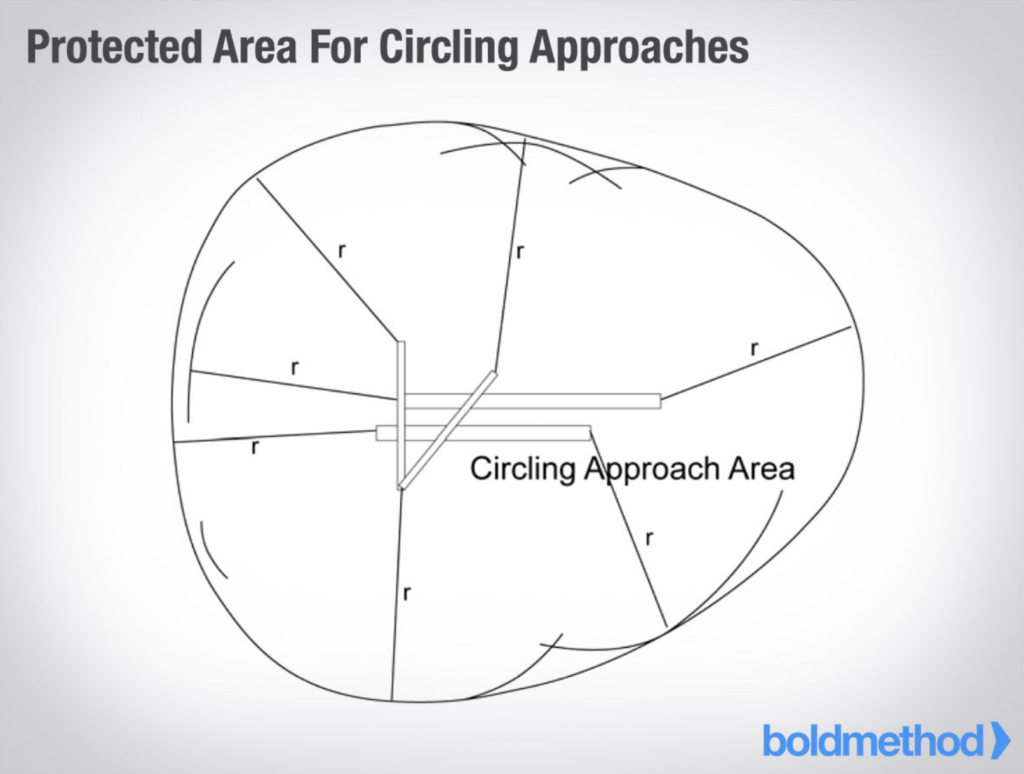
Protected areas are drawn from arcs from the center of each threshold. Courtesy: Boldmethod
The size of this area increases with aircraft category – essentially if you’re heavier, you need to fly faster which means your turn radius increases, and you need more room to circle. This is taken into account using TAS and bank angle when the procedure is designed – along with a healthy dose of mathematical wizardry.
But herein lies an essential difference.
PANS-OPS bases TAS on altitude and circling IAS. TERPS on the other hand bases this on altitude and IAS at threshold. The result is a much smaller circling area, and in some cases higher bank angles.
The maths behind circling approaches is complicated, but the key difference between PANS-OPS and TERPS is IAS.
Take a Category C aircraft for instance (threshold speed 121 – 141 kts). Under PANS-OPS the circling area for an approach would extend to 4.2nm, while under TERPS (with an MDA of less than 1000’) the same area would extend only as far as 2.7 nm. For lower category aircraft, this also increases minimum bank angle beyond 20 degrees. Things can start to get tight.
In a nutshell, because ICAO uses higher IAS for its TAS calculations, and assumes a lesser angle of bank, its circling areas are far roomier.
International operators in particular may be at risk of straying outside of the circling area if they are not familiar with the more restrictive TERPS procedures. To make matters worse, some countries may not be 100% one way or the other. A straight-in approach may be designed to PANS OPS, while the circling approach is designed to keep you within a TERPS assessed area – Mexico and Chile being examples.
And in some cases, all of this can happen down to a minimum visibility of just 1.5 miles (2.4km) under TERPS, versus 2.3 miles (3.7km) under PANS-OPS.
How do I know what kind of procedure I’m flying?
Get your magnifying glass out. It will be written in the margin of your chart. If you’re using Jeppesen, have a look at the bottom left-hand side, written vertically. It’s far from obvious.
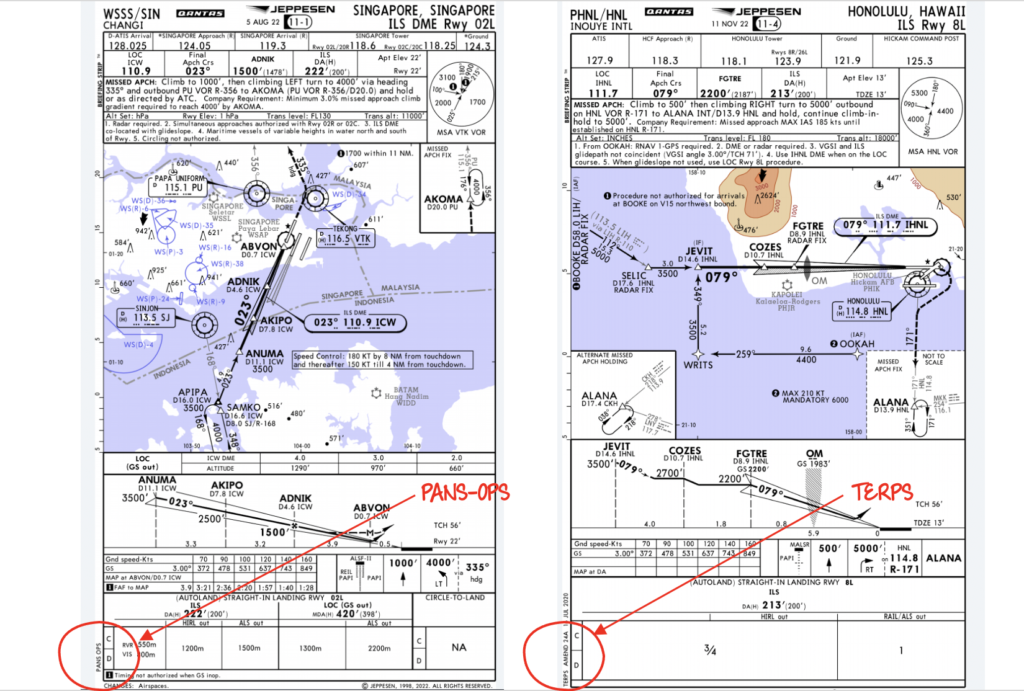
Once you’ve established what type of approach you’ll be flying, you’ll need to think about speed, your circling area, and whether the visibility is appropriate. We’ve put together a little cheat sheet that may help…
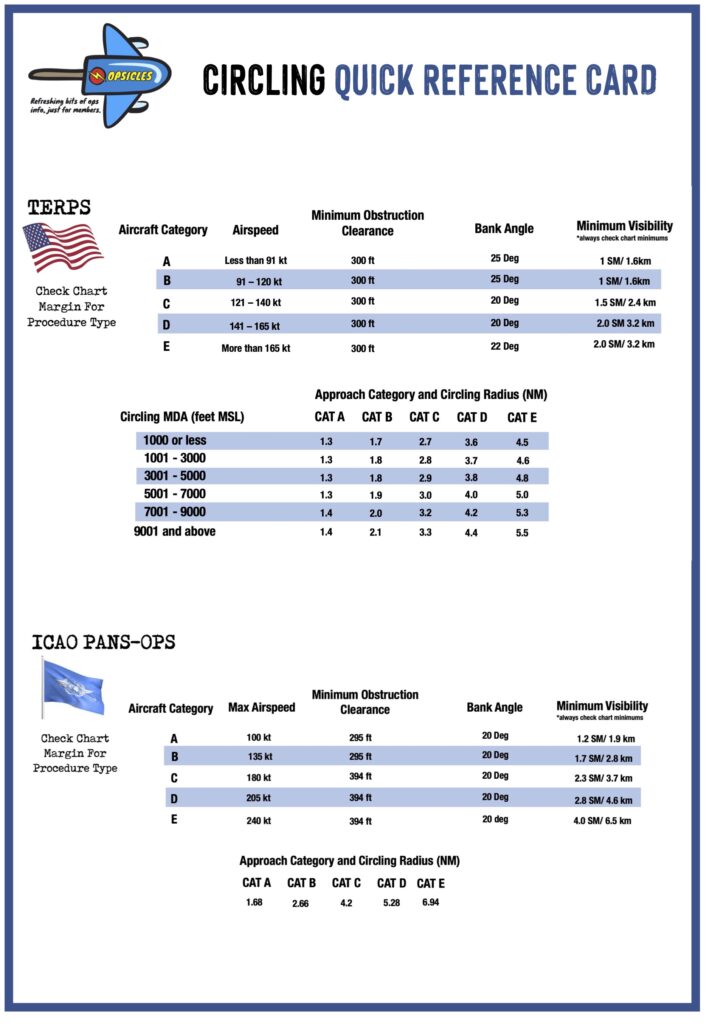
OPSGROUP members: Click to download PDF.
The Stats Don’t Lie
We’re getting circling approaches tragically wrong. What the industry is currently teaching pilots doesn’t seem to be cutting the mustard – and the Flight Safety Foundation agrees. Pilots need to be more aware of the design criteria used for circling approaches, and the limitations that places on their aircraft. This also needs to be made far clearer on approach charts if we’re to reduce risk on these challenging manoeuvres.