US Border Overflight Exemptions: A How-to Guide
Update Aug 2025: BOEs Move to eAPIS (No More Email Applications)

Until now, getting a Border Overflight Exemption (BOE) was an email game. You’d draft up a message to CBP with your operator details, compliance statement, and a few other bits depending on whether it was a new application, renewal, or name change.

That’s now changed. CBP has shifted BOE applications and renewals into the eAPIS web portal. Instead of emailing back and forth, you log in with your usual eAPIS credentials and hit the new “Border Overflight Exemption” link under the manifest options.
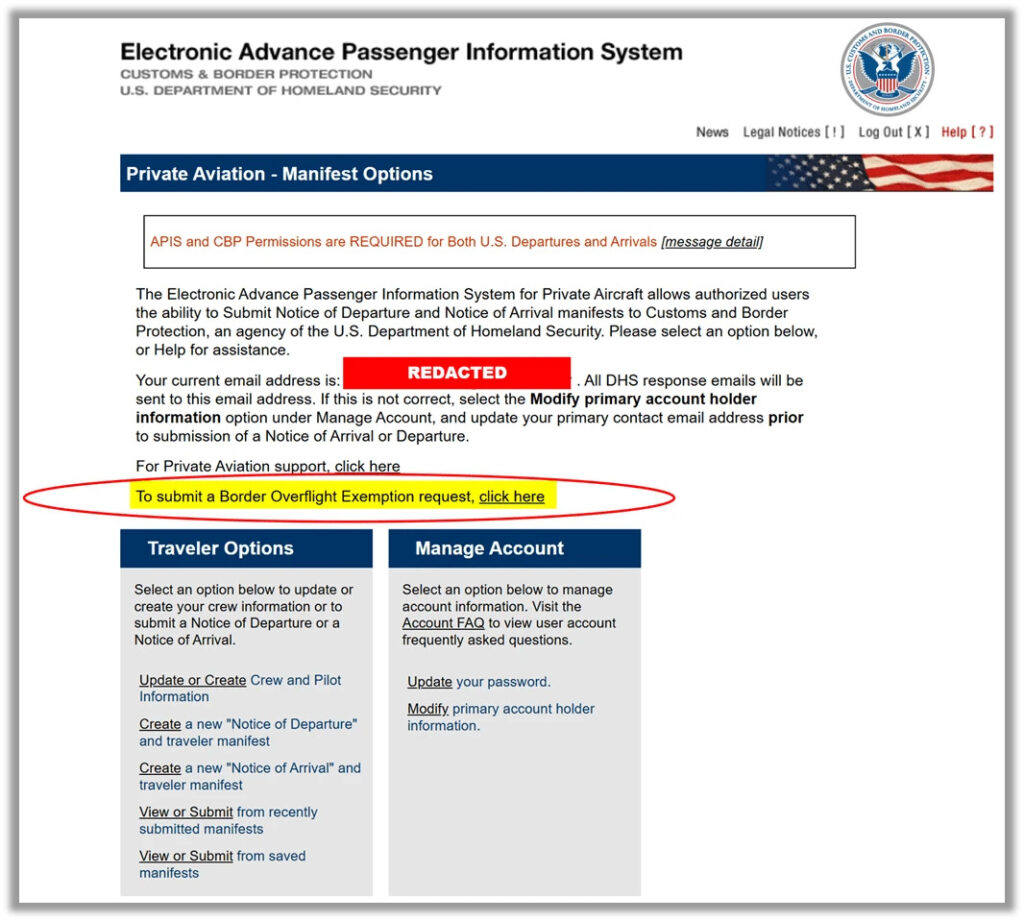
Thanks to the NBAA for this behind-the-scenes screenshot.

CBP says they’ll process these within 30 days or less (same as before). Commercial operators still need to add carrier bond info and confirm customs fees are current, but otherwise it’s a much smoother process. If you use a handler or third-party provider, they’ll continue doing it for you behind the scenes.

New to BOEs? If you’re arriving from the south, CBP normally requires your first landing to be at the nearest southern airport of entry. A Border Overflight Exemption lets you bypass that rule and fly straight to the airport you actually want to reach. More info here.

Original Story Sep 2024: BOE Guide

Back in the days when you had to email your BOE requests to CBP and everything was way more painful, we lovingly prepared a 1-page quick-ref cribsheet showing what to do.
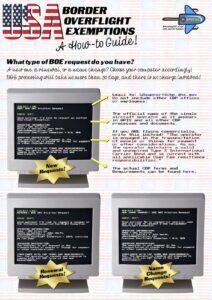
But with the Aug 2025 switch to doing all your BOEing via the eAPIS website, that guide is now defunct! We hereby forever consign it to the great FOD bin of history!
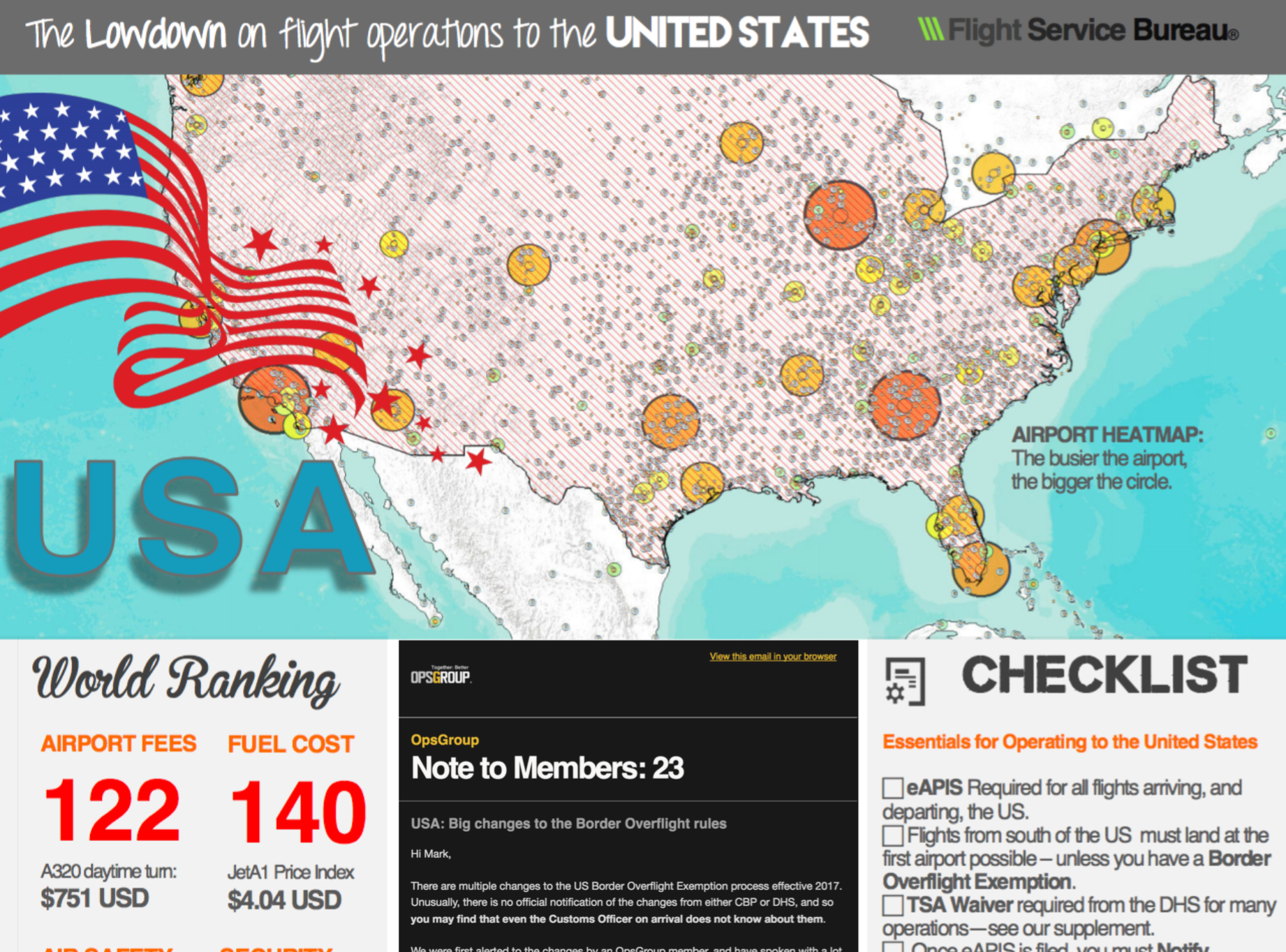

Big changes to US Border Overflight Rules

There are multiple changes to the US Border Overflight Exemption process effective 2017. Unusually, there is no official notification of the changes from either CBP or DHS, and so you may find that even the Customs Officer on arrival does not know about them.

The March 2017 changes may be the start of the end for the Border Overflight Exemption, since most requirements from the CBP perspective are transferred to eAPIS: notably, the fact that individual aircraft are no longer listed on the Approval Letter.

We were first alerted to the changes by an OpsGroup member, and have spoken with a lot of different DHS and CBP officials. From these conversations, we’ve put together our summary of the situation below.

Noteworthy is that at many Airports, the front line CBP officers were not aware of the new rules. CBP have said: “This is new not only to you but to most of the Officers in the field. Your pilots need to know what it says because they will be getting questions when they land.”

What is a Border Overflight Exemption?

  • If you operate a flight to the US from south of the 30th parallel, you must land at the first airport you come to.
  • To avoid this, you can apply to CBP for a Border Overflight Exemption (BOE)
  • With that in hand, you can fly to any airport with customs.
  • So, on to the changes:

Effective March 1st, 2017 :

  • A full list of the changes to the process is in Notes to Members #23 in your OPSGROUP dashboard.
  • We recommend you carry this in the aircraft as well, for any CBP official not aware of the new rules.


MEMBER LOGIN
Join OPSGROUP 


You can request membership of OPSGROUP to receive the full version delivered every Wednesday, along with all OPSGROUP member benefits: Members Questions, Group Discussions, Slack, free maps and charts (normally $25),  Full access to aireport for group reviews of handlers and airports, regular alerts for critical international ops info,  complimentary Airports Database (normally $375), Full access to safeairspace.net including updated risk alerts,  and guidance and help when you want it on any International Operations topic (that last one is really useful!). Read 125 different member reviews.