Pilot Age Limits – The Full Picture

Here’s something we’ve been meaning to do for a long time. It seems there’s no single place online where the rules on pilot age limits are spelled out in plain English. So here you go, friends. If you’ve got suggestions, corrections, or edge cases we’ve missed, drop us a note at blog@ops.group.
The basics:
- For international commercial flights: all pilots must be under 65.
- For domestic commercial flights: most countries follow the same 65-year rule, but some go further – Argentina, Australia, New Zealand, Canada and Japan all allow older pilots under certain medical and operational conditions, while others, like India, apply stricter limits.
- For private flights: there’s no age limit anywhere. The only restriction is the pilot’s medical.
Who makes the rules?
The starting point is ICAO. Annex 1 – Personnel Licensing sets the global standard for pilot age in international commercial air transport operations. The rule is simple:
- 65 years old in multi-pilot operations
- 60 years old in single-pilot operations
These limits apply only to commercial flights – airlines and charter. They do not apply to private flying, where ICAO sets no age restriction at all.
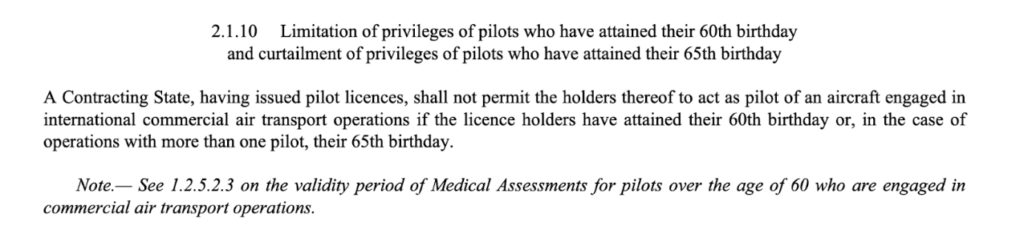
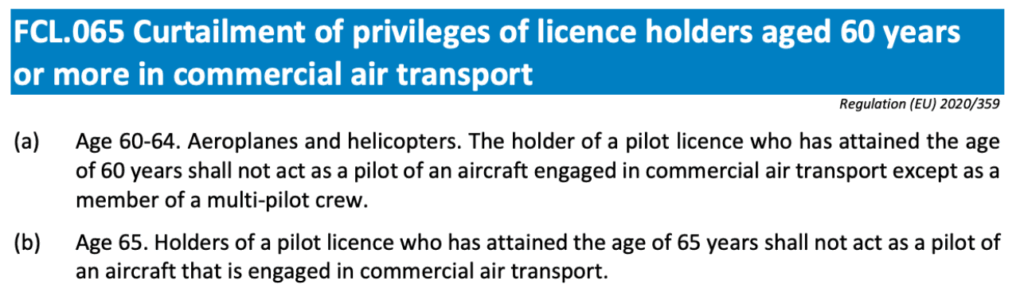
In Europe, EASA mirrors ICAO exactly:
In the US, the FAA applies the 65 limit only to Part 121 airline pilots:

Part 135 charter pilots face no FAA domestic age cap, but once those flights go international, the ICAO 65 rule applies to all pilots on board.
Part 91 private operations are not affected domestically or internationally – there is no ICAO age limit for non-commercial flights, only the medical.
In theory, all ICAO member States should apply the same rules. In practice, some do not. Inside their own borders, countries can be stricter, looser, or set no limit at all. For international flights, the countries that matter are: the State that issued the licence, the State of the operator, and the States being flown into or over. If any of those apply a stricter rule, that’s the one that decides whether the flight can operate.
Once a pilot reaches their 65th birthday, they are no longer eligible to serve on international commercial flights, unless every country on the route specifically authorises it. Under Articles 39 and 40 of the Convention, ICAO Doc 7300, a licence that does not meet ICAO standards such as age limits must be endorsed, and it can only be used internationally if the States concerned specifically accept it.
Medical requirements also tighten with age. According to ICAO Annex 1, pilots over 60 on commercial ops must renew their Class 1 medical every six months instead of once a year.

There used to be an additional condition: if the captain was between 60 and 64, the other pilot had to be under 60. ICAO removed that rule in 2014. Today, two pilots over 60 may operate together without issue.
Private flights
ICAO does not impose any age limits on private, non-commercial operations. A pilot can continue flying internationally at any age – provided they hold a valid medical certificate.
The type of medical required depends on the operation. A Class 1 (ICAO Annex 1) is needed for commercial flying, valid for 12 months until age 60 and then 6 months thereafter.
For private flying, a Class 2 (Europe) or Class 3 (US) medical is sufficient. Standards are lower, checks are less frequent, and validity periods are longer.
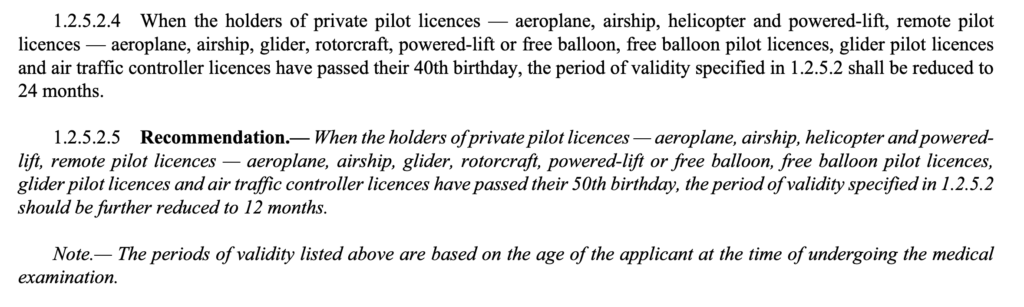
The ICAO Annex 1 baseline sets the same logic: validity shortens progressively with age.
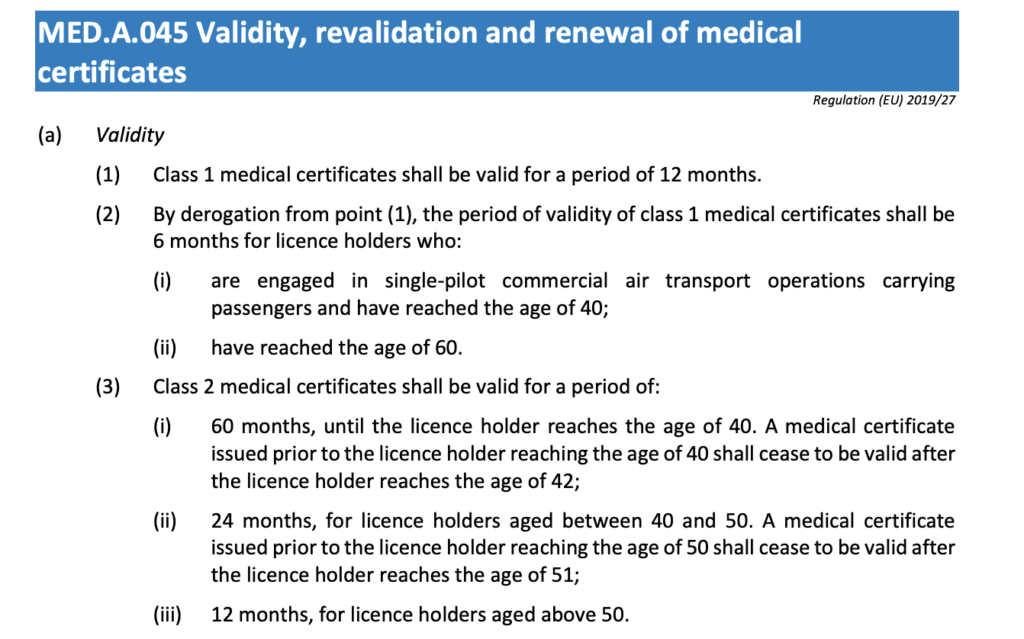
In Europe: Class 2 is valid for up to 60 months if you’re under 40, 24 months between 40-49, and 12 months once past 50:
In the US: Class 3 is valid for 60 months if you’re under 40, and 24 months once past 40:
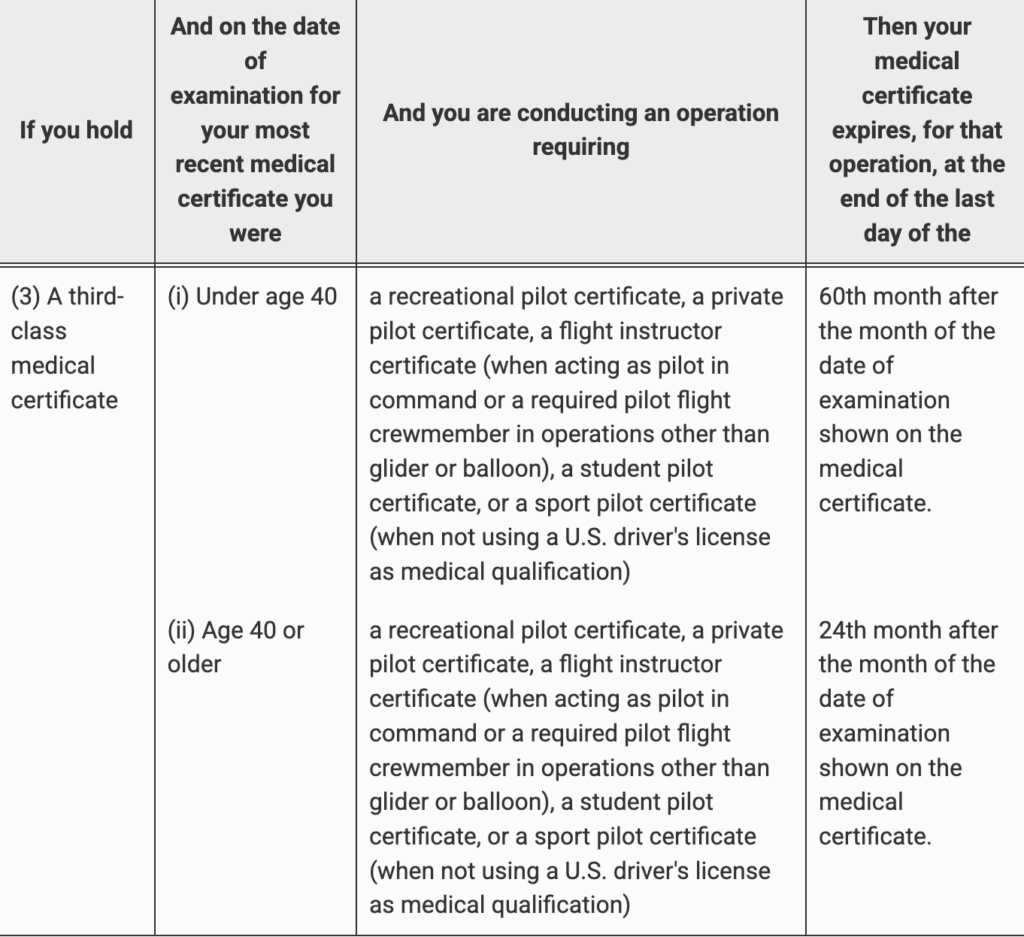
For commercial ops, shorter medical validity periods apply – the details can be found in the same ICAO Annex 1, EASA Part-MED and FAA §61.23 references.
Different rules at home
Countries can set their own age limits for domestic operations. Many follow ICAO’s 65-year rule, but others do it differently. Here are a few examples, and if you’ve seen something else in your ops, let us know!
Argentina: Argentina dropped its old pilot age limits in 2024. Airline/charter pilots can now fly domestic ops until 66 (single-pilot) or 68 (multi-pilot). For international flights, crews must still follow the destination country’s age rules. Private flights already had no age limits here. More info here.
Australia: ICAO’s 60/65 limits don’t apply. There’s no maximum age, but pilots over 60 must pass extra medical and flight reviews. More info here.
New Zealand: Pilot licences are issued for life, with no age cap. Validity depends only on maintaining medical and competency standards. More info here.
Canada: No upper age limit and no loss of privileges after 60 or 65, provided medical and proficiency standards are met. More info here.
Mexico: Couple of issues here: first, Mexico still uses the old ICAO wording for commercial flights; and second, some local officials misapply those same rules to private operations.
- It looks like Mexico still uses the older ICAO wording on pilot age limits – the one that talks about the pilot-in-command (PIC) rather than all pilots. Under that version, a PIC can fly until age 60, or up to 65 only if the other pilot is under 60. The newer ICAO rule applies to all pilots and simply allows both to fly up to 65, but Mexico’s wording (Circular CO SA 14.03/20) hasn’t been updated. It still follows the old PIC-focused rule and applies only to international commercial operations, not to private or domestic flying.
- For private flights, there’s no official age limit – any pilot can fly as long as their medical is valid. In practice, though, enforcement can be inconsistent. Some AFAC officials, especially at MMSL/Cabo San Lucas and other tourist airports, have been known to misapply the 65-year rule even to private flights, sometimes hinting at “fees” to ignore it. If that happens, show them the Circular, which clearly limits the rule to commercial ops, and coordinate with your handler in advance if you don’t speak Spanish.
Peru: The country allows commercial pilots to fly up to age 70, based on medical findings that age alone shouldn’t determine fitness to fly. Pilots over 65 just need more frequent medical checks to keep their certification valid. More info here.
Chile: Going even further, Chile sets no maximum age limit for domestic flying. As long as pilots hold a valid medical certificate, they can keep flying indefinitely within Chilean airspace. More info here.
Japan: Commercial pilots can fly in multi-pilot operations until the day before turning 68, with extra medical and operational requirements:

China: Officially follows ICAO’s 60/65 standard, but some reports we’ve seen suggest some airlines may still apply a 60-year internal cap. Seen this yourself? Tell us!
India: For international multi-pilot flights, only one pilot may be between 60 and 65 – a holdover from ICAO’s pre-2014 “one under 60” rule. More info here.
All these national differences stop at the border. Once a flight is international, the ICAO limit of 65 applies unless a State has specifically authorised older pilots, as permitted under Articles 39 and 40 of the Convention.
Bottom line, if in doubt, always check the AIP GEN 1.7, where each country publishes its differences from ICAO!
Grey areas and edge cases
There are some places where the rules blur.
Ferry and positioning flights: These may not count as “commercial air transport” under ICAO definitions, but many authorities still apply the same limits if the aircraft is operated under an AOC, and the FAA includes ferry and positioning legs under the Part 121 age-65 rule.
Practical limits beyond regulation: Even where no regulatory age limits exist for private ops, pilots over 65 can still face practical restrictions. Some insurance underwriters set their own maximum age limits or raise premiums for older pilots, regardless of medical fitness. In addition, operators, management companies, and recruiting agencies sometimes apply informal age caps when hiring for private or corporate operations, which is a form of ageism that pilots have little means to challenge. A few countries, such as New Zealand, have human rights laws that prohibit age discrimination in employment, although these protections generally apply only to work performed within their own borders.
Wet leases and aircraft registry: When an aircraft is operated under a wet lease or similar cross-border arrangement, the stricter rule between the State of Registry and the State of the Operator may apply. Under the Article 83 bis of the Convention, these States can transfer oversight responsibilities – including crew licensing – from one to the other, meaning a tighter national age limit can override ICAO standards.
The old “no domestic age limit” lists: You’ll still find online lists of countries said to have no age limits, mostly copied from ICAO surveys in the mid-2000s. Treat these with caution! Always check each State’s AIP GEN 1.7 for the latest national differences.
Policy change in motion: IATA recently pushed to raise the international pilot age limit from 65 to 67, suggesting extra safeguards like keeping one pilot under 65 and tighter medical checks for older crews. The idea made it all the way to ICAO’s 42nd Assembly in Montreal (Sep-Oct 2025), but after some debate, it was turned down. For now, the global limit stays where it is: 65.
Corporate retirement policies: Some companies have tried setting their own age-65 limit for Part 91 pilots, but courts have often struck that down as age discrimination (except in one 2014 Exxon case). Instead of using an age cutoff, some operators take a more cautious approach by requiring their pilots to hold a First Class Medical renewed every six months – even though that’s stricter than the FAA actually requires for private or corporate flying.