NAT Doc 006/008 Changes 2023

Read all about it! ICAO are changing up the NAT docs!

Here, for you, is our summary of the *exciting amendments to our *favourite documents.

*They aren’t that exciting. Also aren’t our favourites, clearly that is 007.

First up, Doc 008

NAT Doc 008 ‘Application of Separation Minima North Atlantic Region’ contains exactly what the title suggests: info on the application of separation minima. The standards that it doth contain apply to aircraft in the NAT Region who are communicating via a radio station or via CPDLC and also when in ‘Direct Controller Pilot VHF voice Communication’.

Excellent. We saw an amendment notification and we headed over to see what the change was. With baited breath we clickethed upon the link. Fingers tapping as it slowly downloaded itself and opened. We scrolled with frantic enthusiasm to the ‘amendments’ table. What would the change be? Is it big? Is it exciting?

It is not.

They have just amended paragraph 3.4.2.D to say that longitudinal separation is ‘10 minutes between aircraft on same/intersecting tracks, whether in level, climbing or descending flight, provided the aircraft have ADS-C periodic contracts with a maximum reporting interval of 20 minutes or are being tracked by an ATS surveillance system.’

‘or are being tracked by an ATS surveillance system’ appears to be the only change, at least that we can see anyway.

Doc 006

This one looks more interesting. First up, a review of what Doc 006 is.

In case you aren’t familiar with this one, it used to be:

  • Part I – Contingency Situations Affecting ATC Facilities
  • Part II – Contingency Situations Affecting Multiple FIRs
  • Now it has Part III – Contingency Situations Caused By Space Weather Events, which ‘considers events which are likely to affect one or more than one facility within the NAT region, specifically the contingency processes applied to minimize operational impacts of space weather events.’

You can find the updated Doc 006 parts here.

Part I of Doc 006 – Air Traffic Management Operation Contingency Plan.

The only change in this bit is the insertion of some text onto Page 1 about Part III – The Space Weather Contingencies.

There is also this newly amended table which, while grey and joyless, is actually very handy indeed. This covers general loss of ATC which could be space weather related, but could also not be space weather related.
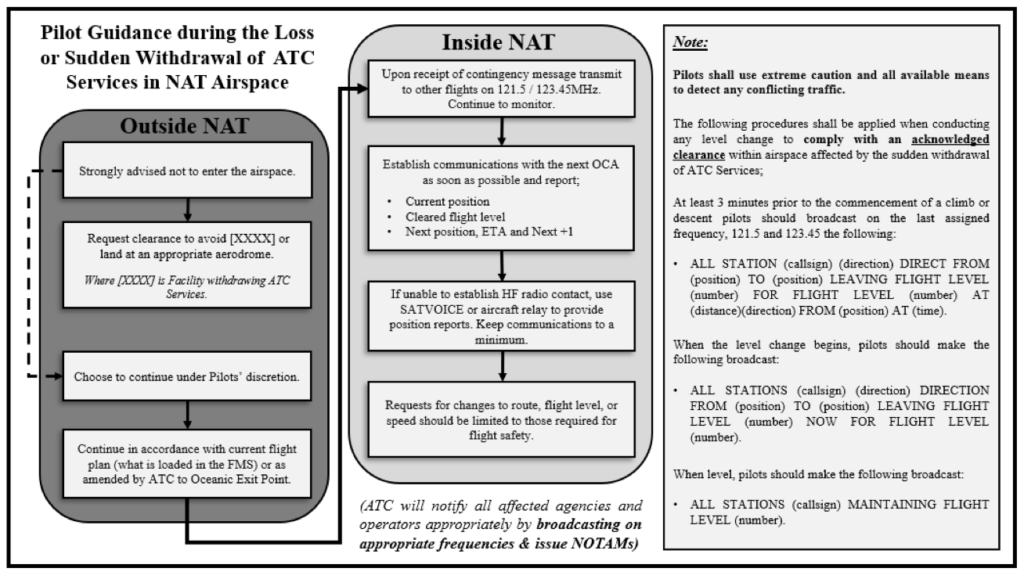
Simple but mighty.

Doc 006 Part III

I’ve given it a section of its own. This is the Space Weather bit, but, there is an actual document – Doc 10100 – which talks about space weather. 10100 can be found here and this is where you should go for *all your space weather knowledge needs.

*Not all, but a good start. 

Doc 006 Part II is all (only) about the contingencies in the event of issues with ATC, navigation, systems etc because of space weather.

A little bit of space weather info before we dive all the way in:

Space weather can play havoc on our GNSS systems, satellite stuff, HF, RF, power grids, even our microwaves (microwave links whatever they be). It can also have effects beyond just one FIR, or even the whole NAT region. So it’s a great thing that we now have a document to help.

Don’t fly too close to the sun

Space Weather peaks around every 11 years, but we’ve seen a load of pretty decent (but not severe) space weather stuff of late. Things like:

  • Disruptions and even total unexpected loss of HF, SATVOICE, CPDLC etc
  • Issues with GNSS (that impacts out ADS-B and C)
  • Weird and random reboots of electronic stuff onboard
  • Passengers and crew growing extra limbs/glowing green etc

The Contingency Phases

They’ve broken the actions down into a few phases.

Initial Action (Reactive Phase):

What is happening during this phase is some space weather is whizzing its way over and an ANSP has become aware of it and so they start telling everyone about it, putting contingency plans into action, getting in touch with other ANSPs for support etc.

If you’re an airplane that is not yet in the NAT region then the general plan is to warn you about what might be awaiting you, and possibly (if it is really bad) re-route you.

If you are already in the NAT then you should do what you would normally do if you lose comms, or have some technical issue and that’s follow the published contingency procedures.

Subsequent Action (Proactive Phase):

What is happening in this phase depends on the severity of the situation, but basically a whole load of communication (about the severity of the situation) and stuff to help manage it.

Long term contingency plans:

This is for the really bad stuff that knocks out comms or satellites of what have you for really long amounts of time.

That… wasn’t very helpful

Doc 006 is really just more of an outline of what ATC will do (and so what the pilots can expect).

So, refer to the nice table, refer to the AIPs, go read your actual contingency procedures, and use this Doc 006 Part III as a helpful guide on what to expect.

Aug 2022 NAT Doc 006 Changes

Are you Trevelyan across the NAT HLA anytime soon? Then here is a summary of the changes that just came out in NAT Doc 006.

What is Doc 006?

It is the Air Traffic Management Operational Contingency Plan for the North Atlantic Region, and we are talking about the Second Edition, August 2022 version which you can find here if you want a look. The last time it was updated was back in Feb 2021, and we covered those changes here.

Page 1

“Aha, a handy list of all the changes,” think Rebecca and Dave as they glance  at page one. “This will be easy. Our job is done already.”

“What does it say?” Rebecca asks.

“It says that there is a new chapter on Common Procedures which were there but are now here…” replies Dave. “And also something about a Notam and some route something somethings…”

“There’s still a lot of red again, isn’t there?” whispers Rebecca.

“Yes, there is,” sighs Dave.

“Should we read it for them?” Rebecca says wearily.

Dave nods.

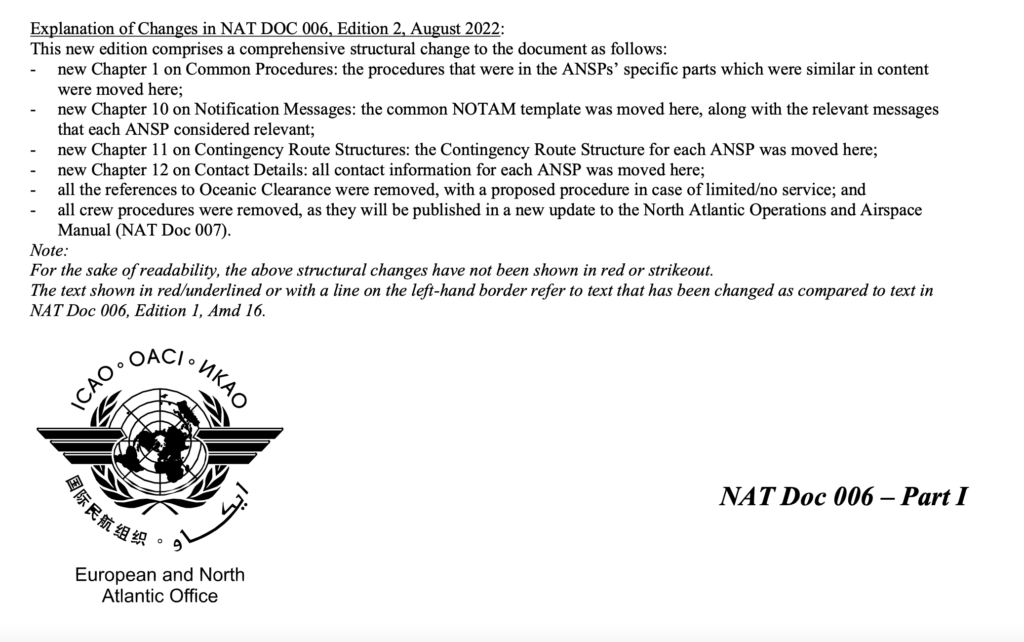
All the changes are in red.

Finding the changes isn’t hard. Understanding them is the annoying bit. So we shall try and make sense of what all those changes are for you so you don’t have to.

(But before we go on though, here is the record of amendments so you can see if any of it looks remotely interesting to you. If not then you can go and do something much more interesting with your time instead of reading further.)

Chapter 1

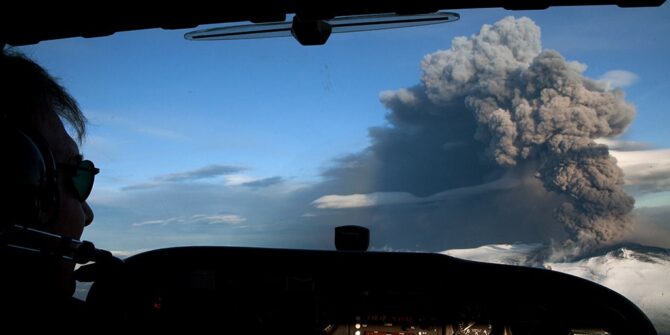
They have updated the information on contingency situations thats might affect multiple FIRs. What could cause that? Volcanic ash could cause that.

They have also added in Reykjavik.

Chapter 1

Sorry, that bit before was just an intro or something.

So, Chapter 1 – Common Procedures.

  • Limited Service: If ANSPs are going to only be able to provide a limited service they will try and let everyone know at least 12 hours in advance by Notam. This is for times like if datalink going to be down or if there are some huge solar flares heading their way that might take out their HF for a bit.
  • No Service: It’s the No Service Situations we really need to worry about. If this happens then they will get a message to whoever they can, and whoever gets the message will help share it out to as many people as they can.

In any region, the results will be the same. With Comms disruption, they will obviously attempt other methods. There is likely to be a fair amount of frequency congestion on whatever methods are still working.

With control services, there may be some additional restrictions which affect traffic flows, and there may well be reroutings. Where possible, these will be limited to those not yet in the NAT (a bit easier for the old fuel planning). 

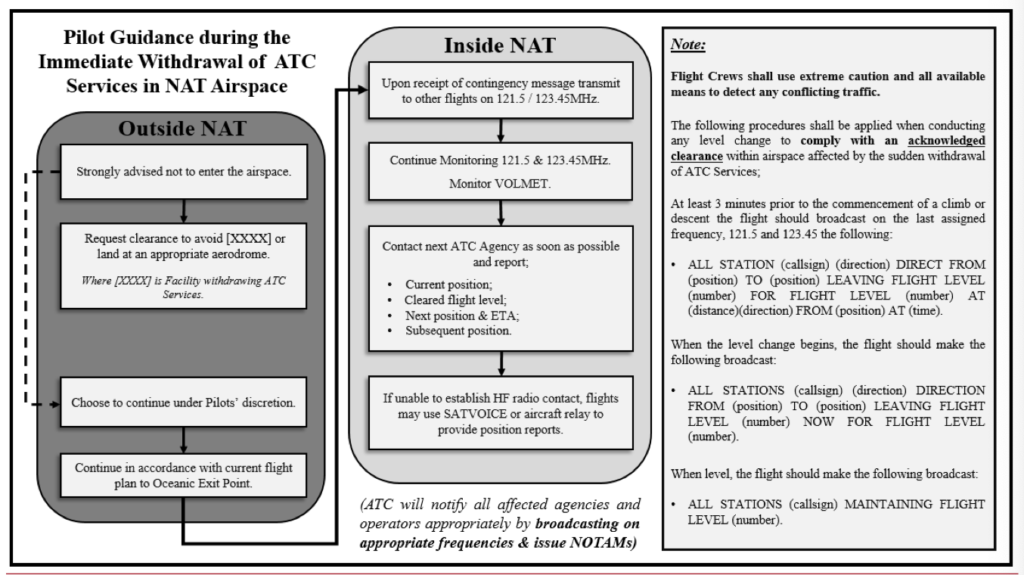
In the event of a sudden withdrawal of services, here is an excellent chart for pilots to print out and have handy.

Immediate withdrawal of services

It’s what the handy guide says, but in case you don’t want to read that:

  • Already in the NAT? Basically, stick with the last received and acknowledge clearance, try and talk to anyone you can and make sure you give position reports. You can use SATVOICE for this too. If you’re in the middle of a level change, complete it as quickly as you can. If it’s a control centre evacuation and you’re on ADS then revert to voice.
  • Approaching the NAT? If you’re within 20 minutes and it is getting evacuated then stick with your last clearance. Only aircraft less than 60 minutes from their OEP can transit Gander. They guarantee no conflict profiles.

The Next Chapters

Shanwick: Contingency procedures have moved to chapter 11.

Gander: Nil Red

Reykjavik: This has a lot of new info, although not specifically in this section. The main thing is, if you can’t get hold of Iceland Radio HF then try Shanwick radio first, then Gander or Bodø if still no luck. Reykjavik is the only FIR without supporting procedures.

Santa Maria: If Comms are down and you have ATS safety SATVOICE (INMARSAT or IRIDIUM) then you can call them on 426302 or 426305. If you have a non ATS safety satellite network (some big old sat phone from the 80’s onboard) then try +351 296 886 655 but only if you really, really need to.

New York: Nein Rot.

Bodø: Bodø ACC includes Domestic control, Oceanic and Radio (HF). Thankfully it can be supported by basically all its neighbours FIRs (except Reykjvik).

Shannon: Non Rouge.

Brest: No roja.

Chapter 10 – Notification Messages

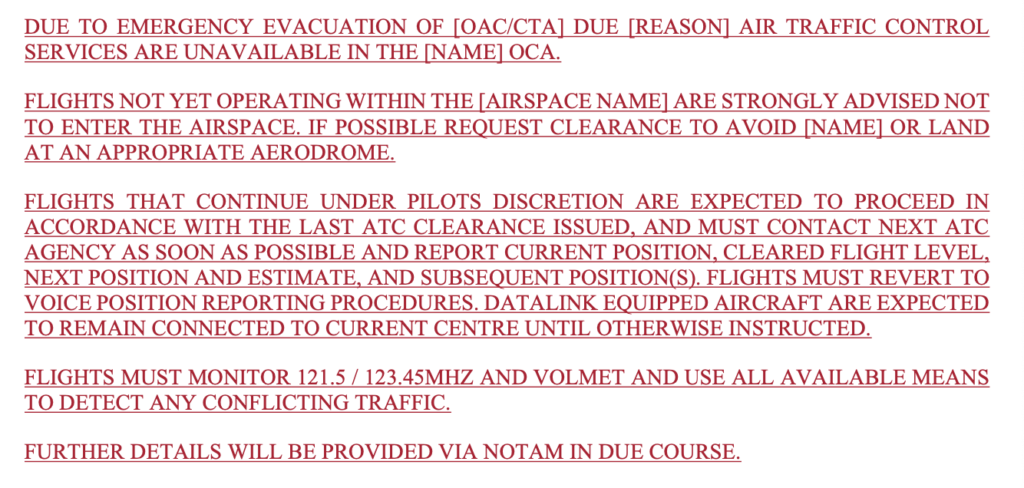
Or ‘The Great River of Red’ as I know call it. Actually, most of this can be looked at in the below image (it’s a picture of their example of a Notam).

Limited service? Info will be sent via other ANSPs.

No service? It has probably been evacuated and notifications of this will be sent via the NAT track messages and transmitted on any appropriate frequencies.

Chapter 11 – Route Structures

This contains info on the routes for each region. Mainly Reykjavik because they’ve added all of those in. There are some nice diagrams in this bit.

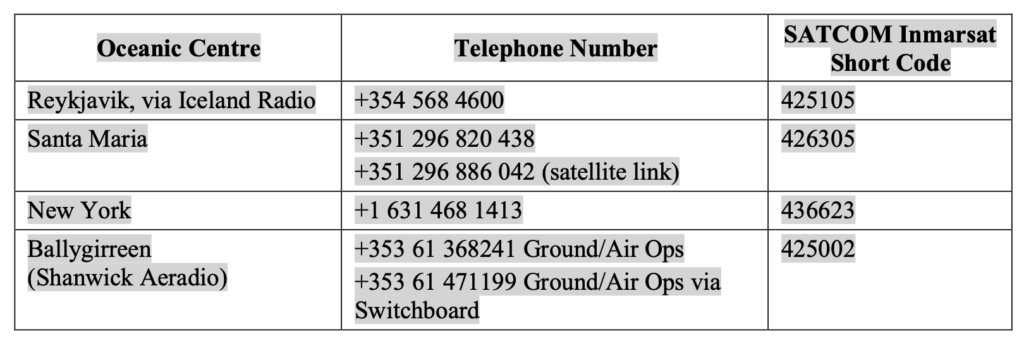
Chapter 12 – Contact Info

This is the contact details. Lots of red for the new Reykjavik folk.


That’s it. We’re off to play some Goldeneye on our N64. Found something important that we missed? Let us know! news@ops.group


Feb 2021 NAT Doc 006 Changes

ICAO have published an updated NAT Doc 006, effective Feb 2021.

This document details what happens on the North Atlantic when ATC goes down for any reason. It’s the official go-to manual to check the Contingency Plan they put in place during these so-called “ATC Zero” events.

In particular these include the contingency arrangements in place to deal with:

  • The airspace suffering contamination by volcanic ash.
  • The steps taken to deal with a mass turnback of traffic over the NAT region.

You can download a pdf of the new NAT Doc 006 here.

And you can get the little explainer doc here.

Summary of what’s changed:

  • They have updated the section talking about contingency plans for the Gander Oceanic FIR. There is basically some updated contact info, updated contingency routes in the event of Gander Evacuations, and some wording changes clarifying the procedures to be used in event of a comms disruption or full loss of ground-air comms capability.
  • The plan only applies to Gander Oceanic FIR, and has removed the ADS-B designated airspace over Greenland because Gander no longer provide ground based ADS-B separation.

Here’s a breakdown of each of the big changes, in chronological order (i.e. following the order they appear in the NAT Doc 006 guidance doc!):

The Disruption of ground/air comms capability section was updated:

Shanwick Oceanic FIR and Reykjavik Oceanic FIR provide supporting procedures for Gander. So if there is a general disruption of ground/air comms capability in Gander, comms services will be maintained using available equipment and will be supplemented with the assistance of adjacent facilities. HF normally provided by the CYQX International Flight Service Station will be delegated to other International Stations and the frequencies will be published in a NOTAM.

They then corrected the misspelling of the word ‘dependent’ about 50 times:

Ok, maybe only about 6 times.

The ‘No Service Procedure’ was updated:

If Gander ACC is evacuated, Shanwick will take over the ATC provision in the Oceanic bit as much as they can. They won’t issue re-clearances to aircraft in Gander Oceanic though. Moncton and Montreal ACC will take on the en-route ATC provision in Gander FIR.

Contact Info updated:

Pilot/Operator Procedures were updated:

If you have a clearance already, and are routing in from another OCA, then in you go and follow the clearance.

This is what it says –

“While flights with an acknowledged oceanic clearance may transit Gander’s oceanic airspace, flights not yet within Gander OCA are strongly advised not to enter the airspace. Flights operating with an acknowledged oceanic/ATC clearance that continue under pilot’s discretion are expected to proceed in accordance with the last oceanic/ATC clearance issued. En-route requests for changes to route, level or speed should be limited to those required for flight safety.”

It has removed the bit about flights in other OCAs expecting a big re-route, and how Reykavik and Santa Maria will advise on procedures. The Procedures will be as per the Notam issued and the paragraph above gives the procedure.

East and Westbound flights above FL290 contingency routes have been updated:

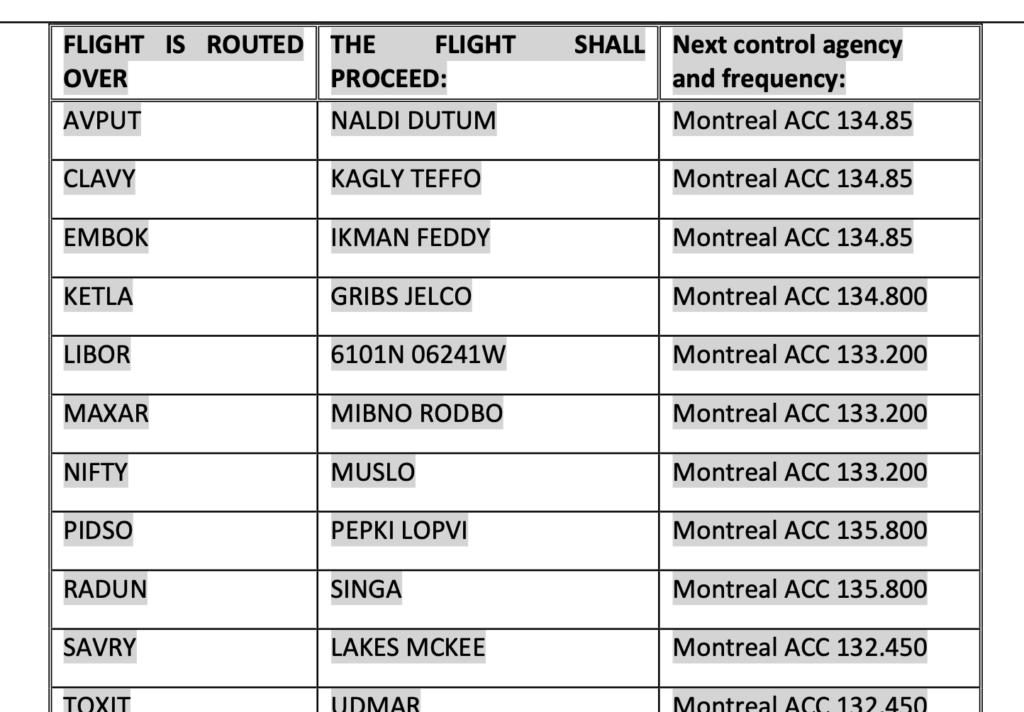
The change is that instead of just extending the OTS system to begin at fixes on the boundary between Gander and the Moncton or Montreal FIR, they will now use laterally spaced routes instead and connect them to oceanic exit points in the next agency. Once comms are established with the next agency, you’ll get a re-clearance.

There are a bunch of updated route tables (like this one below). So if you’re initially routing west via AVPUT and Gander evacuate, you will then proceed to NALDI, DUTUM and talk to Montreal for what to do after.

The long term contingency plan changed a bit:

Basically they clarified notes on how evacuations and loss of the Gander ATC service will likely not exceed 48-72 hours. They will also attempt to provide immediate or near immediate resumption of service specially for emergency, humanitarian and critical military flights. Everyone else can expect a “phased approach with flow control.”

Even more contact info was added:

The emergency NOTAM format has been updated:

Everyone loves a big long Notam. Here’s the new one they’ll be using from now on if everything suddenly stops working:

DUE TO EMERGENCY EVACUATION OF [OACC] DUE [REASON, e.g. COVID19] AIR TRAFFIC CONTROL SERVICES ARE UNAVAILABLE IN THE [NAME] OCA. FLIGHTS NOT IN RECEIPT OF AN OCEANIC CLEARANCE SHOULD REQUEST CLEARANCE TO AVOID [NAME] OAC/FIR OR LAND AT AN APPROPRIATE AERODROME. ONLY FLIGHTS OPERATING WITH AN ACKNOWLEDGED OCEANIC/ATC CLEARANCE ARE PERMITTED TO OPERATE WITHIN [NAME] OCA. FLIGHTS NOT YET OPERATING WITHIN THE [AIRSPACE NAME] OCA BUT IN RECEIPT OF AN [OCEANIC] OR [ATC] CLEARANCE ARE STRONGLY ADVISED NOT TO ENTER THE AIRSPACE. FLIGHTS OPERATING WITH AN ACKNOWLEDGED OCEANIC/ATC CLEARANCE THAT CONTINUE UNDER PILOTS DISCRETION ARE EXPECTED TO PROCEED IN ACCORDANCE WITH THE LAST OCEANIC/ATC CLEARANCE ISSUED AND MUST CONTACT NEXT ATC AGENCY AS SOON AS POSSIBLE AND REPORT CURRENT POSITION, CLEARED FLIGHT LEVEL, NEXT POSITION AND ESTIMATE, AND SUBSEQUENT POSITION(S). FLIGHTS MUST REVERT TO VOICE POSITION REPORTING PROCEDURES. DATALINK EQUIPPED AIRCRAFT ARE EXPECTED TO CONNECT TO/REMAIN CONNECTED TO CURRENT CENTRE UNTIL OTHERWISE INSTRUCTED. FLIGHTS MUST MONITOR 121.5 / 123.45MHZ AND VOLMET AND USE ALL AVAILABLE MEANS TO DETECT ANY CONFLICTING TRAFFIC. FURTHER DETAILS WILL BE PROVIDED VIA NOTAM IN DUE COURSE.

Anything we missed?

Let us know. news@ops.group