Special Report: Russia transition to ICAO RVSM

Big Changes in Russia

Last month’s change by Russia and CIS States created the single biggest revision print in the history of Jeppesen – that’s quite an update! Here’s a summary of those changes and how it affects you on your next international flight crossing these countries.

Transition to ICAO “Vertical Separation System” and RVSM on 17th November, 2011.
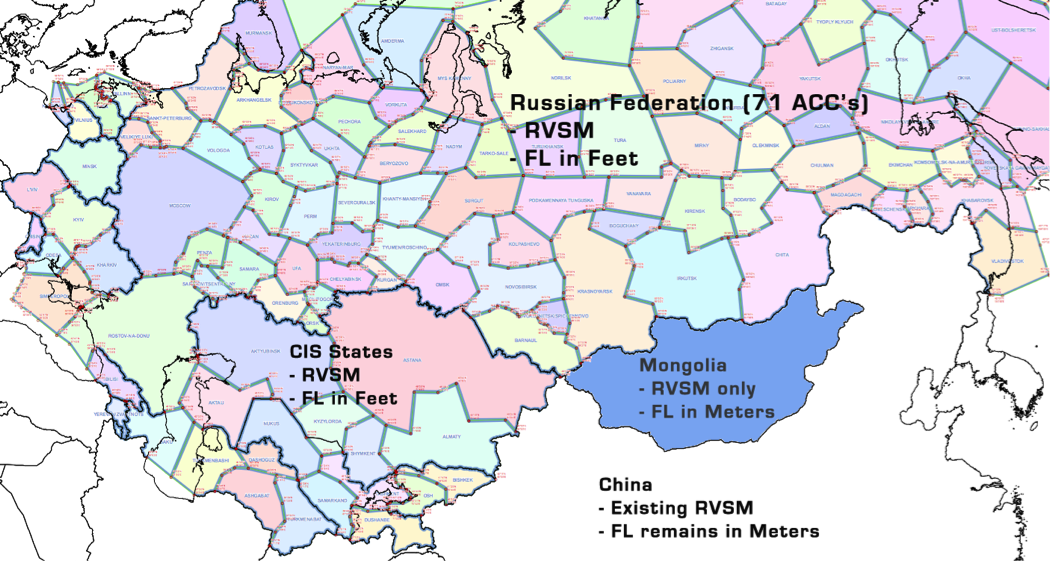
RVSMAirspace

This is a big, significant change, to flying in Russia and the CIS. The AIC’s issued by the member states are particularly vague and uninformative, so here’s some plain English explanations that will hopefully help understanding of the change. If you have more questions, just ask us …

Where?
Russia
Mongolia
Kazakhstan
Kyrgyzstan
Tajikistan
Uzbekistan
Afghanistan.

What’s happening?
There are two things being brought in here –
1.  RVSM, which is happening in all countries, and
2.  Standard ICAO Flight Levels in feet, that we are used to in the rest of the world – which is happening everywhere except Mongolia.

When?
One minute past midnight, UTC, on the 17th of November, 2011.

RVSM
Standard meter separation at the moment is 600 meters above 8,900 meters. From Nov 17th, that will change to 300 meters – or 1,000 feet, up to FL410/FL411.

Flight Levels
At the moment, you’ll get a clearance from a Russian controller to “Climb Flight Level 8,900 meters”. You will jot this down, get out your conversion card, and run your finger down to 8,900 meters, to read off the Feet equivalent – FL 291. Dial 291 on the MCP, or fiddle with the FMS, and away you go.

After the change, your new clearance will be “Climb Flight Level 290”. No different to what you’re used to at home now.

What altitudes are affected?

Above the transition level, all levels will be FL, allocated in feet.

Below the transition level, altitudes will be in meters, for example, 1850 metres, 1500 metres, etc..  This is how things work in Belarus at the moment, for example, if you’ve ever been to Minsk.

Implementation
If you’re flying on the night of 16th November, here’s what you’ll hear.

2300Z “Attention all aircraft, RVSM Operations will begin in 1 hour
2340Z“Attention all aircraft, RVSM Operations will begin at 0001 UTC”

From 2300 only RVSM aircraft will be accepted in RVSM airspace (as opposed to sorting it all out at midnight Z)

Some exceptions:

AFGHANISTAN

A sign of the times – Afghanistan is implementing RVSM but is keeping three levels for military aircraft only. FL300 and FL310 will only be available to MIL aircraft, as will FL350.

MONGOLIA

Mongolia thought about it, but didn’t join in the change completely. They’re just doing RVSM, so the Meter allocation scheme will change to 300 meter instead of 600 meter separation, but that’s it.

ATC will issue the Flight Level clearance in meters. Pilots shall use the Mongolia RVSM FLAS Diagram (same as your existing China RVSM document) to determine the corresponding flight level in feet. The aircraft shall be flown using the flight level in FEET.

The request metric flight level within Mongolia RVSM airspace in Flight Plan shall be expressed as S followed by 4 figures (such as S1250, S1220 and S1190 represent 12500m, 12200m and 11900m respectively).

Eastbound Levels example
– ATC will say “KLM 802, Climb Flight Level 8,900 meters”
– Feet equivalent is FL 291 per your on-board conversion table
– Set FL 291 on your altimeter

Transition Zone
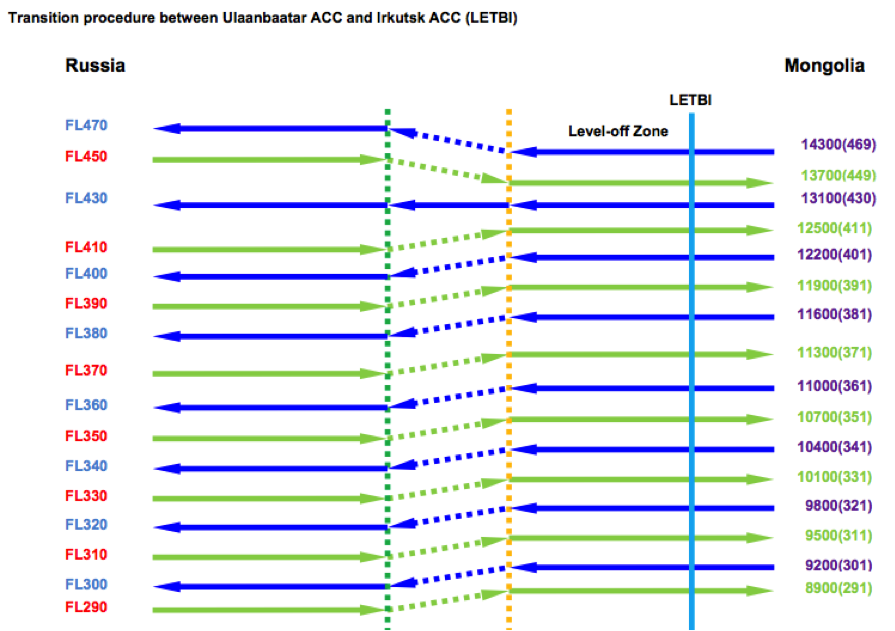
Because Mongolia is working in Meters and Russia will now work in feet, there will be a small altitude adjustment near the ACC boundary.

Each ACC will have a different arrangement, some will do the transition on the Russian side and some on the Mongolian side – but each will have a “Level Off Zone” – 5 minutes of level flight, before or after which the climb/descent will take place.

Example 1
Let’s look briefly at position LETBI – the boundary between Ulaanbaatar ACC (Mongolia) and Irkustsk ACC (Russia). The transition zone here is on the Russian side.

An eastbound aircraft heading for Mongolia will be at FL370. Around 10 minutes prior to LETBI, the Russian controller will climb the aircraft to FL371 (11,300 meters) so that the aircraft is level at the new meter level for 5 minutes. Transfer of communications and control at LETBI will have the aircraft level at the correct meter level for Mongolia.

Example 2
A westbound aircraft along the same route, will maintain 11,600 meters (FL381). The Mongolian controllers will transfer comms and control at LETBI to the Russians.

“Irkustsk hello, KLM 801, maintaining Flight Level 11,600 meters”
“KLM 801, Irkustsk, roger, maintain present level”

5 minutes AFTER position LETBI:
“KLM 801, Irkustsk, descend Flight Level 360”
BoundaryLevels


Special Report: Post Hurricane Irene update

Post-Irene Hurricane Update

As Irene tracks away north-east over Canada, we have the following information from Airports in the path of the Hurricane.

Bahamas


Irene’s path across the Bahamas

Following its track across the Turks, Irene hit the southern Bahamas early on Thursday with winds reaching 100 knots+. The eastern side of the island chain was worst hit, with Cat Island and Abaco suffering perhaps the worst structural damage.

MYGF/Freeport was initially flooded and remained closed on Friday, it is now open again.
MYNN/Nassau suffered power outages,and Friday morning’s traffic was restricted by the lack of a radar service. This was re-instated by 12pm and delays reduced to minimal.
MYES/Staniel Cay was flooded but also opened again on Friday morning.

Nassau Flight Service have confirmed that all airports, both major and smaller outlying airports, are now open again. However, we would recommend confirming before undertaking any ops to the more remote islands.

US East Coast


The track across the US over the weekend

As of Monday afternoon, we have the following information from Airports affected by the hurricane.

KEWR/Newark – reopened to arrivals at 6am and departures from 12pm today.
KJFK/Kennedy – as per EWR, open to arrivals at 6am and departures from 12pm.
KLGA/La Guardia – resumed a normal operating schedule at 7am today.

KMMU/Morristown, NJ – Airport is open with some areas still flooded. One taxiway is still underwater but re-routes using a runway are available. The Signature ramp is completely flooded and unavailable. Lighting is not yet restored and may not be until tomorrow, so daytime operations only.

KCDW/Essex County, NJ – Airport is open and ops normal.

KSWF/Stewart, NJ – Airport is reopened and running at normal capacity on the GA side, there may be some airline delays.

KFOK/Westhampton Beach – Airport running with no issues.

KBTV/Burlington, Vermont – The state has been badly hit by flooding and many major roads are out of service. The Airport itself however is OK, and no damage or flooding occured. All ops normal.

KMGJ/Orange County, NY – Airport is closed to all traffic except heli ops. Both runways 3/21 and 8/26 are flooded. Runway 8/26 is expected to open around 2000LT tonight if clean up is successful.

KHPN/White Plains, NY – Airport fully operational but with delays. Some flooding on roads around the airport may delay ground transport. Ground Stops are creating delays Monday afternoon, likely due increased traffic due TEB’s closure. Possibility of these delays continuing into the evening. Average delay 30 mins, maximum 1 hour.

KTEB/Teterboro, NJ – Airport closed.Significant flooding of runways and taxiways, and ramps. Flood waters are receding since yesterday but only slowly. An Airport lighting systems check will take place between 1700-1800 this evening, after which a more definite opening time can be given by the Airport Authority. Anticipated reopening is Tuesday am.


Teterboro Airport, NJ, pictured on Monday morning. Thanks to Meridian FBO TEB for these pictures.

Atlantic / NAT Tracks

All airports in the New York area were closed from 1200LT on Saturday until Monday morning. Further, as a result of Irene’s tracking, most NAT flights to eastern seaboard airports were cancelled for Sunday night. As a result, NAT Traffic on Sunday was exceptionally light. Monday night’s NAT Tracks, which are 5 tracks from STEAM to CYMON, are expected to be at normal levels, if not busier as some additional flights may be expected following the schedule upset.

No compounding ATC or Weather issues in Europe for Tuesday am.


Special Report: Oceanic Errors in the North Atlantic

Oceanic Errors in the North Atlantic/NAT Region

ICAO oversees a number of North Atlantic Working Groups comprised of industry, ATC and state regulators. These working groups regularly review the most ‘popular’ Oceanic Errors:

  • Large Height Deviations (300 feet or more)
  • Gross Navigation Errors (25 NM or more)
  • Loss of Longitudinal Separation.

ICAO has published the following recommendations to reduce oceanic errors, that should be addressed in initial and recurrent ground training:

LARGE HEIGHT DEVIATIONS
1.    Conditional clearances require special attention. A Conditional Clearance is an ATC clearance given to an aircraft with certain conditions or restrictions such as changing a flight level based on a UTC time or a specific geographic position. The following is an example of a conditional clearance given to a crew: Maintain FL330. After passing 20W climb to FL350. Cross 25W level. Report leaving. Report reaching. NOTE – in this example, FL330 is the present FL. The main part of this clearance is that after 20W the aircraft starts the climb and is maintaining the cleared level prior to 25W.
2.    In oceanic, non radar RVSM airspace, during a climb or descent, crews must advise ATC when leaving and reaching a flight level.
3.    Each flight level change must be specifically approved by ATC. A filed flight plan with a requested change in flight level (step climb) is not a clearance to initiate the change in altitude.
4.    Crews must ensure a CORRECT understanding of when a climb or descent should be initiated or completed.
5.    Crews must exercise caution and ensure a clear understanding when ATC uses the terms “by” or “at” when referring to a longitude crossing (for example when to make a flight level change). This applies whether the clearance is given via voice or data link.
5.1.    The following are examples of conditions or restrictions given to crews when the terms AT or BY are used in a conditional clearance.
6.    Crews must be diligent in reviewing performance data for their particular aircraft, so as to avoid either requesting or accepting clearance to unrealistic flight levels which are outside of the performance envelope of the aircraft.
NOTE: Crews must carefully consider in their performance planning the significant temperature inversions that can frequently occur over the Atlantic Ocean. This is particularly important when aircraft are near to maximum gross weight and when attempting to comply with flight levels dictated at oceanic entry points.
7.    Crews should be aware that requesting unrealistic flight levels can seriously impact separation between their aircraft and other NAT traffic. NOTE: If there has been a significant change affecting the aircraft weight after the flight plan has been computed, request a new flight plan. An example would be if you add a considerable amount of fuel to tanker through a location where the fuel cost is high.
8.    If a crew finds itself at a flight level that becomes unsustainable due to degrading performance, it is imperative that they communicate immediately with ATC in order to coordinate a flight level change as soon as possible.
9.    Crews must be alert for situations when ATC issues clearances that have only a longitude rather than a latitude and longitude. The clearance should be clearly understood as to when to make a flight level change.
10.  Crews must ensure they are following the correct contingency procedure in case of lost communications. Unlike other oceans, the NAT lost communications procedure is to maintain the last assigned flight level. ATC approval is required for all flight level changes.
11. Crews must ensure they obtain an OCEANIC clearance level prior to oceanic entry, enter the ocean at the cleared flight level and establish a post entry point altitude check.
NOTE: Crews must be proactive to ensure that they are maintaining their cleared oceanic flight level prior to the oceanic entry point.

GROSS NAVIGATION ERRORS (GNES)
1.    Fly the route received in the OCEANIC clearance – not the filed flight plan.
2.    A reclearance scenario is the prime cause for most navigational errors. Crews must ensure they correctly copy the RECLEARANCE, reprogram (and execute) the FMS (or Long Range Navigation System, LRNS), update the Master Computer Flight Plan (CFP) and update the plotting chart. The FMS crosschecks for the clearance should include distance and track checks between the new waypoints.
NOTE: Track and distance tables are available commercially for every ten degrees of longitude.
3.    Crews must follow a RECLEARANCE (and not the filed flight plan). The captain should ensure that all flight crew members are aware of the details of the RECLEARANCE by briefing all non-flying crew members.
4.    Ground crosschecks of the Long Range Navigation System (LRNS) should include distance and track checks between waypoints. Enroute procedures must also include distance and track checks when passing a waypoint.
5.    The crosscheck of the FMS coordinates should include comparing the expanded coordinates against the flight plan.
6.    It is strongly recommended that a plotting chart be used and procedures include a position plot 10 minutes after each waypoint annotated with the coordinates and time of the plot. Compare all oceanic waypoints on the chart against the Master Computer Flight Plan (CFP).
7.    Standard Operating Procedures (SOPs) for LRNS must include independent clearance copy, data entry (Coordinates and/or waypoints), and independent crosschecks to verify that the clearance is correctly programmed. These procedures must also be used when enroute changes are entered. This task cannot be delegated.
8.    There should only be one CFP on the flight deck. It should be labeled the Master and should reflect the current cleared route of flight.
9.    Crews must be alert for similar sounding named oceanic boundary waypoints (e.g. PITAX versus BERUX) when receiving the ATC clearance.

EROSION OF LONGITUDINAL SEPARATION
1.    Crews must communicate to ATC any ETAs that change by 3 minutes or more. This is an ICAO requirement and the information is used to modify ground-based ATC flight tracking systems.
2.    Crews must adhere to the assigned (True) Mach. Operators flying Long Range Cruise or ECON to conserve fuel are having a negative impact on the strict tolerance required for ATCs longitudinal separation.
3.    Crews should verify the accuracy of ETAs or ATAs (particularly the hour) forwarded to ATC to prevent an error of one hour.
4.    Crews must ensure they advise ATC in a timely manner of any change in their ETA for the oceanic entry point.
5.    Crews must ensure that the aircraft master clock (typically the FMS) is set using an approved calibrated time source to be used for all ETAs and ATAs.

FLIGHT PLANNING
1.    Dispatchers and Flight Planners must ensure the filed routes around the oceanic boundary do not include crossing multiple oceanic entry/exit points.
2.    Pilots must ensure they know current conditions to include NOTAMS (e.g. forecast turbulence in RVSM airspace) and weather documents (e.g. ETPs and alternate airports). In addition, pilots must be knowledgeable in the information on the computer flight plans and do basic crosschecks of fuel, winds and groundspeeds.

CONTROLLER PILOT DATA LINK COMMUNICATIONS (CPDLC)
1.    Conditional clearances require special attention. A conditional clearance is an ATC clearance given to an aircraft with certain conditions or restrictions such as changing a flight level based on a UTC time or a specific geographic position. The following is an example of a scenario where a CPDLC conditional clearance was given to a crew. The crew subsequently failed to comply with the time restriction, but reported leaving its flight level, thereby enabling the controller to catch the error.

At approximately 1133Z a CPDLC message composed of the following uplink message elements (UM) was sent to the flight:
UM19 – MAINTAIN F370
UM21 – AT 1205 CLIMB TO AND MAINTAIN F380
UM128 – REPORT LEAVING F370
UM129 – REPORT LEVEL F380
The expected WILCO response was received by the Oceanic Controller. At approximately 1134Z (ie. 31 minutes before it should have started the climb), a CPDLC message composed of the following downlink message element (DM) from the aircraft was received by the OAC:
DM28 – LEAVING F370.
The air traffic controller took immediate action to confirm the flight level and to issue a clearance via voice for the flight to expedite climb to a flight level that ensured vertical separation.
NOTE: The receipt of the LEAVING F370 message enabled prompt action to correct this error.

2.    Upon receipt of a CPDLC uplink message, it is important for both pilots to independently and silently read and verify the clearance.
3.    It is important to note that the CPDLC uplink message may be more than 1 page in length. Review the entire message carefully, in the correct order, before taking any action. It may be helpful to print the message.
4.    Both pilots should resolve any questions that they may have regarding the clearance with each other and if necessary with ATC prior to initiating any action. If unable to fully understand the CPDLC clearance, pilots should revert to backup voice communication.
5.    Pilots should not use voice to verify that an up-linked CPDLC message has been received or to inquire if a down-linked datalink message has been received by the ATS provider.
6.    Crews should be cautious with CPDLC clearances (message sets) that are delayed.
7.    Crews should be cautious with clearances when communicating via CPDLC and HF radio simultaneously. CPDLC is the primary communication means when it is operating. The clearance is received from that [CPDLC] source only.
8.    Crews should avoid using the free-text method.
9.    Crews should be sure that HF SELCAL is working even when CPDLC is functioning properly – do a SELCAL check prior to oceanic entry and at each Oceanic Control Area (OCA) boundary.

GENERAL
1. Dual checking of oceanic clearance MUST be SOP (avoid physiological breaks or distractions near the oceanic boundary or when copying and reprogramming enroute reclearances). Changes must be communicated clearly to non-flying flight crew members so that they understand RECLEARANCES when they relieve flying flight crew members.
2.    Radio operators relay for/to controllers. The majority of oceanic communications such as position reports or crew requests go through a radio operator. The radio operator is not an air traffic controller. Radio operators must relay all reports and requests to ATC for approval and processing.
3.    The use of the terms “expect” or “able” by ATC is NOT a clearance. Typical phraseology is to use, “ATC clears….”
4.    Relays of ATC instructions between aircraft MUST be accurate. Ensure a correct read back is received from every communication link in the relay.
5.    Always read the LRNS or the plotting chart first and then compare it to the master source (i.e. CFP). This is a human factor’s practice that could prevent the pilot from seeing what he/she expects to see.
6.    Crews must immediately clarify any confusion about the clearance.

SLOP – STRATEGIC LATERAL OFFSET PROCEDURES (RIGHT offsets only)
1.    Crews should be aware of this procedure for use in oceanic and remote airspace. SLOP should be a SOP, not a contingency, and operators should be endorsing the use of lateral offsets for safety reasons on all oceanic and remote airspace flights.
2.    Crews should be aware of the “coast-out to coast-in” operational use of the procedure.
3.    Crews should be aware of the three SLOP options: centerline, 1 NM RIGHT offset or 2 NM RIGHT offset. NOTE: Operators are reminded that the current SLOP was created to reduce the risk of collision. It was also designed to incorporate wake turbulence avoidance. SLOP enhances flight safety by reducing the risk not only from operational errors but also crews executing a contingency with a highly accurate LRNS.
4.    Offsets to the left of centerline are NOT authorized under SLOP and should not be flown.

CONTINGENCIES
1.    The 15 NM lateral offset contingency procedure is now universal for ALL oceanic areas (formerly 30 NM in the NAT and 25 NM in the Pacific). Operators should update their ground training and manuals to reflect this change. Details of the 15 NM contingency procedure can be viewed in the NAT Doc 007.
2.    The published Weather Deviation Procedure is now universal in all oceanic areas. It is important for pilots to understand that the ICAO published Weather Deviation Procedure is a contingency and should only be flown when an ATC clearance cannot be obtained. Details of the weather deviation procedure can be viewed in the NAT Doc 007. (please refer to Section “Deviation Around Severe Weather”).
Note: If the aircraft is required to deviate from track to avoid weather (e.g. thunderstorms), the pilot must request a revised clearance from ATC prior to deviating. Crews must not deviate laterally or vertically without attempting to obtain an ATC Clearance. However, if such prior ATC clearance cannot be obtained, pilots must follow published ICAO Weather Deviation Procedures
3.    Crews are reminded to execute the correct contingency procedure in case of an emergency descent, turbulence, etc. It is important to minimize the risk to you and other aircraft.
4.    Crews should be aware that there is more than one contingency maneuver and should be familiar with the recommended procedure for each in-flight occurrence typee.

Recommended Reading!

– Your primary source document for NAT Ops is “NAT Doc 007: Guidance in and above the NAT/MNPS Airspace